
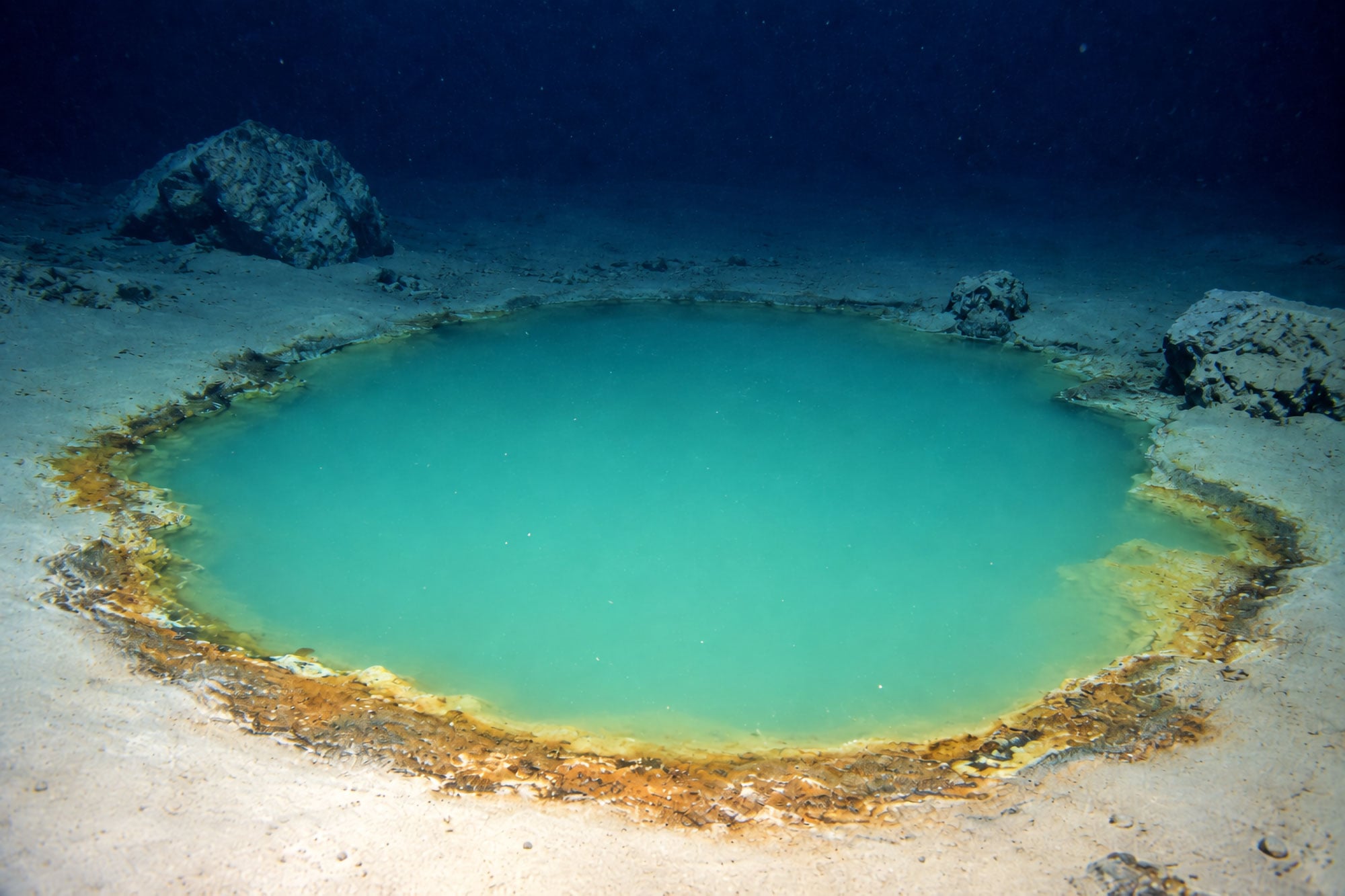
New evidence from deep in the Red Sea suggests that chemical reactions involving manganese and iron may have provided energy for life in Earth’s earliest oceans.
Long before atmospheric oxygen filled the sky or photosynthetic organisms harvested sunlight, Earth hosted a mysterious biosphere whose energy sources remain uncertain.
Clues to how those primitive organisms survived are emerging from dark, hypersaline underwater lakes known as brine pools at the bottom of the Red Sea. In a new study, Chakraborty and colleagues found that microbes thriving in these oxygen-free environments leave chemical signatures that may remain recognizable after a brine pool disappears.
Microbes and metals offer clues to early life
Bacteria and archaea, two distinct groups of microorganisms, were abundant in an active pool 1,770 meters, or about 5,800 feet, below the surface. Their presence reflects how scientists’ understanding of brine pools has changed. Once presumed lifeless because of their extreme saltiness and lack of oxygen, these environments are now known to support extremophiles, organisms adapted to conditions that exclude many other forms of life.
Beneath the pool’s microbial mat, the researchers found sediments rich in manganese, iron, molybdenum, and copper, raising questions about the relationship between the organisms and these metal deposits.
By analyzing sediments and organic matter from the active pool and three seafloor sites outside brine pools, the team established how pronounced that enrichment was. Some areas beneath the mat contained metal concentrations more than 100 times those at the comparison sites. To characterize the communities associated with this chemistry, the researchers used metagenomics, which examines environmental genetic material, and metatranscriptomics, which examines RNA to reveal which genes are being expressed.
The genetic analysis identified manganese-oxidizing microbes such as Nitrospira in the active pool, providing a possible biological connection to the oxidized iron and manganese compounds found in its sediments. Oxidation involves losing electrons, and microbes can obtain energy through certain reactions that oxidize metals. Together, the microbial and chemical evidence suggests that converting Mn(II), a form of manganese, into manganese oxides could have provided an energy source before the Great Oxidation Event, when atmospheric oxygen rose around 2.4–2.2 billion years ago.
The chemical fingerprints microbes leave behind
Evidence that such chemical traces can persist came from a suspected “extinct” brine pool nearly 1,400 meters, or about 4,600 feet, beneath the surface. Mineral rings surrounded a depression filled with dead marine organisms, suggesting that it had once held brine.
Its sediments showed enrichment patterns similar to those in the active pool, including oxidized manganese and organic matter enriched in molybdenum. Finding these signatures in both settings could help researchers interpret comparable deposits in ancient rocks, where the original microbial communities are no longer available to study.
The findings support hypotheses that metal enrichment in early oceans could have occurred without oxygen-producing photosynthesis or photoautotrophy, the use of light to make organic matter. The authors note that more research is needed, but chemical energy obtained by oxidizing manganese and iron remains a possible means by which the earliest ocean life sustained itself.
Reference: “Brine Pool Microbes Enrich Metalliferous Sediments in Salt Giant Basins” by Morgan I. Chakraborty, Hannah Shernisky, Clément G. L. Pollier, Amanda M. Oehlert, Arash Sharifi, Ali Pourmand, Bolton J. Howes, Benjamin Minch, Mohammad Moniruzzaman, Larissa Frühe, Mattie Rodrigue and Sam J. Purkis, 2 September 2026, AGU Advances.
DOI: 10.1029/2026AV002570
Never miss a breakthrough: Join the SciTechDaily newsletter.
Follow us on Google and Google News.