
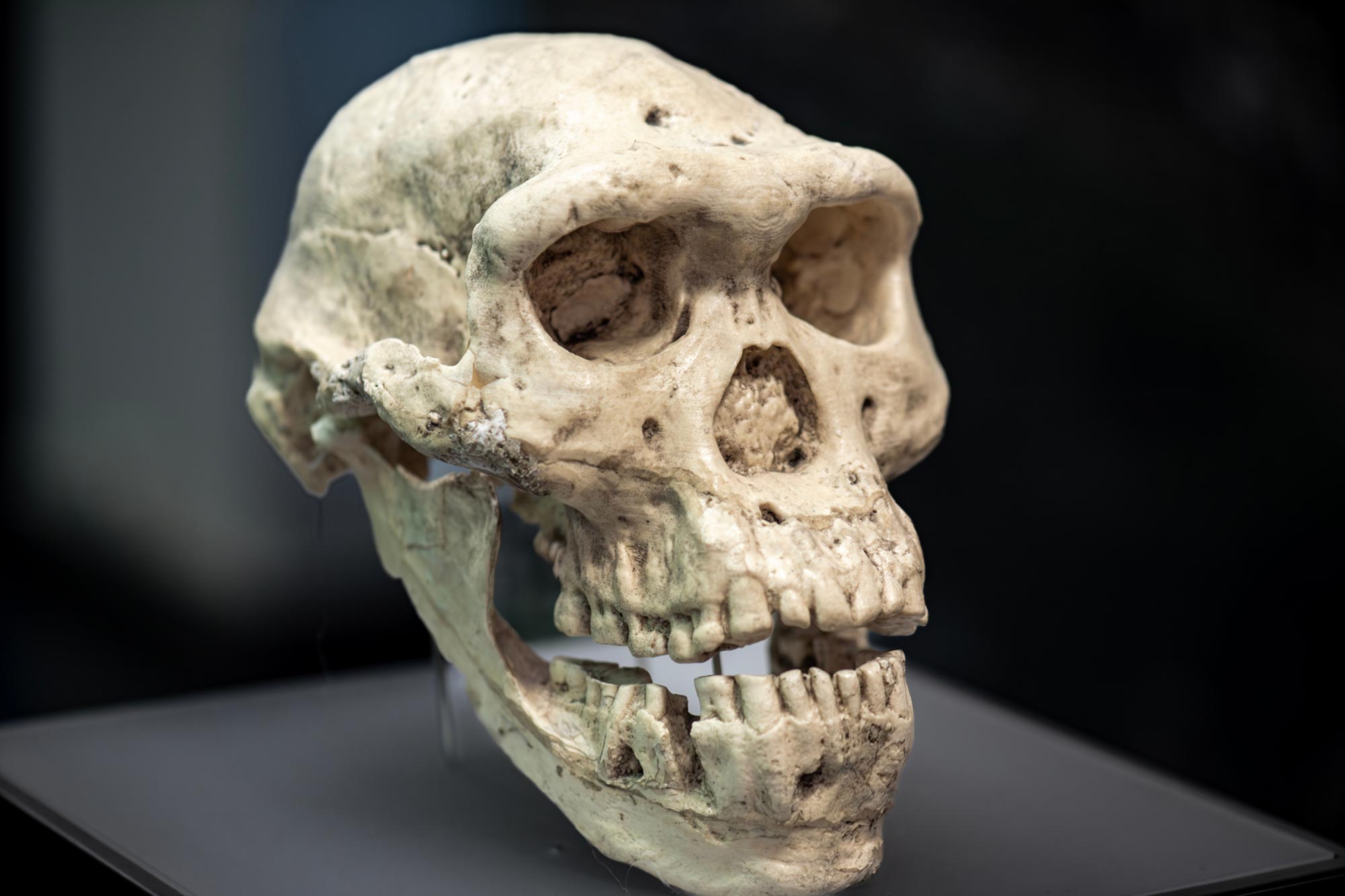
Fossils from Drimolen Cave capture a moment when two contrasting hominin species lived side by side.
Two million years ago, two very different human relatives occupied the same landscape in what is now South Africa. One was Homo erectus, with a larger brain and smaller molar teeth. The other, Paranthropus robustus, had a brain only slightly larger than that of a chimpanzee and massive teeth powered by strong chewing muscles. At Drimolen Cave, P. robustus outnumbered Homo erectus by more than 10 to one.
Until now, however, the earliest evidence of Homo erectus at Drimolen came from DNH 134, a child who was between two and four years old. Because the specimen was so young, researchers could not be certain what adults from this early population looked like.
“Homo erectus is the first species of hominin that researchers broadly agree fits within our own genus Homo and is likely directly ancestral to us. Drimolen preserves evidence for the first appearance of this species 2 million years ago, however, the original fossil, DNH 134, belonged to a child aged between two and four, and there was uncertainty about what the adult version may have looked like,” lead researcher Dr. Jesse Martin said.
An adult Homo erectus at 2 million years
Researchers from La Trobe University, South Africa, and the United States have now identified an adult Homo erectus skull fragment, DNH 127, among 18 newly described hominin fossils from the site. Dated to about 2 million years ago, the specimen strengthens the evidence that Homo erectus was already living in southern Africa at that time. Adult fossils from other parts of the world, including Dmanisi in Georgia, date to about 1.8 million years ago.
“This paper publishes a new adult fossil attributed to Homo erectus, DNH 127, providing further confirmation that this species first appeared in southern Africa 2 million years ago.”
The fossils come from the Drimolen Main Quarry in South Africa’s Cradle of Humankind, one of the world’s richest deposits of human ancestors. The site was discovered in 1992, but many fossils excavated there through 2019 had never been formally published and therefore remained unknown to science. The newly described specimens have been attributed to Homo erectus and P. robustus, with the findings published in Annals of Human Biology.
Two species took different paths
The two species followed markedly different evolutionary paths while sharing the same environment. Homo erectus was evolving a larger brain and smaller molars, changes Martin said may have been associated with meat eating. P. robustus, meanwhile, retained a brain only slightly larger than that of a chimpanzee while developing enormous molars and increasingly powerful chewing muscles for processing tough and hard foods, a combination Martin compared to a mortar and pestle.
“These two human species shared the same landscape and are both preserved in Drimolen cave. While we know that Homo erectus and the lineage leading to us was ultimately the successful one, 2 million years ago P. robustus outnumbered Homo erectus at Drimolen by more than 10 to one. During this time period, it was our ancestors that looked like the outside long-odds chance to survive,” Dr Martin said.
P. robustus teeth grew larger
Comparing the roughly 2-million-year-old P. robustus fossils from Drimolen with specimens from the 1.8-million-year-old Swartkrans Cave allowed the researchers to trace anatomical changes across approximately 200,000 years. Teeth became larger during that interval, along with the muscles used for chewing, providing evidence that the species was undergoing microevolutionary change in response to climatic pressures.
“This paper confirms that the P. robustus fossils from the 2-million-year-old Drimolen Cave are slightly but importantly different from the P. Robustus fossils at the 1.8-million-year-old Swartkrans Cave.
“During this 200,000-year period, P. Robustus teeth became even larger, and so did the muscles associated with chewing. Hominin fossils are so rare that generally the differences between them are huge, and researchers are left to make educated guesses regarding what existed in the missing parts of the fossil record.
“However, the large number of fossils from Drimolen, some of which are published in this paper, allow an unprecedented insight into the micro-evolutionary changes that shaped human ancestors.”
Researchers had previously recognized the distinctive anatomy of the Drimolen population with the subspecies name P. robustus ukusa. Martin said the additional fossils described in the new study support that formal recognition.
Reference: “New hominin cranial and mandibular remains from Drimolen Main Quarry, South Africa” by Jesse M. Martin, A. B. Leece, Stephanie Baker, Andy I. R. Herries and David S. Strait, 25 September 2026, Annals of Human Biology.
DOI: 10.1080/03014460.2026.2725046
This work was supported by Australian Research Council, DP170100056.
Never miss a breakthrough: Join the SciTechDaily newsletter.
Follow us on Google and Google News.