

Direct activation of the cellular energy sensor AMPK extended lifespan in three distantly related model organisms, strengthening the case for testing the approach in mammals.
Every cell has to decide how to spend its limited supply of energy. When fuel runs low during fasting, exercise, or other forms of stress, cells can cut back on costly activities such as building proteins and storing fat, while shifting toward processes that release energy from existing stores. Researchers have now found that directly activating one of the proteins that controls this switch can extend lifespan in several very different organisms, in some cases by more than 25%.
The study, published in Aging Cell, tested a drug that directly activates AMPK, a metabolic enzyme that continuously monitors cellular energy levels. Scientists from the MRC Laboratory of Medical Sciences, Imperial College London, the University of Cologne, and collaborating institutions found anti-aging effects in fission yeast, nematode worms, and fruit flies.
AMPK shifts cells into energy-saving mode
AMPK responds when cellular energy begins to fall. Instead of allowing energy-intensive processes to continue at the same pace, it suppresses activities such as producing new proteins and storing fat, while promoting the breakdown of existing fat and sugar for fuel.
Dr. Helena Cochemé, who leads the Redox Metabolism Group at MRC LMS, compared that response to a familiar feature on a smartphone. “AMPK is effectively the body’s equivalent to the ‘energy saving mode’ on a mobile phone.”
Because AMPK plays such a central role in metabolism, changes in its activity have been linked to metabolic disorders including type 2 diabetes and obesity. Increasing AMPK activity can also produce health benefits, and several existing treatments, including the diabetes drug Metformin and weight-loss drugs such as Semaglutide, are known to activate the pathway.
Those treatments, however, often influence AMPK indirectly. That makes it harder for researchers to determine whether an observed biological effect comes from AMPK itself or from other pathways affected by the drug.
Direct activation isolates AMPK’s effects
The researchers instead used a compound called 991, which targets AMPK directly. Professor David Carling, who leads the Cellular Stress Group at MRC LMS, said: “By switching on AMPK specifically using a direct activator, it is possible to achieve a much cleaner result, avoiding potential side effects.”
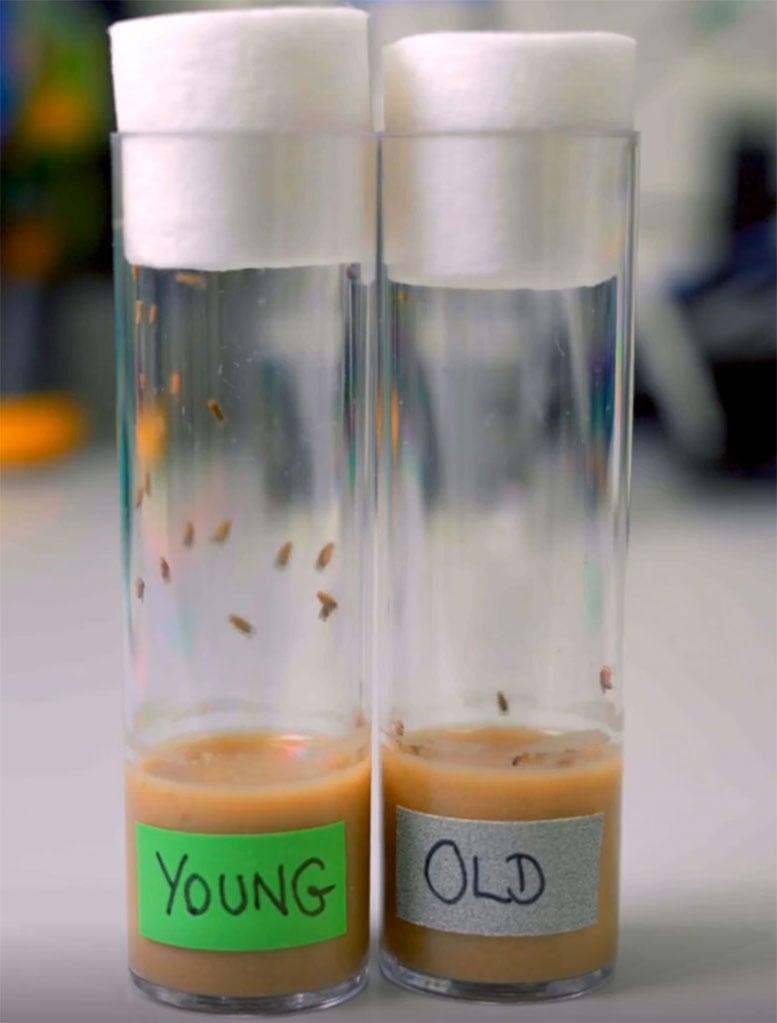
The team tested the approach in fission yeast, S. pombe, nematode worms, C. elegans, and fruit flies, Drosophila. Their short lifespans allow scientists studying aging to track survival and biological changes far more rapidly than they could in mammals.
“The fact that we can extend lifespan in yeast, worms, and flies is very exciting,” Cochemé said.
“Worms and flies in the lab live for around three weeks and three months respectively, compared to roughly three years for mice, so we can make progress and discoveries much more rapidly and efficiently than in mammalian systems.
“Our study is the first demonstration that directly targeting AMPK using a drug can have longevity benefits in living organisms.”
Lifespan gains appear across three species
Finding a similar effect across three distantly related species strengthens the case that the underlying mechanism may not be limited to one particular model organism. It does not, however, establish that the same intervention will extend lifespan in mammals or people.
“If a treatment works successfully in three such distantly related species, then these results give us more confidence that in the longer term, the effects possibly translate to mammals and eventually perhaps humans,” Cochemé said.
Mice are the next test
The researchers now want to determine whether directly activating AMPK can produce comparable effects in mice. “Now that we have very solid, convincing evidence from the laboratory model organisms, the next step will be to show that we can also improve health and extend lifespan in mice,” Carling said.
“Direct AMPK activators have already been used safely in clinical trials for the treatment of specific metabolic diseases.
“This opens the door for using AMPK activators to treat a range of human diseases in the future.”
Professor Filipe Cabreiro, who leads the Host-Microbe Co-Metabolism Group at MRC LMS and also runs a laboratory at the University of Cologne in Germany, emphasized that the research remains far removed from testing anti-aging treatments in people.
“The field is still a long way from anti-aging clinical trials in humans. This is because aging is not technically classified as a disease.
“But improving health in older age would be hugely beneficial from a societal and healthcare perspective, since aging is a major risk factor for so many diseases, such as heart disease, diabetes, cancer, and dementia.
“The ability to make individuals healthier for longer, for instance, by pharmacologically targeting energy balance through AMPK, would be a major biomedical breakthrough.”
Reference: “Direct Pharmacological Activation of AMPK Extends Lifespan in Yeast, Worms and Flies” by Eliano dos Santos, Marie Blickling, Fiona C. Leiper, John-Patrick Alao, Claudia Lennicke, Andrea Foley, Jon R. Wilson, Steven J. Gamblin, Bénédicte Chazaud, Giovanna Lollo, Rémi Mounier, Gaëtan Juban, Charalampos Rallis, David Carling, Filipe Cabreiro and Helena M. Cochemé, 29 September 2026, Aging Cell.
DOI: 10.1111/acel.70721
This study was primarily publicly funded by the Medical Research Council, part of UKRI.
Never miss a breakthrough: Join the SciTechDaily newsletter.
Follow us on Google and Google News.