
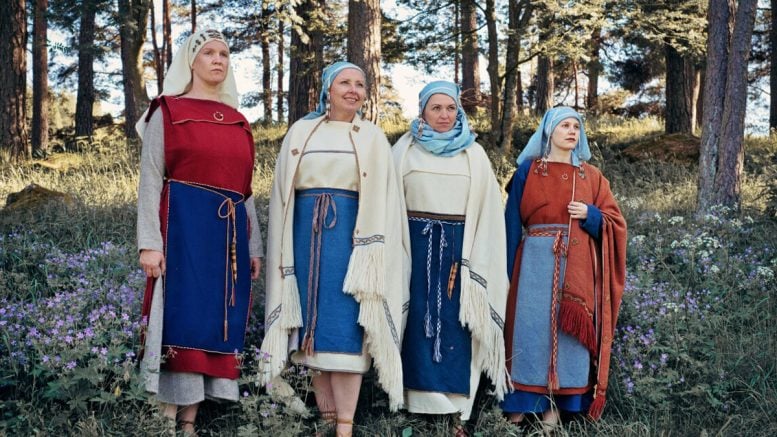
A thousand years ago, Finland’s coastal and inland communities shared similar ancestry. Today, their DNA tells two different stories.
A University of Turku study has traced how migration from Sweden reshaped the ancestry of Finland’s southwestern coast while inland populations retained a genetic connection to their medieval predecessors. The findings also reveal ties linking people in Finland to communities across the Baltic Sea.
Published in Genome Biology, the research analyzed 34 ancient genomes, including 32 from people who lived during the 11th through 13th centuries and two from the Late Iron Age. The team compared these with ancient DNA from other Baltic regions and genomes from present-day Finland.
Shared Ancestry, Different Futures
During the Early Medieval period (1050–1250 CE), coastal and inland communities in southwestern Finland were genetically very similar. Their cultural and economic differences, evident in archaeological remains, did not correspond to a clear division in ancestry.
That similarity faded over the following centuries. In inland areas, including Häme, the researchers found genetic continuity stretching nearly a millennium into the present. Along the coast, however, modern residents have considerably more Scandinavian ancestry than people buried there roughly 1,000 years ago.
“Our findings suggest that migration from Sweden began to have a broader impact on Finland’s population relatively late, during the Middle Ages,” said lead author and postdoctoral researcher Ronan James O’Sullivan. “Of course, people were already moving across the Baltic Sea earlier than 1250 CE, but migration from Sweden to Finland on a larger scale seems to have taken place only after the early medieval period.”
The results suggest that Swedish migration left its strongest demographic imprint along the coast. They cannot establish precisely when that shift occurred, however, because the ancient individuals studied largely predate it. DNA from later burials could help fill that gap.
DNA Maps a Connected Baltic World
The team also searched ancient genomes from around the Baltic Sea for shared stretches of inherited DNA. These segments can reveal distant family connections, offering evidence of human movement that complements archaeological finds and historical records.
People from early medieval Finland had genetic links to individuals from Viking Age Sweden, Gotland, Latvia, and the Lake Ladoga region, among other places. The strongest connections were with Gotland, consistent with the island’s central position in Baltic trade. The sea connected these communities through routes along which goods, people, and family ties could travel.
A connection also surfaced aboard the Swedish warship Kronan, which sank in 1676. Two victims shared DNA segments with early medieval individuals from Finland. Historical records show that people from Finland were recruited to serve on the vessel, and the genetic evidence supports Finnish roots for at least some aboard.
“Finland was never isolated from the wider Baltic world,” O’Sullivan said. “Our results show that people living here were closely connected to the vibrant, international networks that spanned the Baltic Sea.”
Reference: “Population genomics, demography, and circum-Baltic connectivity of Early Medieval southwestern Finland” by Ronan James O’Sullivan, Ulla Nordfors, Nelli-Johanna Saari, Kerttu Majander, Jussi-Pekka Taavitsainen, Kati Salo, Adam B. Rohrlach, Elina Salmela, Thiseas C. Lamnidis, Luca Traverso, Johannes Krause, Sanni Peltola and Päivi Onkamo, 15 September 2026, Genome Biology.
DOI: 10.1186/s13059-026-04277-7
Never miss a breakthrough: Join the SciTechDaily newsletter.
Follow us on Google and Google News.