

An unusual magnetic state detected in a layered material could offer a new route to ultrafast memory and energy-efficient electronics.
Inside a crowded electronic circuit, stray magnetic fields can interfere with nearby components. Researchers developing faster, more efficient computers want to use electron spin, a quantum property, to carry information alongside electrical charge. That requires materials that can handle spin without creating unwanted magnetic interference.
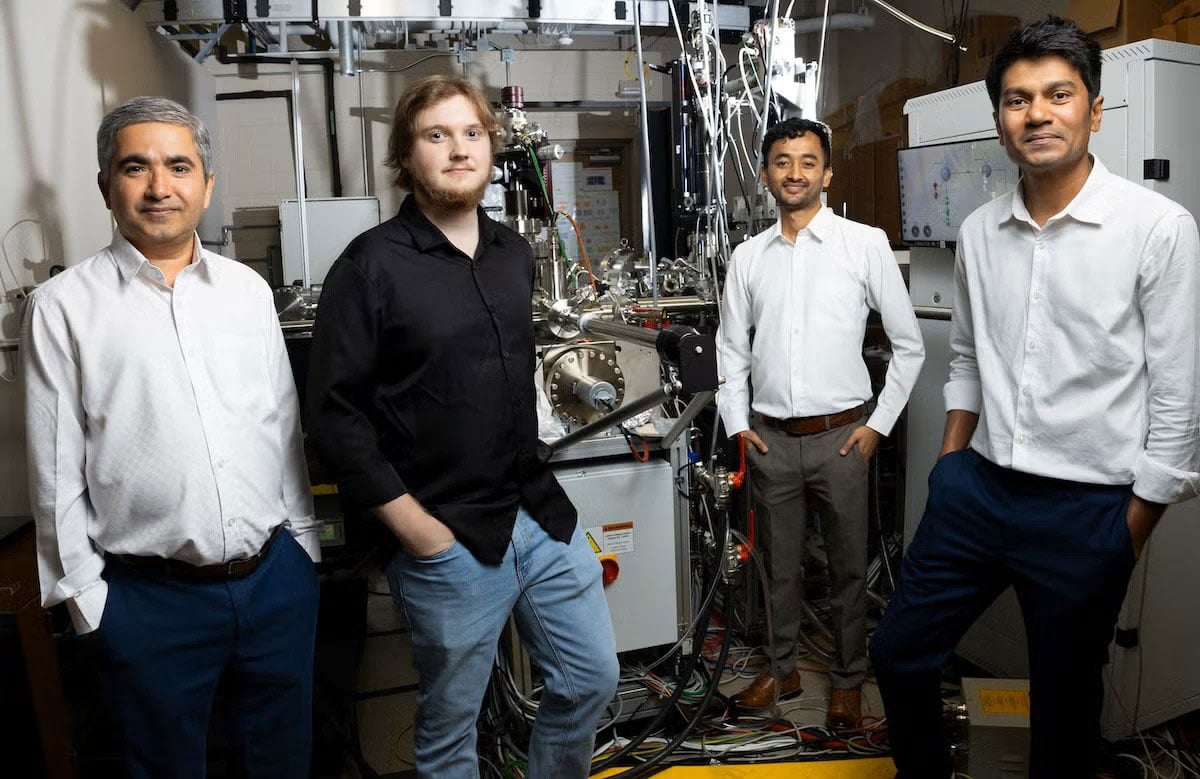
University of Central Florida physicist Madhab Neupane and his collaborators have found a promising candidate in Co₁/₄TaSe₂, a layered material containing magnetic cobalt atoms. Their experiments detected signatures of altermagnetism, a form of magnetism that combines useful properties of ferromagnetism and antiferromagnetism.
In ferromagnets, including everyday magnets, magnetic moments align in the same direction and produce a magnetic field. In antiferromagnets, opposing magnetic moments cancel one another out, largely avoiding stray fields. Conventional antiferromagnets, however, lack some of the useful electronic properties of ferromagnets, leaving researchers looking for materials that offer both advantages.
Split electron states point to altermagnetism
Neupane’s team examined Co₁/₄TaSe₂ to determine whether its electrons showed the distinctive behavior associated with altermagnetism. The material belongs to a family called transition-metal dichalcogenides, or TMDs, which consist of thin, weakly bound layers. Magnetic cobalt atoms sit between the layers and help produce its unusual magnetic properties.
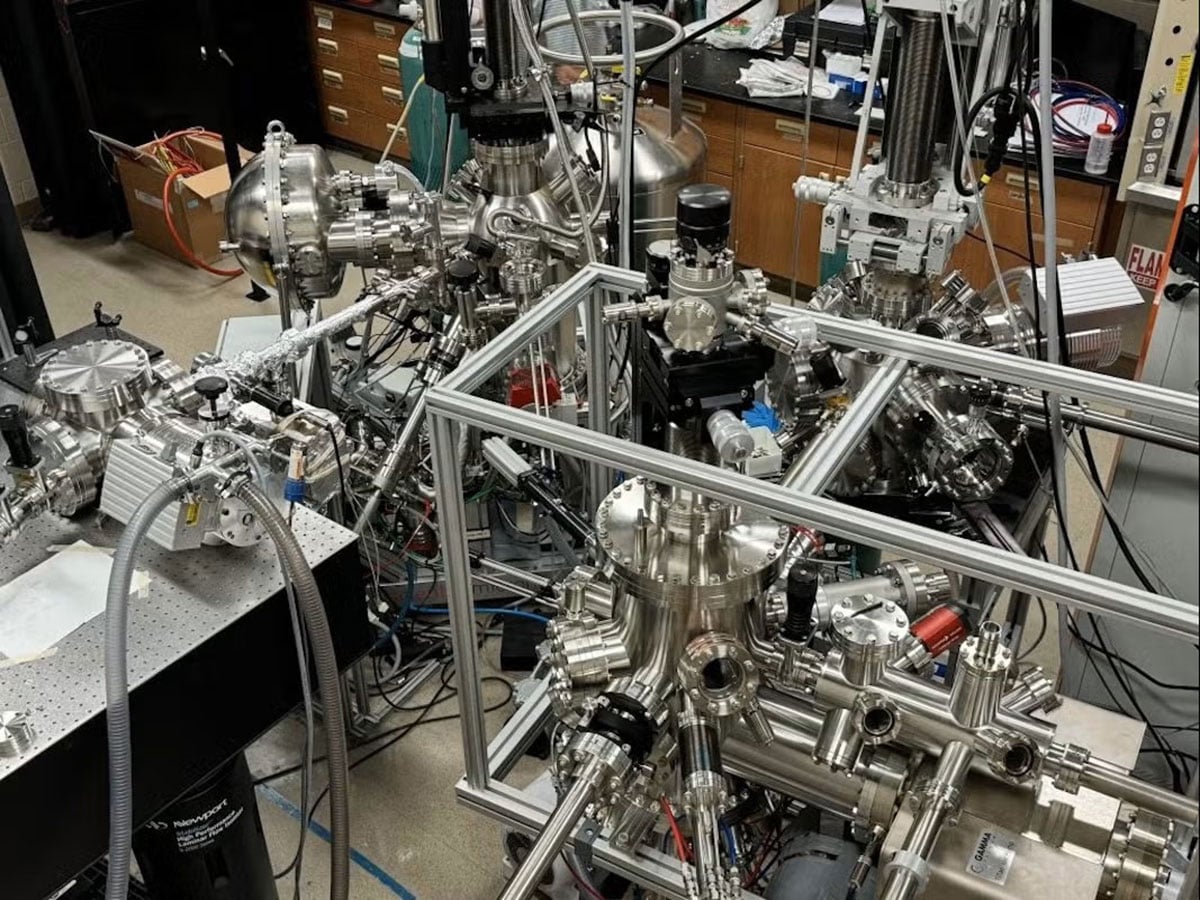
The team screened high-quality samples made by their collaborators for exceptionally clean surfaces. They needed those surfaces for angle-resolved photoemission spectroscopy, or ARPES, a technique that measures electrons’ energies and motion to map a material’s electronic structure. Since the measurements are highly sensitive to the surface, sample cleanliness was essential for observing the electronic behavior accurately.
“Our approach was to use higher-resolution methods that were insensitive to the electron’s spin to measure the splitting in the energy levels,” Neupane says. “Then, we complemented this measurement with spin-resolved ARPES to conclusively tell if this looks like altermagnetism.”
The measurements revealed a characteristic splitting in the material’s electronic bands, the ranges of energy electrons can occupy. Using the spin-sensitive technique, the researchers then found that the split states had opposite spin polarizations, a key signature of altermagnetism.
“The significance became clear once the experimental measurements consistently matched our theoretical predictions,” Neupane says. “Seeing those independent pieces of evidence converge gave us confidence that we had identified a genuine layered altermagnet.”
The team also traced the relevant electronic state primarily to the material’s interior. Researchers had previously been uncertain whether the important signatures in layered materials would come mainly from the surface or from deeper inside. The measurements showed clear signs of altermagnetic order in an electronic state originating within Co₁/₄TaSe₂.
Why altermagnetism forms remains unresolved
Researchers can modify the material and measure how its magnetic and electronic properties change. That flexibility makes it useful for investigating interactions that are difficult to resolve through theory alone. “Evidence for altermagnetism in a versatile materials platform opens a lot of new possibilities,” says Milo Sprague, the study’s lead graduate student researcher. “There’s currently a lot of debate in altermagnetic theory about how the spin-polarized electronic states interact with other magnetic phenomena. Now we have a material that we can easily modify to explore these new questions.”
Competing interactions between electrons may help determine which magnetic state forms, according to theoretical studies. Researchers still need to understand why altermagnetism develops and when it becomes favored over ferromagnetism or other antiferromagnetic arrangements.
“There are many details to the theory of how altermagnets work that haven’t been explored or verified yet,” Neupane says. “Now that we have identified several platforms for answering these questions, more advanced studies into these materials are underway.”
Toward ultrafast memory without magnetic interference
Electrons could also carry information through these materials in spin currents, flows of electron spin that researchers are exploring in the field of spintronics. “These materials are distinguished from more conventional antiferromagnets by their ability to generate and detect spin currents without the negative effect of producing stray fields,” Neupane says. “This new property makes them very well positioned for use in many different applications — including spintronics, ultrafast memory devices, terahertz networks and energy-efficient electronics.”
Scientists can separate and combine the weakly bound layers into extremely thin structures, making layered materials attractive for small transistors, optical technologies, and other devices. Adding the ability to control electron spin could expand what those thin components can do. “As electronic devices continue to shrink, researchers need new materials that can operate faster while consuming less energy,” Neupane says.
“If this approach proves viable, then layered altermagnets will be at the forefront of electronics development,” Neupane says. Inside a crowded circuit, those thin layers could eventually help carry information through electron spin without exposing neighboring components to disruptive magnetic fields.
Reference: “Observation of Altermagnetic Spin-Splitting in an Intercalated Transition Metal Dichalcogenide” by Milo Sprague, Mazharul Islam Mondal, Anup Pradhan Sakhya, Resham Babu Regmi, Surasree Sadhukhan, Arun K. Kumay, Himanshu Sheokand, Igor I. Mazin, Nirmal J. Ghimire and Madhab Neupane, 20 August 2026, Nature Communications.
DOI: 10.1038/s41467-026-76784-x
This material is based upon work supported by the U.S. Department of Energy, Office of Science under Award Number DE-SC0024304.
Never miss a breakthrough: Join the SciTechDaily newsletter.
Follow us on Google and Google News.