
A crystal that uses light to produce hydrogen from water could open a new route to cleaner, more affordable fuel.
Hydrogen can power a fuel cell car, yet making that fuel from natural gas releases carbon dioxide before it ever reaches the tank. Water offers another source of hydrogen, but separating its hydrogen atoms from oxygen takes energy, and supplying that energy cleanly can make the fuel considerably more expensive.
Oregon State University chemist Kyriakos Stylianou and his collaborators have developed a family of materials that use light to produce hydrogen from water rapidly and efficiently. Their work, published in the Journal of the American Chemical Society, centers on a porous crystalline material called BVR-19, whose response to light offers clues for designing better systems to turn sunshine into fuel.
Green hydrogen’s steep price gap
Running electricity through a catalyst already allows hydrogen to be extracted from water through a process called electrocatalysis. The catalyst speeds up the chemical reaction without undergoing a permanent chemical change itself, but the sustainability of this approach depends on using renewable electricity. Competing with hydrogen made from natural gas also requires that electricity to be inexpensive.
Stylianou cited a substantial price gap: about $1.50 per kilogram for hydrogen produced through methane-steam reforming, the conventional natural gas process, compared with about $5 per kilogram for green hydrogen. Bringing those costs closer together could matter well beyond the gas pump, since hydrogen also goes into ammonia production, metal refining, and plastics manufacturing.
Metal choice shapes hydrogen production
Inside BVR-19, organic molecules connect positively charged metal ions into a structure with nanoscale pores. These crystalline structures, known as metal-organic frameworks, or MOFs, give chemists many ways to adjust a material’s properties by choosing different metals and organic building blocks. Almost 100,000 MOFs have already been synthesized, and the properties of another half-million have been predicted, out of millions of possible designs.
“By changing the metal while keeping the rest of the material essentially the same, we discovered why some versions of the MOF work much better than others,” Stylianou said. “These findings provide new design rules for creating more effective materials for solar fuel production.”
Sulfur puts sunlight to work
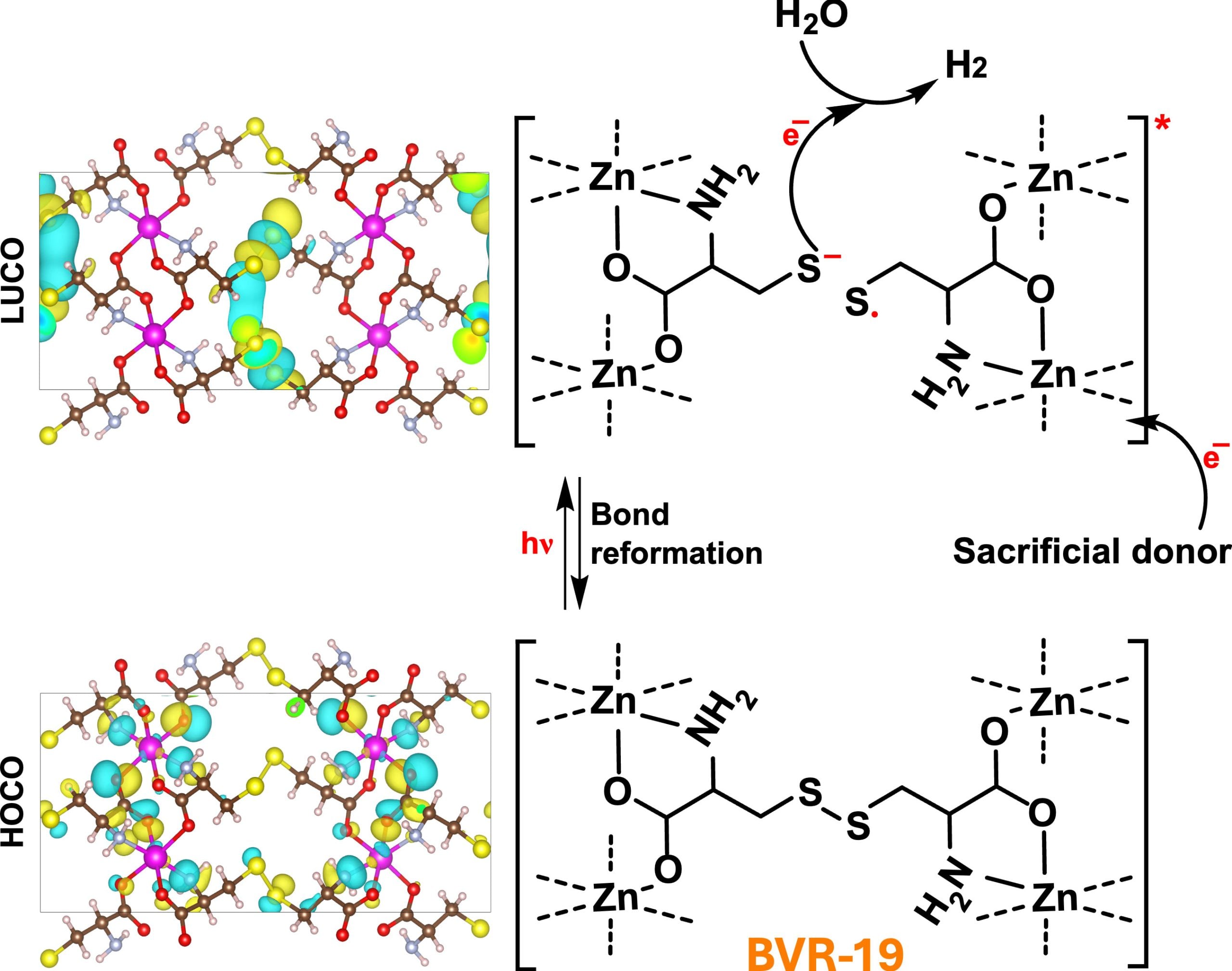
Light striking BVR-19 temporarily breaks a bond between two sulfur atoms, creating reactive sulfur species. That response is part of what makes the material a photocatalyst: it absorbs light, reaches a higher energy state, and uses that energy to help drive a chemical reaction.
“The organic component does the important work,” Stylianou said. “Instead of relying primarily on the metal atoms, our material uses its sulfur-containing organic building blocks to capture light energy and move electrons where they are needed to produce hydrogen. This represents a different way of thinking about how these materials should be designed.”
BVR-19 carries out that work without requiring an additional expensive metal catalyst, which Stylianou said could simplify future systems for producing hydrogen with light. Its preparation could offer another advantage: the material forms spontaneously in a water-based solution at room temperature, giving it what he described as a strong energy advantage during synthesis.
Filling a fuel cell car’s tank with hydrogen made this way would depend on turning those material advantages into an affordable production system. Stylianou, who directs OSU’s Materials Discovery Laboratory, known as the MaD Lab, sees the findings as guidance toward that goal. “Our work provides a blueprint for designing better materials that can bring down the cost of green hydrogen,” he said.
Reference: “Intraligand Charge Transfer in Metal-Organic Frameworks Facilitates Radical Anion-Mediated Hydrogen Evolution” by Emmanuel Nyela Musa, Galen Fritz, Dylan Pyle, Logan S. Lancaster, Taylor D. Krueger, Min Soo Jung, Jacob M. Lessard, Andrzej Gladysiak, Ankit K. Yadav, Silas Musa Blessed, Prayash Mohanty, Jacob S. Hirsch, Hongliang Huang, William F. Stickle, Xiulei Ji, Chong Fang, Tim J. Zuehlsdorff and Kyriakos C. Stylianou, September 14, 2026, Journal of the American Chemical Society.
DOI: 10.1021/jacs.6c13238
The Murdock Charitable Trust, the National Science Foundation and the OSU College of Science supported the study.
Never miss a breakthrough: Join the SciTechDaily newsletter.
Follow us on Google and Google News.