
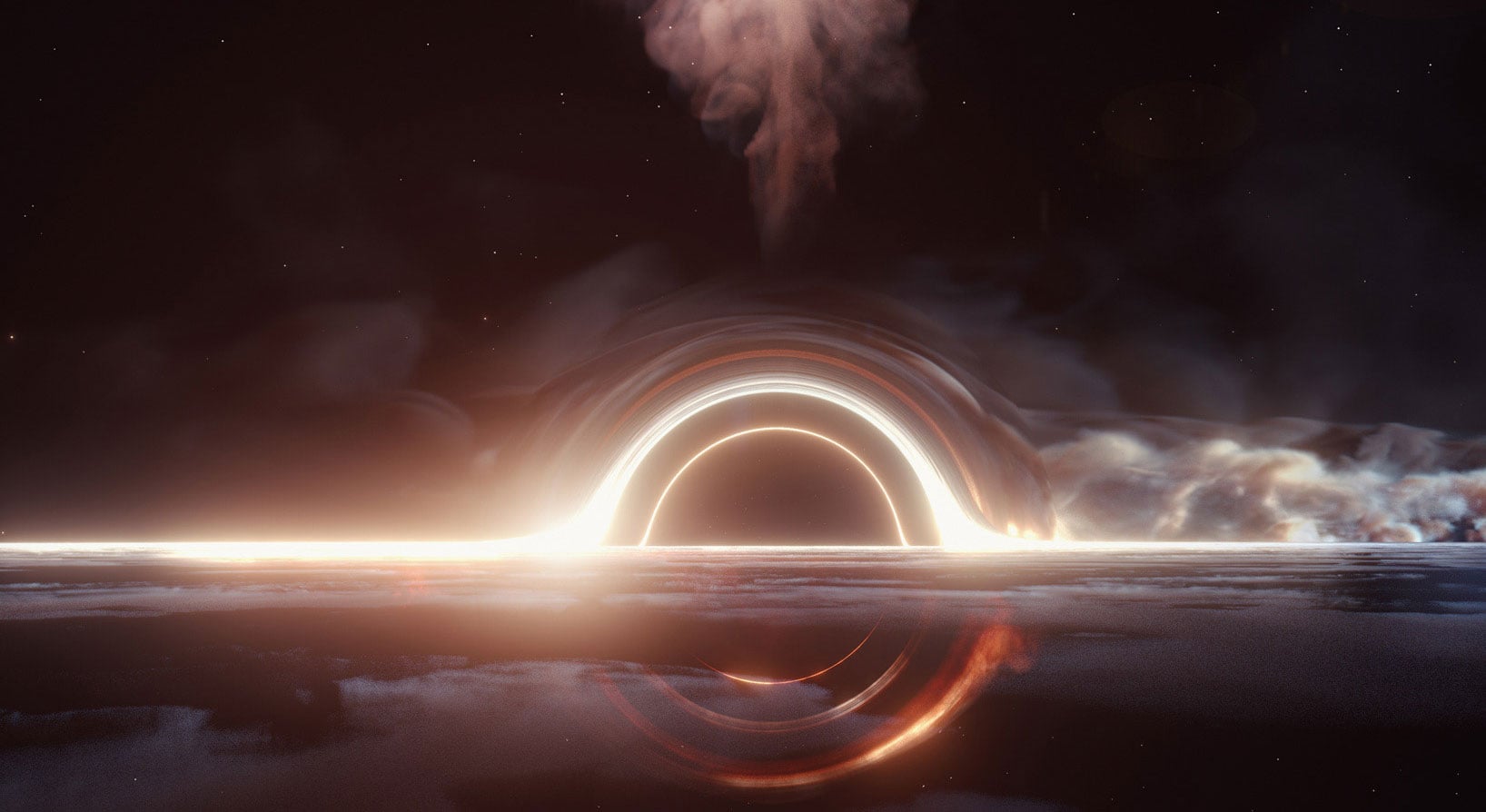
Rare stellar deaths have given astronomers a new clue to when supermassive black holes suddenly produce jets.
Black holes separated by millions of times in mass may follow the same rule when they launch powerful jets into space.
Astronomers studying stellar destruction events have found that supermassive black holes can switch on jets when their feeding rate falls to about 2 percent of the Eddington limit, the same threshold already associated with jet formation in much smaller black holes in the Milky Way. The result suggests that some of the physics governing black hole feeding may remain consistent across an extraordinary range of sizes.
The research, led by Dr. Adelle Goodwin of Curtin University’s International Centre of Radio Astronomy Research (ICRAR) and the Forrest Research Foundation, has been published in Nature Astronomy. Coauthor Dr. Andrew Mummery is based at the Institute for Advanced Study in Princeton.
One Rule Across Vastly Different Black Holes
The researchers compared black holes roughly 10 times the mass of the Sun with supermassive black holes weighing millions of solar masses. Despite that enormous difference, both appear capable of producing jets at the same stage of their feeding cycle.
“These black holes are separated by enormous differences in mass, but they appear to switch on their jets at the same point in the feeding process,” Dr. Goodwin said.
“That tells us something fundamental about black holes: the physics does not seem to care how big they are.”
For decades, astronomers have suspected that black holes may obey similar physical rules regardless of mass. Testing that idea with supermassive black holes is difficult because major changes in their feeding behavior can unfold over thousands of years, far longer than astronomers can observe directly.
Watching a Black Hole Destroy a Star
Goodwin and her colleagues turned to tidal disruption events, rare episodes in which a star passes close enough to a supermassive black hole to be pulled apart by its gravity.
The debris does not disappear into the black hole all at once. Some material falls inward, while other material can be expelled through outflows and narrow jets that travel vast distances through space.
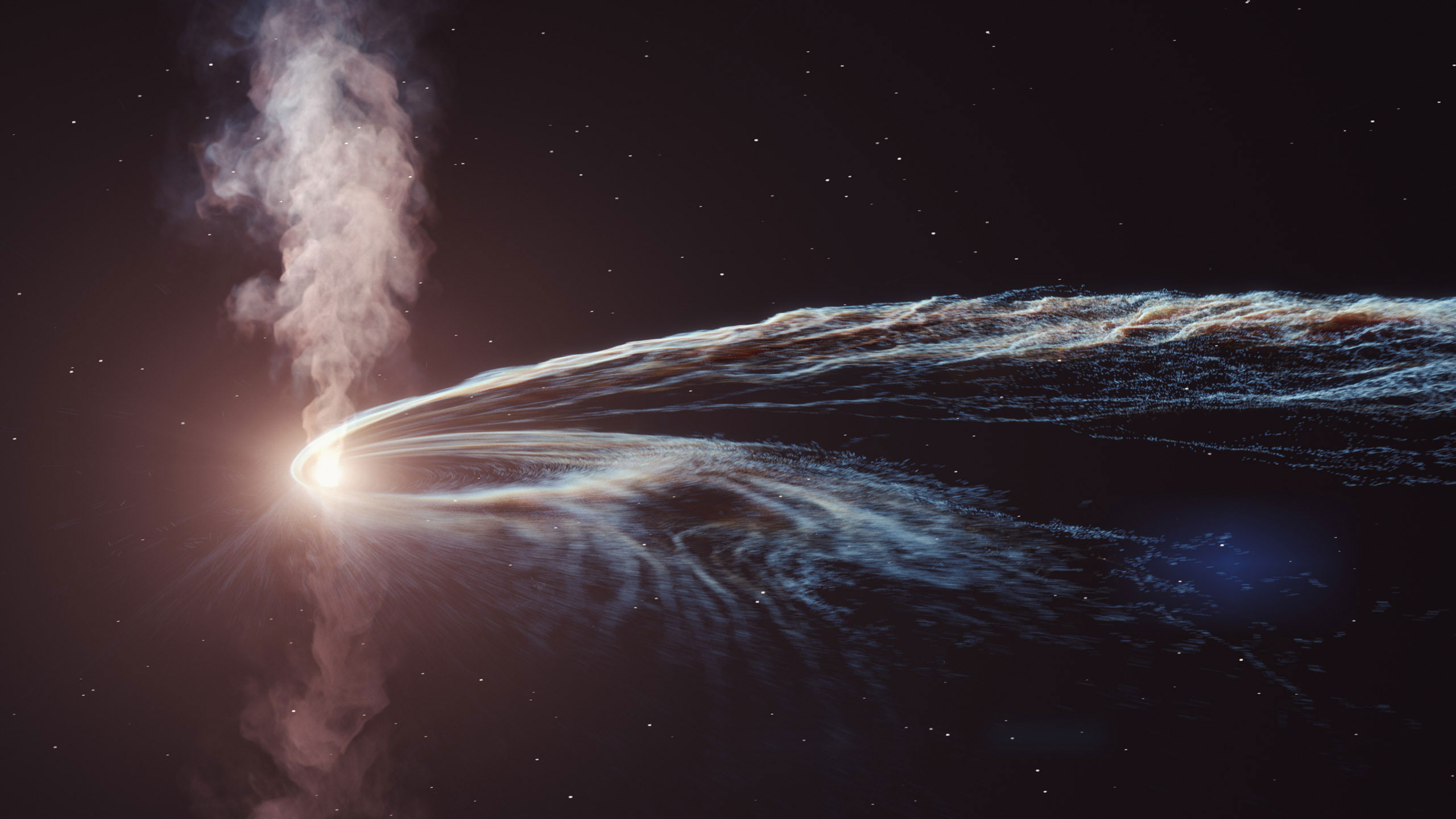
“When a black hole tears apart a star, it does not swallow everything neatly,” Dr. Goodwin said.
“Some of the material is consumed, and some is launched back into space in powerful jets and outflows.
“You can think of it as a black hole burp, except these burps can blast material across enormous distances and influence the galaxies around them.”
Tidal disruption events allow astronomers to watch a supermassive black hole’s feeding rate change over just a few years rather than waiting for processes that would normally take millennia.
Why Some Jets Appear Years Later
One puzzle has been the widely different timing of radio emission after tidal disruption events. Some black holes produce detectable jets soon after destroying a star, while others remain radio quiet for months or even years before suddenly becoming active.
“We were looking at these events and asking why the timing was so different,” said Dr. Goodwin.
The researchers analyzed 20 tidal disruption events using optical, ultraviolet, X-ray, and radio observations collected by telescopes in Australia, the United States, India, South Africa, and space. They then narrowed the sample to 10 events for which they could reliably model both the black hole’s feeding rate and the timing of its radio outflow.
Two distinct periods of jet production emerged from the data.
A Critical Threshold at 2 Percent
The first jet phase occurs early, when a newly fed black hole is consuming material at extremely high rates. A second phase can occur hundreds to thousands of days after the star is disrupted, once the feeding rate has fallen substantially.
The delayed jets appeared when the black hole reached about 2 percent of its Eddington limit. The Eddington limit describes the point at which the outward pressure produced by radiation balances the inward pull of gravity. Astronomers often use it as a reference for comparing how rapidly black holes are consuming matter.
“The delayed jets were appearing when the black hole’s feeding rate dropped to the same critical point already known from much smaller black holes.
“That was the moment we realized this was not just a quirk of one type of black hole, but it looked like a rule that applied across the Universe.”
The same approximate 2 percent threshold is already associated with jet formation in stellar-mass black holes in the Milky Way. Finding it in supermassive black holes suggests that the transition is tied to the physics of accretion itself rather than to a black hole’s absolute mass.
A Pattern Recognized in Madrid
The connection became clear while Goodwin and Mummery were attending a conference in Madrid. Away from the telescope data, the two researchers realized that the behavior they were seeing in tidal disruption events resembled a transition already documented in much smaller black holes.
That comparison provided a possible explanation for why radio jets can appear at such different times after a star is destroyed. Some may be produced during the initial period of extreme feeding, while others emerge only after the accretion rate declines to the lower critical threshold.
The result does not mean every tidal disruption event must produce a jet at exactly the same time. Instead, the study identifies feeding rate as a potentially useful physical marker for when jet production becomes more likely.
Predicting When to Look
That marker could help astronomers decide when to return to a tidal disruption event with radio telescopes.
“Radio telescopes are incredibly powerful, but knowing when to look is just as important as knowing where to look,” said Dr. Goodwin. “If we can anticipate when a black hole is more likely to launch a jet, we can run better targeted campaigns, waste fewer observations and improve our chances of catching these rare events at the moment they matter most.”
Telescope time on major observatories is limited and highly competitive. Better predictions could reduce unnecessary follow-up observations while increasing the chance of detecting delayed jets when they switch on.
The work is particularly relevant to the Square Kilometre Array Observatory (SKA), whose low-frequency component is being built in Western Australia. The Australian Government has invested $387 million in the project, while the total cost of the SKA exceeds $2 billion.
Preparing for a Flood of New Events
Future sky surveys are expected to discover many more tidal disruption events. Astronomers will not be able to follow every event continuously across every wavelength, making physical indicators of jet activity increasingly useful for deciding where telescope time should be concentrated.
The study offers one such indicator: a black hole’s changing feeding rate may help predict whether a delayed radio jet is approaching.
Forrest Research Foundation Director Professor James Arvanitakis said the result also reflected the value of supporting research without requiring a predetermined outcome.
“The Forrest Research Foundation did not fund a predetermined answer, we backed an exceptional researcher with a difficult question,” Professor Arvanitakis said.
“That question has led to a discovery of international significance.
“This is exactly why fundamental research matters: it expands what we know, sharpens how we use major scientific infrastructure and builds capability that reaches well beyond astronomy.
“The fact this discovery was driven from Western Australia speaks to the strength of our research ecosystem, and the value of giving outstanding people a reason to build their careers here.”
Reference: “A universal critical accretion rate for black hole jet formation” by Adelle J. Goodwin, and Andrew Mummery, 17 September 2026, Nature Astronomy.
DOI: 10.1038/s41550-026-02951-1
Funding: Forrest Research Foundation
Never miss a breakthrough: Join the SciTechDaily newsletter.
Follow us on Google and Google News.