
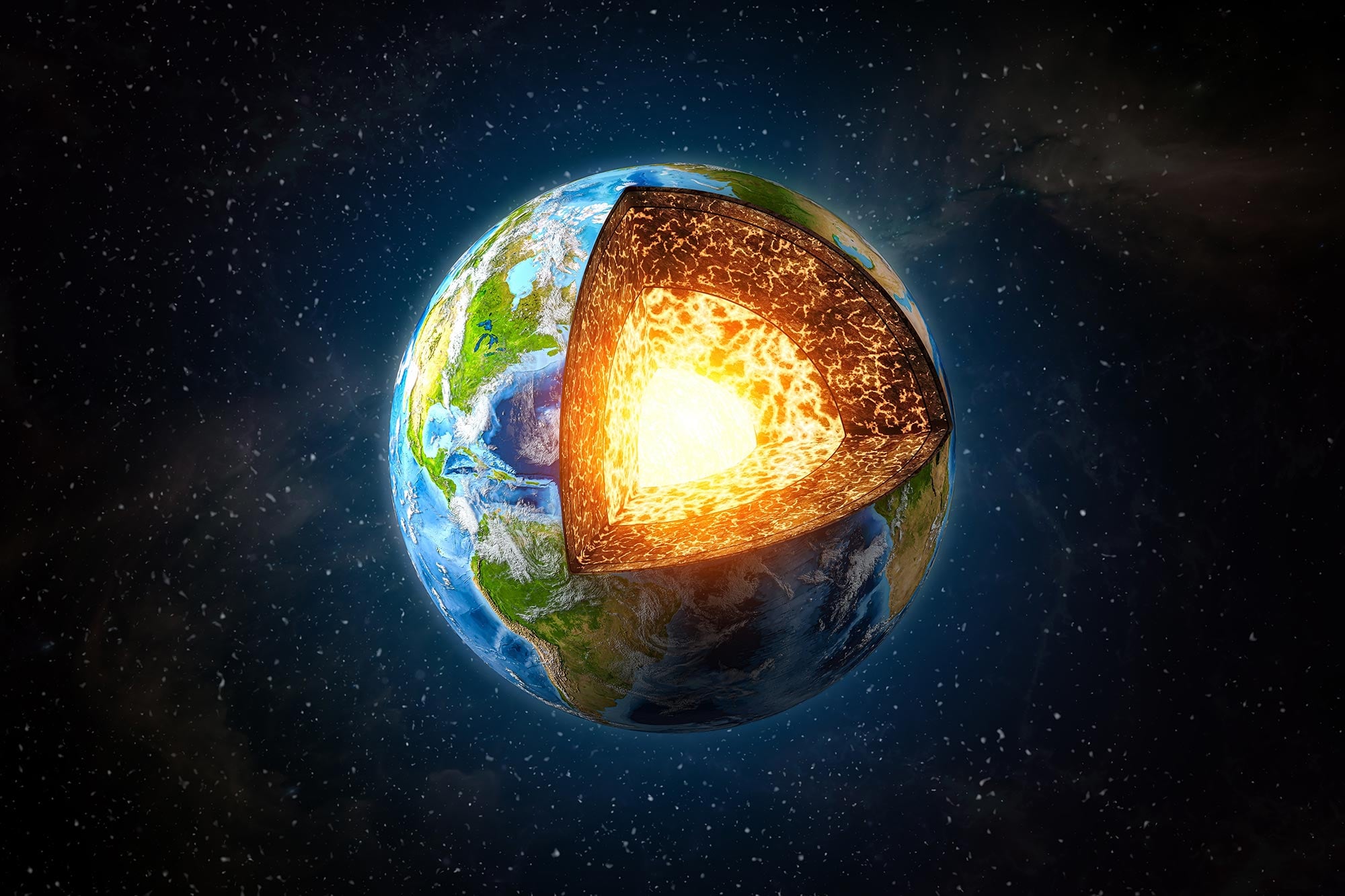
Ancient eruptions may have helped shape the air we breathe, with laboratory experiments revealing magma’s unexpected ability to store extra oxygen.
Molten rock deep inside Earth can take up an extra supply of oxygen under pressure, according to a new study. That finding raises the possibility that rising magma could release oxygen on its way to the surface, a process that may have contributed to increases in atmospheric oxygen billions of years ago.
Oxygen makes up more than half the atoms in Earth’s silicate interior, but its abundance does not necessarily mean it is available to escape into the atmosphere. Much of it is chemically bound to other elements. Geoscientists have generally assumed that the quantities and electrical charge states of elements such as silicon, magnesium, and iron determine how much oxygen magma contains. Knowing those ingredients should let them calculate the oxygen needed to balance the chemistry. Whether molten rock could absorb additional oxygen as a separate volatile component, as it does water and carbon dioxide, has remained largely unexplored.
The study, published in National Science Review, was led by Dr. Yanhao Lin and Dr. Ho-kwang Mao of the Center for High Pressure Science and Technology Advanced Research (HPSTAR). They worked with Prof. Haiyang Niu of Northwestern Polytechnical University and Prof. Wim van Westrenen of Vrije Universiteit Amsterdam.
Pressure boosts magma’s oxygen uptake
To test whether magma could take up oxygen beyond that calculated amount, the researchers needed to give it an additional oxygen supply. They added platinum oxide (PtO₂) to create an oxygen-rich environment for synthetic mid-ocean ridge basalt, a laboratory-made version of volcanic rock from the ocean floor. Using piston-cylinder and cubic presses, they melted the basalt at temperatures of 1,200 to 1,800 °C (about 2,190 to 3,270 °F) and pressures ranging from 1 atmosphere to 7 gigapascals. At the upper end, that pressure is roughly 1 million pounds per square inch.
The team also ran experiments at the same pressures and temperatures without platinum oxide. Comparing the two sets would help reveal whether making extra oxygen available changed how much the molten rock retained.
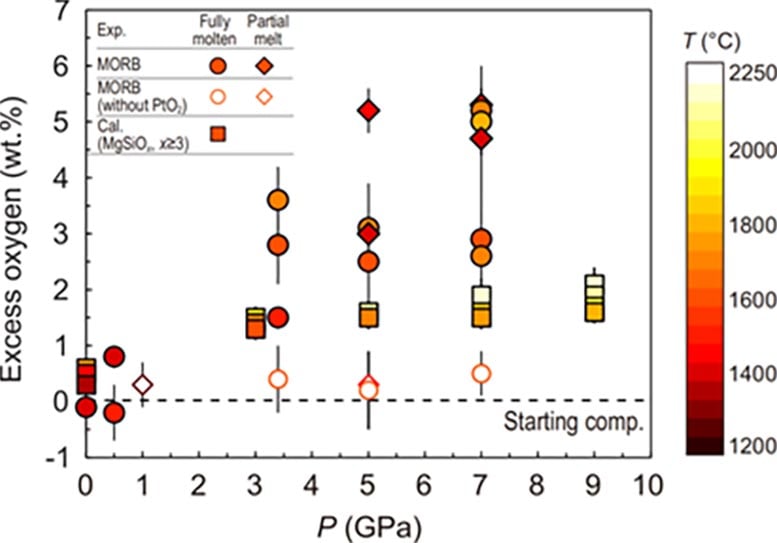
After rapidly cooling, or quenching, the melts into glass, the researchers measured the oxygen remaining in each sample. Not all of it counted as extra. Some was needed to balance the other elements, and some was contained in water and carbon dioxide. By measuring the glass’s elemental composition and its water and carbon dioxide contents, the team could subtract those accounted-for amounts from the total oxygen. They called the remainder “excess oxygen.”
With platinum oxide added, excess oxygen was close to zero at 1 atmosphere but exceeded 5% of the sample’s weight at 7 gigapascals. The control experiments without platinum oxide yielded only 0.2% to 0.5% excess oxygen by weight. High pressure therefore appeared to help the melt take advantage of the additional oxygen supply. Some oxygen may have escaped during quenching, so the measured amounts likely underestimate how much the molten samples originally held.
Oxygen becomes part of the glass
There was another distinction to resolve: had the oxygen become part of the material, or was it simply trapped inside gas bubbles? Raman spectroscopy, which uses scattered light to probe a material’s structure, detected no signature of oxygen gas in the glass. That indicated the excess oxygen had been incorporated into the glass structure.
Simulations led by Niu examined how the melt could accommodate this extra oxygen at the atomic level. The team used deep neural network (DNN) interatomic potentials, computational models that describe how atoms interact, with the accuracy of ab initio calculations based on fundamental physical principles. In the simulations, oxygen entered the melt until equilibrium was reached, meaning there was no further net uptake.
As more oxygen dissolved, the electrical charges on oxygen atoms spread across a wider range, and a small fraction of those atoms formed peroxide-like bonds with one another. These changes offered clues to how the melt’s chemistry could accommodate oxygen beyond the amount predicted by the conventional accounting. The simulations used a simplified magnesium-silicon-oxygen system and produced lower oxygen contents than the basalt experiments, but they reproduced the same increase with pressure.
That pressure dependence resembles the behavior of water and carbon dioxide, which dissolve more readily in magma at higher pressures. The authors therefore suggest that oxygen should also be treated as a separate component of silicate melts. Doing so could change how researchers assess the evolution of magma oceans, the release of volatile substances, and the development of planetary atmospheres, with implications for long-term habitability on other terrestrial planets.
Magma may have supplied atmospheric oxygen
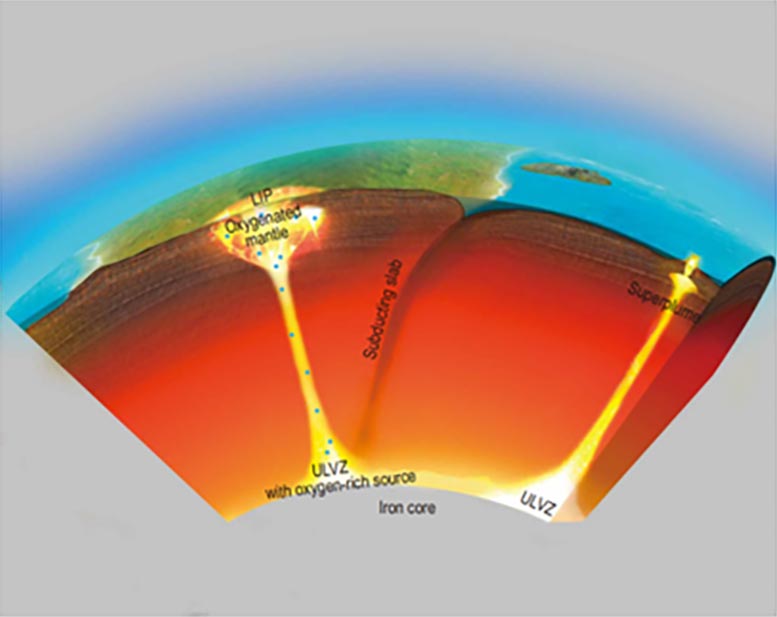
Within Earth, magma formed in oxidized regions of the mantle could collect substantial excess oxygen while under pressure. As it rises, the falling pressure could reduce how much oxygen it can retain, causing a gradual release. The oxygen could then drive oxidation reactions in the shallow mantle, crust, and atmosphere, allowing magma to transport oxidizing power from deep underground toward the surface.
The researchers propose that this process may help explain a timing overlap in Earth’s history. Major increases in atmospheric oxygen roughly 2.5 to 2.0 billion years ago coincided with the formation of some of the largest large igneous provinces (LIPs), vast accumulations of rock produced by volcanic activity. Their rough estimate suggests that if magma erupted during that period released just 0.27% of its weight as excess oxygen, it could have supplied as much oxygen as today’s atmosphere contains.
Reference: “Magma as a carrier of non-stoichiometric oxygen linking Earth’s interior and atmosphere” by Yongjiang Xu, Haiyang Niu, Wim van Westrenen, Ruiheng Liu, Peiyan Wu, Ho-Kwang Mao and Yanhao Lin, 25 August 2026, National Science Review.
DOI: 10.1093/nsr/nwag539
This work was supported by the National Natural Science Foundation of China (42250105), the National Key Research and Development Program of China (2024YFF0807500) and the Young Thousand Talents Program to Y.L., and the National Natural Science Foundation of China (92370118) and the National Natural Science Fund for Excellent Young Scientist Fund Program (Overseas) of China to H.N. Center for High Pressure Science and Technology Advanced Research is supported by the National Natural Science Foundation of China (U1530402 and U1930401).
Never miss a breakthrough: Join the SciTechDaily newsletter.
Follow us on Google and Google News.