
Close Menu
    Facebook X (Twitter) Instagram
    SciTechDaily
    • Biology
    • Chemistry
    • Earth
    • Health
    • Physics
    • Science
    • Space
    • Technology
    Facebook X (Twitter) Pinterest YouTube RSS
    SciTechDaily
    Home»Earth»Seismic Mystery Solved: Scientists Find a New State of Matter at Earth’s Center
    Earth

    Seismic Mystery Solved: Scientists Find a New State of Matter at Earth’s Center

    By Science China PressDecember 1, 20252 Comments5 Mins Read
    Facebook Twitter Pinterest Telegram LinkedIn WhatsApp Email Reddit
    Share
    Facebook Twitter LinkedIn Pinterest Telegram Email Reddit
    Inside Earth Layers Glowing Core
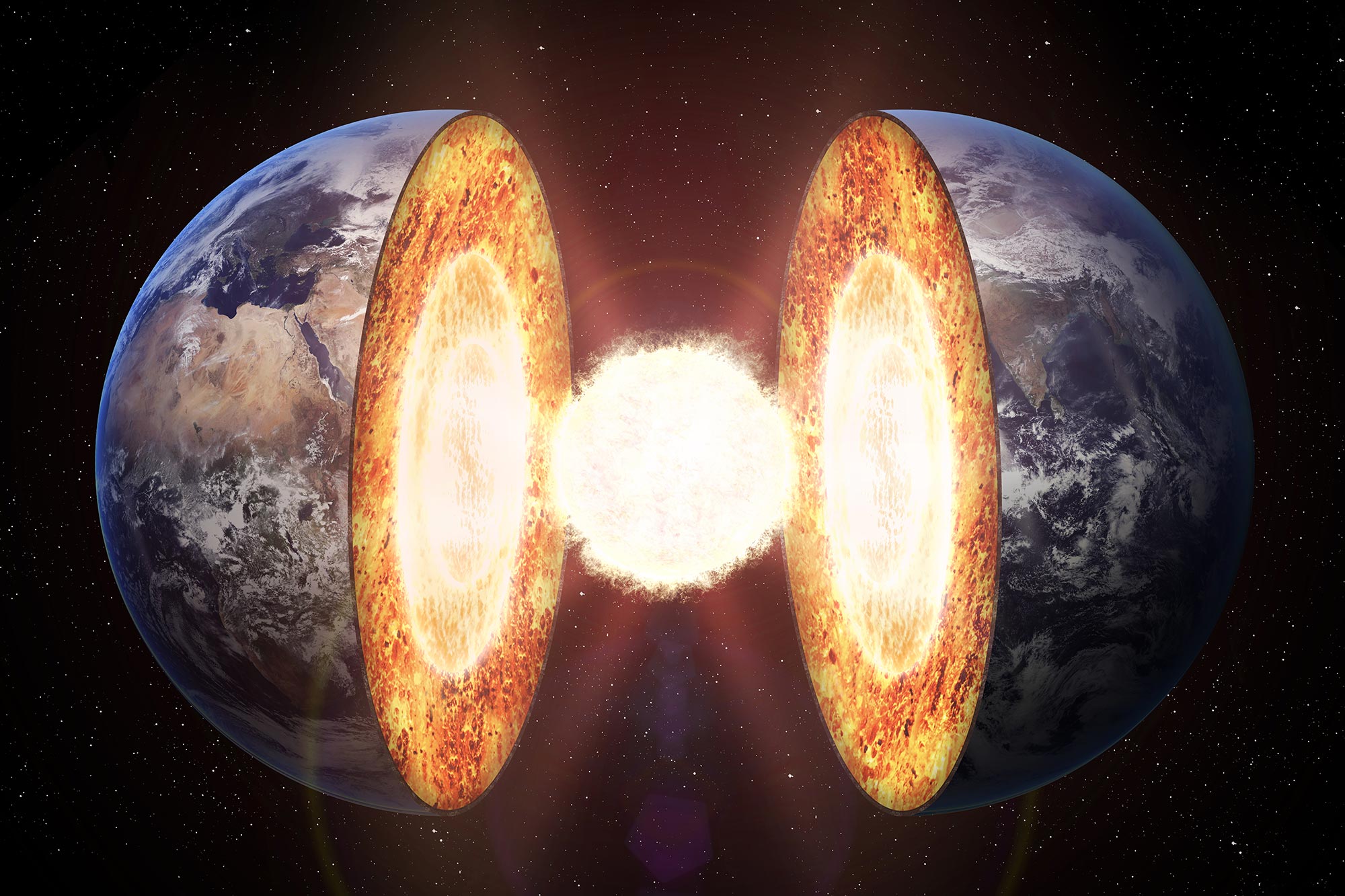
    Earth’s inner core may not be a conventional solid at all, but a superionic material where light elements drift like liquid through a rigid iron lattice. New experiments show that this unusual state dramatically softens the core, matching seismic clues that have puzzled scientists for decades. Credit: Shutterstock

    Chinese researchers have discovered that interstitial carbon in iron-carbon alloys behaves in a superionic, liquid-like state under Earth’s core pressure and temperature conditions.

    Beneath Earth’s molten outer core lies a solid central region, the inner core, a compact sphere made of an iron light-element alloy pressed by more than 3.3 million atmospheres and heated to temperatures comparable to the Sun’s surface.

    For many years, researchers have struggled to explain its unusual behavior: although it is solid, it behaves like an unexpectedly soft metal, slowing seismic shear waves and displaying a Poisson’s ratio closer to butter than to steel. This has raised a long-standing question about how the planet’s solid center can appear both firm and surprisingly pliable.

    A major study published in National Science Review now provides a strong explanation. Scientists have found that Earth’s inner core is not behaving like an ordinary solid at all; instead, it occupies a superionic state, where light elements move through a rigid iron lattice with liquid-like mobility. This finding reshapes scientific views of what is happening deep within the planet.

    The research team, led by Prof. Youjun Zhang and Dr. Yuqian Huang of Sichuan University and Prof. Yu He of the Institute of Geochemistry, Chinese Academy of Sciences, demonstrated that iron-carbon alloys shift into a superionic phase when subjected to intense pressure and heat. In this form, carbon atoms travel quickly through the crystal framework of solid iron, greatly reducing its stiffness.

    “For the first time, we’ve experimentally shown that iron–carbon alloy under inner core conditions exhibits a remarkedly low shear velocity.” said Prof. Zhang. “In this state, carbon atoms become highly mobile, diffusing through the crystalline iron framework like children weaving through a square dance, while the iron itself remains solid and ordered. This so-called “superionic phase” dramatically reduces alloy’s rigidity.

    From Theory to Experiment

    While computer models had hinted at such a state in 2022, direct experimental proof remained elusive — until now. Using a dynamic shock compression platform, the team accelerated iron–carbon samples to speeds of 7 kilometers per second, creating pressures up to 140 gigapascals and temperatures near 2600 kelvin — conditions similar to those in the inner core.
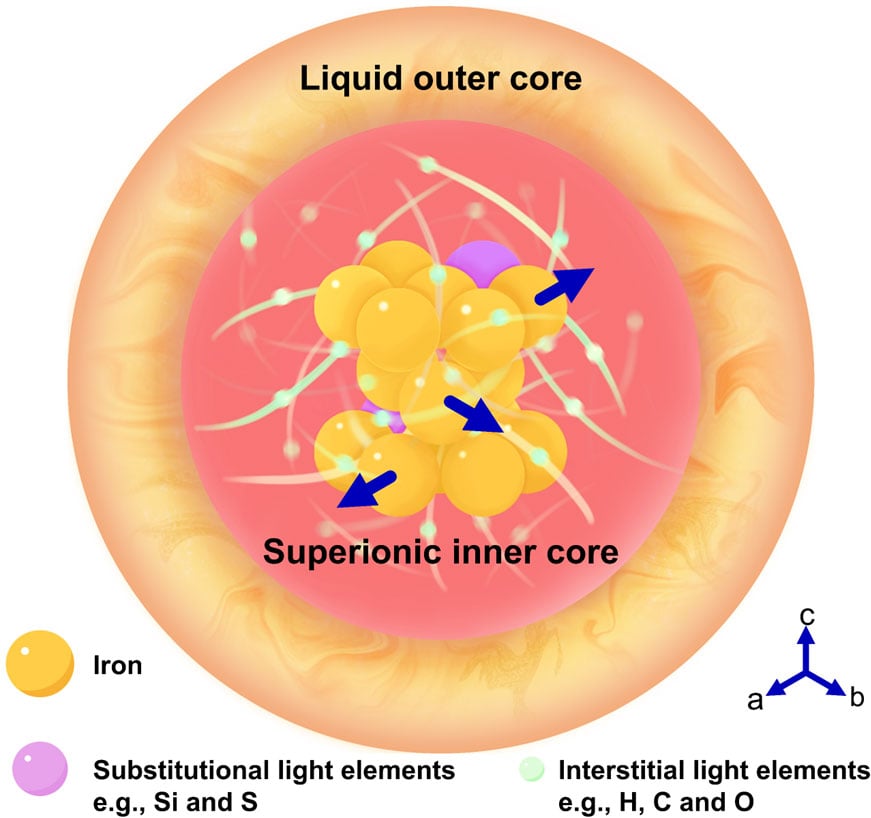
    The Atomic Behavior of Iron and Light Elements in Earth’s Inner Core
    Iron atoms form a rigid hexagonal close-packed (hcp) structure, with a subset of these atoms exhibiting collective motion along the [100] and [010] directions. Within this hcp iron lattice, interstitial light elements diffuse freely in a liquid-like manner, while substitutional light elements remain confined to their respective substitutional lattice sites. Consequently, the Earth’s inner core exists in a hybrid state of solid and liquid-like behavior. Credit: Huang et al.
    By combining in-situ sound velocity measurements with advanced molecular dynamics simulations, the scientists observed a sharp drop in shear wave velocity and a spike in Poisson’s ratio — matching the “soft” seismic signals detected deep within Earth. On the atomic scale, the results revealed carbon atoms slipping freely through the iron lattice, weakening its rigidity without destroying its structure.

    A Dynamic Core with Global Impact

    The superionic model not only explains the core’s puzzling seismic properties but also opens new perspectives on Earth’s internal dynamics. The movement of light elements could help account for seismic anisotropy — variations in wave speeds depending on direction — and may even influence Earth’s magnetic field.

    “Atomic diffusion within the inner core represents a previously overlooked energy source for the geodynamo,” said Dr. Huang. “In addition to heat and compositional convection, the fluid-like motion of light elements may help power Earth’s magnetic engine.”

    The findings also settle long-standing debates about how light elements behave under extreme pressures. Previous studies focused on compounds or substitutional alloys, but this research highlights the importance of interstitial solid solutions — especially those involving carbon — in determining the core’s properties.

    Rethinking the Planet’s Heart

    According to Prof. Zhang, the discovery signals a shift in how scientists view Earth’s center. “We’re moving away from a static, rigid model of the inner core toward a dynamic one,” he explained.

    Beyond Earth, the discovery of a superionic phase could also shed light on the magnetic and thermal evolution of other rocky planets and exoplanets. As Zhang notes, “Understanding this hidden state of matter brings us one step closer to unlocking the secrets of Earth-like planetary interiors.”

    Reference: “Experimental evidence for superionic Fe–C alloy revealed by shear softening in Earth’s inner core” by Yuqian Huang, Yu He, Youjun Zhang, Jun Li, Long Hao, Bo Gan, Gang Jiang, Qiang Wu and Ho-kwang Mao, 26 September 2025, National Science Review.
    DOI: 10.1093/nsr/nwaf419

    This work was funded by the National Natural Science Foundation of China, the Sichuan Science and Technology Program, and the CAS Youth Interdisciplinary Team.

    Never miss a breakthrough: Join the SciTechDaily newsletter.
    Follow us on Google and Google News.

    Earth Science Geophysics Popular Science China Press Seismology
    Share. Facebook Twitter Pinterest LinkedIn Email Reddit

    Related Articles

    Scientists Say a Hidden Structure May Exist Inside Earth’s Core

    Scientists Discover Massive Magma Reservoir Beneath Tuscany

    Mysterious Structures Discovered Beneath Earth May Explain Why Our Planet Supports Life

    A Volcano Erupted 6,000 Miles Away. Why Did It Shake the Ground 16,000 Feet Deep in Alaska?

    Decades-Old Earthquake Mystery Finally Solved by New Model

    Scientists Solve 50-Year Mystery of Strange Zone Deep Inside Earth

    Unusual Seismic Signals Are Rippling Through Earth’s Core, Revealing Planetary Secrets

    A Relic of Ancient Oceans and Planetary Collisions – Scientists Shed New Light on Earth’s Mysterious D” Layer

    Rethinking Earth’s Surface: Geoscientists Discover Hidden Faults of the Pacific Plate

    2 Comments

    1. kamir bouchareb st on December 1, 2025 9:32 am

      thanks for this

      Reply
      • John Wyatt on December 2, 2025 12:23 am

        Looking at the new state of the core of earth, may help us break ground on studying new ways to look at the metal make up and how it can be used for antigravity, creating energy shields by adding electromagnetic properties, the ideas are endless. Then again I am no one, from nowhere TX lol.

        Reply
    Leave A Reply Cancel Reply

    • Facebook
    • Twitter
    • Pinterest
    • YouTube

    Don't Miss a Discovery

    Subscribe for the Latest in Science & Tech!

    Trending News

    Mezcal “Worm” in a Bottle Mystery: DNA Testing Reveals a Surprise

    New Research Reveals That Your Morning Coffee Activates an Ancient Longevity Switch

    This Is What Makes You Irresistible to Mosquitoes

    Shockingly Powerful Giant Octopuses Ruled the Seas 100 Million Years Ago

    Scientists Stunned by New Organic Molecules Found on Mars

    Rewriting Dinosaur Evolution: Scientists Unearth Remarkable 150-Million-Year-Old Stegosaur Skull

    Omega-3 Supplements Linked to Cognitive Decline in Surprising New Study

    First-of-Its-Kind Discovery: Homer’s Iliad Found Embedded in a 1,600-Year-Old Egyptian Mummy

    Follow SciTechDaily
    • Facebook
    • Twitter
    • YouTube
    • Pinterest
    • Newsletter
    • RSS
    SciTech News
    • Biology News
    • Chemistry News
    • Earth News
    • Health News
    • Physics News
    • Science News
    • Space News
    • Technology News
    Recent Posts
    • Male Birth Control Breakthrough: Scientists Find Way To Turn Sperm Production Off and Back On
    • A Common Vitamin Could Hold the Key to Treating Fatty Liver Disease
    • New Research Shows Vitamin B12 May Hold the Key to Healthy Aging
    • Scientists Map Thousands of Brain Connections With RNA Barcodes
    • This Gene Tweak Turns Strawberries Into Healthier, Tastier Superfruit
    Copyright © 1998 - 2026 SciTechDaily. All Rights Reserved.
    • Science News
    • About
    • Contact
    • Editorial Board
    • Privacy Policy
    • Terms of Use

    Type above and press Enter to search. Press Esc to cancel.