
Radiation near the Moon can pass straight through the body, yet preliminary Artemis I measurements suggest a smaller-than-expected increase in exposure compared with low Earth orbit.
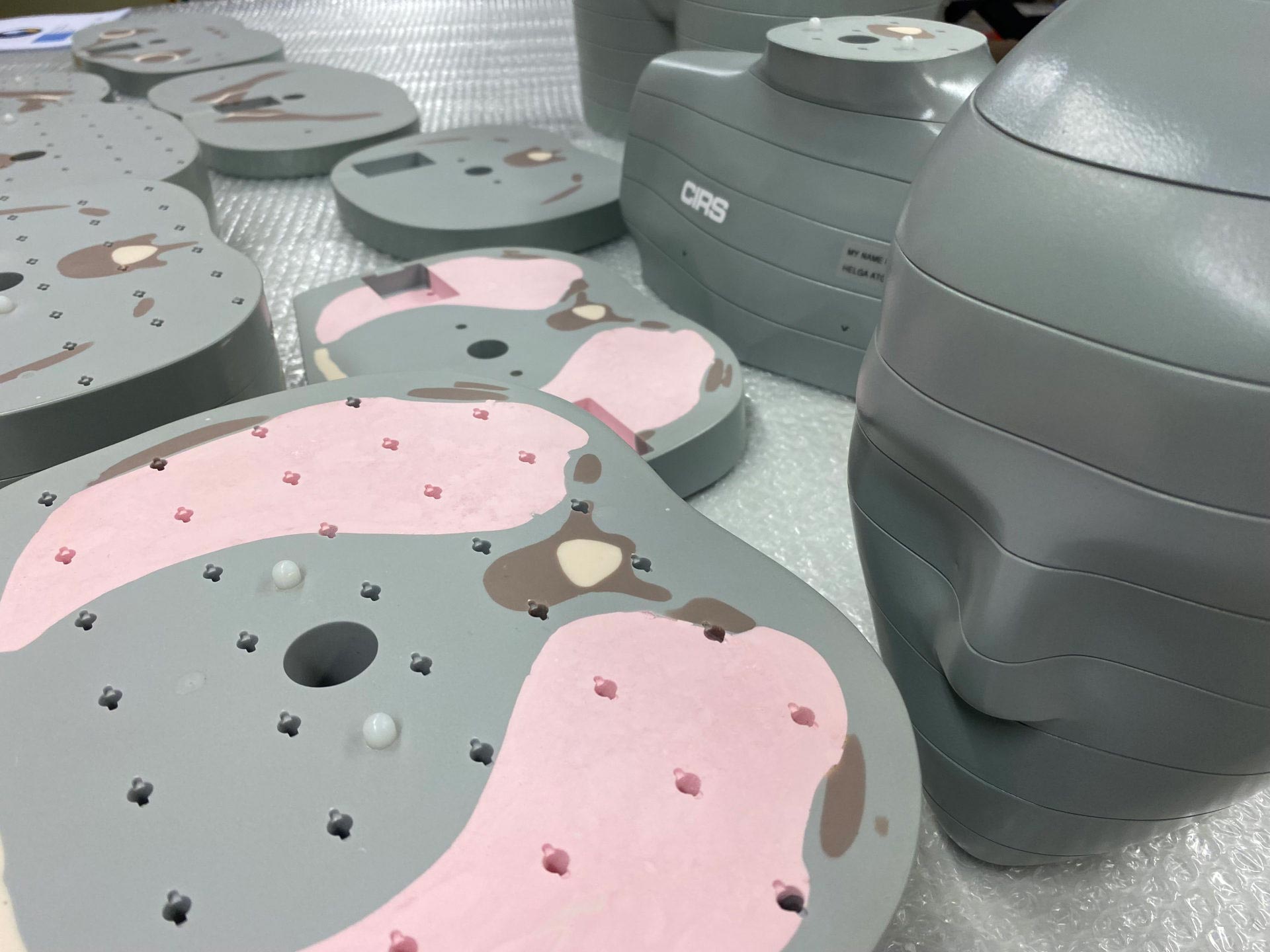
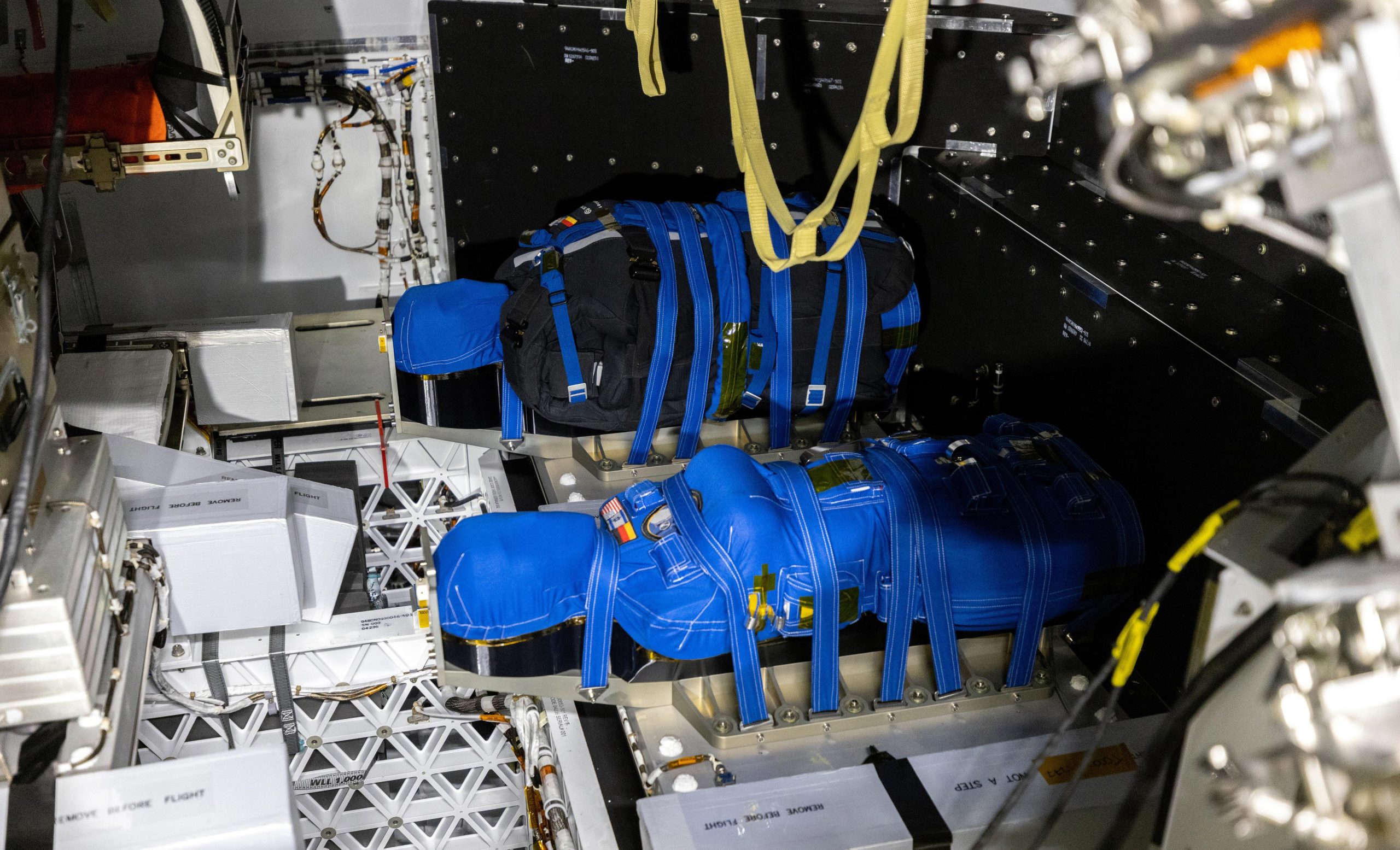
Beyond Earth’s protective magnetic field, astronauts face a constant bombardment of high-energy particles from deep space. But how much radiation would they actually absorb during a journey around the Moon? NASA’s Artemis I mission offered a rare opportunity to find out. Aboard the uncrewed Orion spacecraft, two human-shaped mannequins carried more than 10,000 tiny crystal detectors that recorded radiation exposure throughout their simulated bodies.
Surprisingly, radiation doses near the Moon were only moderately higher than those in low Earth orbit, a smaller increase than researchers might have expected.
Among these detectors were experimental lithium fluoride crystals developed by physicists at the Institute of Nuclear Physics of the Polish Academy of Sciences (IFJ PAN) in Cracow. Flown as part of the Matroshka AstroRad Radiation Experiment (MARE), the crystals captured microscopic traces of cosmic radiation during Orion’s journey in late November and early December 2022. A new study published in Radiation Measurements explains how scientists decoded those traces, revealing new details about radiation exposure in deep space and demonstrating a promising technique for detecting particles that conventional instruments can overlook.
Higher doses without Earth’s radiation belts
“Low-energy protons, trapped by our planet’s magnetic field within the Van Allen belts, can account for the majority of the radiation dose received by astronauts in low Earth orbit. In the vicinity of the Moon, this substantial contribution disappears. Our measurements from the MARE experiment indicate that, although total radiation doses near the Moon are higher than those in Earth orbit due to the considerable levels of galactic radiation, the difference is not as large as one might intuitively expect,” says Prof. Pawel Bilski of IFJ PAN, a co-author of the paper.
Inside the Artemis I mannequins, known as human phantoms, the recorded radiation dose was essentially uniform. Galactic radiation is more prominent near the Moon, and its particles have such high energies that they can pass through an entire body, depositing only part of their energy along the way. That pattern differed from measurements made during the MATROSHKA experiment aboard the International Space Station more than a decade earlier. There, low-energy protons from Earth’s Van Allen belts contributed part of the dose and lost their energy at different depths inside the phantoms, producing an uneven distribution of radiation exposure.
Blue light reveals radiation’s tracks
Both MARE phantoms carried the experimental fluorescent lithium fluoride detectors, some highly enriched in the isotope lithium-7. The Cracow team also supplied nearly 600 crystalline detectors of another type, known as thermoluminescent detectors.
“The fluorescent radiation dose detectors based on lithium fluoride, developed at our institute, are passive in nature. In other words, they work like photographic film: once the crystals have been exposed to radiation, the tracks left by individual particles must be analyzed optically under a microscope,” explains Prof. Bilski.
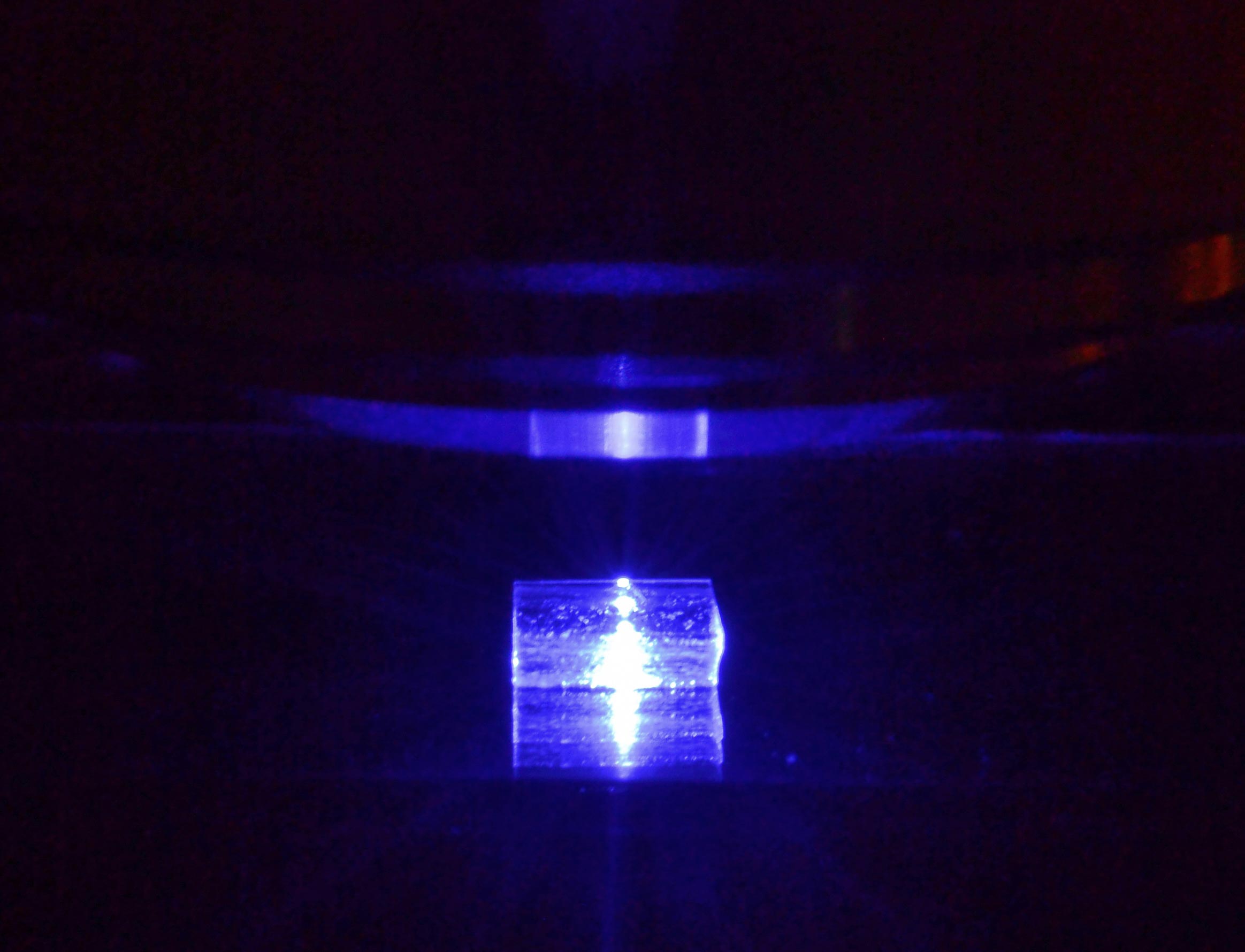
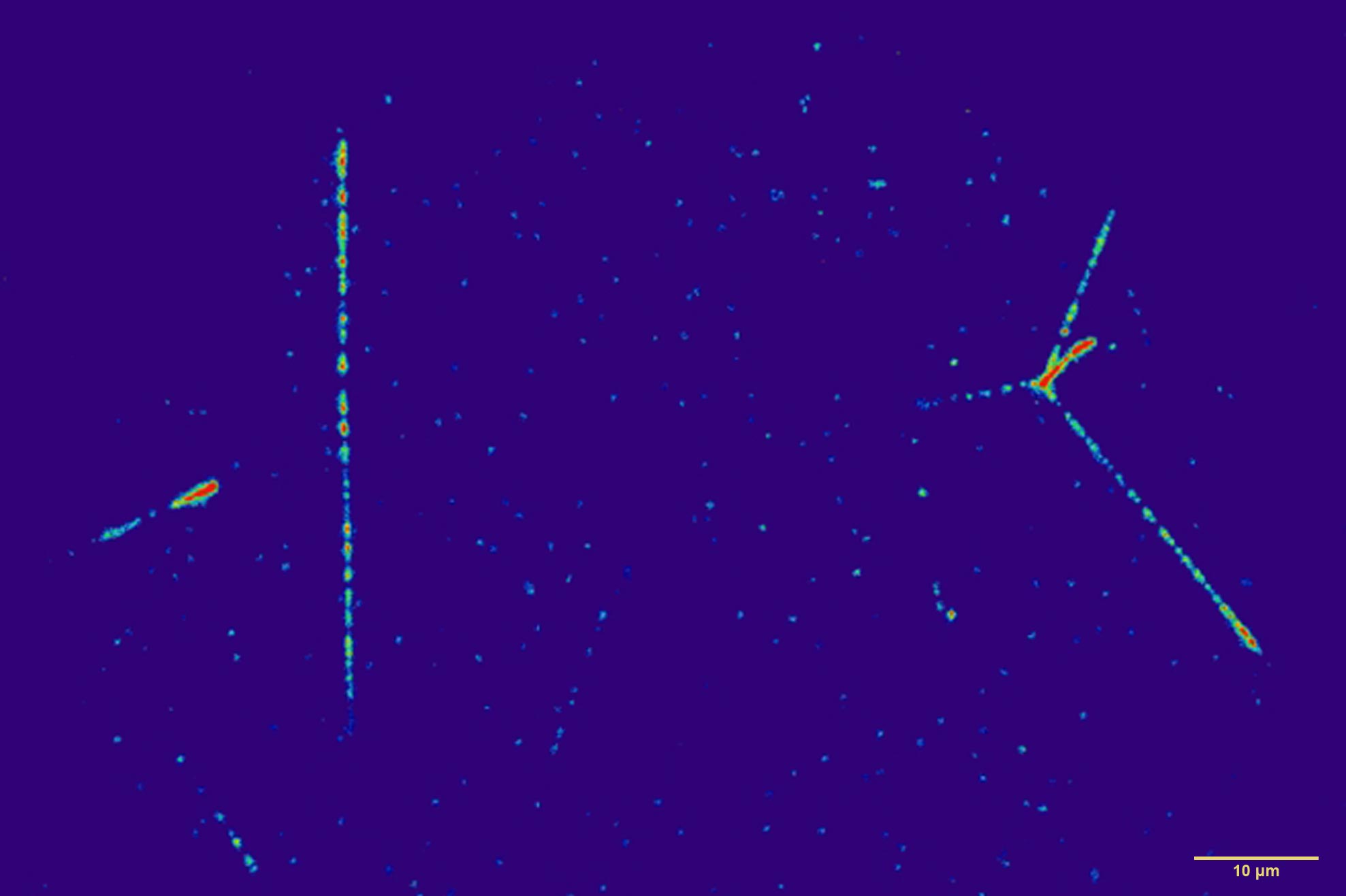
As particles of ionizing radiation pass through lithium fluoride, they create defects in its crystal lattice, the orderly arrangement of atoms within the material. These defects act as color centers. During laboratory readout, blue light excites the centers, making them emit red fluorescence that can be observed under a microscope. Conventional plastic track detectors require chemical etching before their tracks can be read, but lithium fluoride needs no such treatment. A standard fluorescence microscope allowed the researchers to examine the tracks from the lunar mission quickly and without difficulty.
Radiation tracks conventional detectors miss
Extracting quantitative measurements required more complex calibration methods because cosmic radiation bears little resemblance to a controlled laboratory beam. Typical physics experiments expose detectors to particles of the same type, with well-defined energies and a precisely known direction of arrival. Cosmic radiation contains all naturally occurring types of particles and atomic nuclei, spanning a very broad energy range and arriving from every direction.
With tracks running through the crystals at different angles, the microscope brings a segment approximately one micrometer in size into focus, while its camera also captures a blurred glow from the remaining portions. That extra light affects fluorescence intensity, the primary measurement used to assess ionization density, or how densely a particle knocks electrons out of atoms along its path. Track shape also matters. Highly ionizing particles leave continuous, clearly defined lines, while weakly ionizing particles can leave a series of separate dots, further affecting the measured intensity.
“After applying a series of corrections and developing software to appropriately remove the background interfering with the measurements, our results differed by no more than 15% from those obtained using conventional track detectors across the entire overlapping range of energy deposition values. Moreover, we also recorded numerous particle tracks corresponding to energy deposits below the detection threshold of the detectors used to date,” Prof. Bilski emphasizes.
IFJ PAN developed its fluorescent lithium fluoride detectors a decade ago and has continuously improved them since. The crystals used on Artemis I were grown using the Czochralski method, in which a crystal is pulled from molten material. Their dimensions are measured in millimeters rather than centimeters, making them convenient for people to wear. They also resolve tracks more finely than conventional chemically etched plastic detectors, allowing higher radiation doses to be recorded while individual tracks remain distinguishable. Their broad range of detectable particle types and energies enables a better assessment of total radiation exposure.
Lithium fluoride detectors can also record neutron doses, particularly when enriched in lithium-6. Neutrons react with lithium nuclei inside the material, producing secondary charged particles locally. Those particles then interact with the crystal much as incoming ionizing radiation does, leaving a detectable record.
Reference: “Application of LiF fluorescent nuclear track detectors for measurements of cosmic radiation at the lunar orbit within the MARE experiment” by P. Bilski, A. Kilian, M. Sankowska, T. Horwacik and T. Berger, 1 September 2026, Radiation Measurements.
DOI: 10.1016/j.radmeas.2026.107806
The research conducted as part of the MARE project was supported by a grant from the National Science Centre, Poland (NCN), under its OPUS program.
Never miss a breakthrough: Join the SciTechDaily newsletter.
Follow us on Google and Google News.