

Chang’e-6’s retrieval of lunar farside samples reveals crucial insights into the SPA basin’s intrusive magmatism, aiding the understanding of lunar origins and geological processes.
Lunar igneous activities, including intrusive and extrusive magmatism, and their products contain significant information about the lunar interior and its thermal state. Their distribution is asymmetrical on the nearside and farside, reflecting the global lunar dichotomy.
All previously returned lunar samples were from the nearside (Apollo, Luna, and Chang’e-5), and samples from the South Pole-Aitken (SPA) basin on the farside have long been considered the key to rebalancing the asymmetrical understandings of the Moon and disclosing the lunar dichotomy conundrum.

First Farside Lunar Sample Return: Chang’e-6 Mission
The Chang’e-6 mission of the Chinese Lunar Exploration Program is the world’s first lunar farside sample-return mission, which landed in the south of the Apollo basin within the SPA basin on the farside. Earlier this year, the Chang’e-6 mission successfully launched on May 3, landed on the lunar surface on June 2, and returned to the Earth on June 25 carrying a total of 1935.3g of lunar soil.
These precious samples would open a window to solve the long-standing question of lunar dichotomy and reshape our knowledge of our closest neighbor. However, compared with the well-known mare volcanism surrounding the Chang’e-6 landing site, the intrusive magmatic activities have a much more obscure presence and origin, impeding future sample analyses when they are available for application.
Study of Intrusive Magmatism at Chang’e-6 Landing Site
In a recent research paper published in The Astrophysical Journal Letters, Dr. Yuqi Qian, Professor Joseph Michalski, and Professor Guochun Zhao from the Department of Earth Sciences at The University of Hong Kong (HKU) and their domestic and international collaborators have comprehensively studied the intrusive magmatism of the Chang’e-6 landing site and its surroundings based on remote sensing data.
The study revealed their extensive distributions and obscure nature with significant implications for the petrogenesis of lunar plutonic rocks and the Chang’e-6 mission, which will facilitate scientists’ further study of the lunar farside.
Key Findings on Intrusive Magmatism
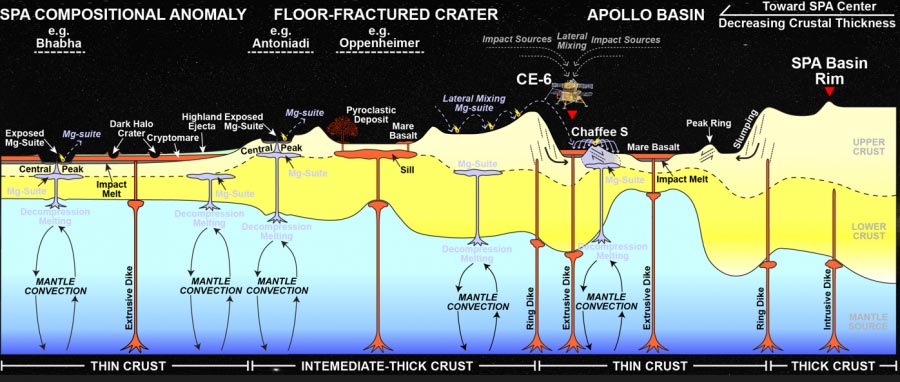
The researchers found that intrusive magmatism is widespread in the SPA basin. They occur in various forms including sills beneath floor-modified craters, linear and ring dikes shown by gravity data, and Mg-suite intrusions with characteristic spectral absorptions. These observations agree with the intermediate-thick crust of SPA where intrusion is favored.
Landing in the SPA basin, Chang’e-6 likely collected plutonic rocks, excavated and transported by adjacent impact craters to the sampling site, that could be examined by the ongoing sample studies. They have discovered two heavily degraded floor-fractured craters (see Apollo X and Apollo Q craters in Figure 1), inspiring them to identify more similar features on the Moon. All indicate that intrusive magmatism is abundant in the Chang’e-6 sampling region.
Insights into Plutonic Materials from Chang’e-6 Samples
This study has traced potential plutonic materials in the Chang’e-6 samples and found that Mg-suite materials highly likely exist, primarily from the western peak ring of the Apollo basin delivered by Chaffee S crater. These Mg-rich materials contain crucial information on the origin of mysterious KREEP-poor Mg-suite rocks.
Samples from both the intrusive and extrusive magmatism from the never-sampled farside, especially the mysterious Mg-suite, will shed further light on solving the lunar dichotomy conundrum and a series of fundamental scientific questions relating to secondary crust building and early evolution of the Moon.
Academic Perspectives on Lunar Studies
Professor Xianhua LI, an academician of the Chinese Academy of Science (CAS), and a leader of China’s lunar sample studies from the Institute of Geology and Geophysics (CAS), said: “The results of this research set a significant geological framework to study plutonic rocks in the Chang’e-6 samples, especially Mg-suite rocks.”
Professor Li emphasized: “Their petrogenesis and timing are unclear, and this research would dramatically help to understand their origin mechanism.”
HKU’s Role in Lunar Exploration and Research
“This research is an excellent example of HKU’s deep involvement in the China’s Lunar Exploration Program,” said Professor Guochun ZHAO, an academician of the Chinese Academy of Science and Chair Professor of Earth Sciences (HKU).
“Lunar and space exploration programs are an important component of China’s goal to become a scientific and technological power, and HKU’s proactive involvement in these programs will bring additional resources for Hong Kong to become an international centre for science and innovation,” he continued.
Future Prospects for HKU in Lunar Research
HKU is the first university in Hong Kong that possess lunar samples obtained by the Chang’e-5 mission. Building on the foundation of this work, the geologists from HKU will also pursue opportunities to study Chang’e-6 samples in the future and be more deeply involved in the Chinese Lunar Exploration Program.
Reference: “Extensive Intrusive Magmatism in the Lunar Farside Apollo and South Pole–Aitken Basins, Chang’e-6 Landing Site” by Yuqi Qian, James Head, Joseph Michalski, Shengxia Gong, Wei Yang, Zilong Wang, Long Xiao, Xianhua Li and Guochun Zhao, 15 August 2024, The Astrophysical Journal Letters.
DOI: 10.3847/2041-8213/ad698f
Never miss a breakthrough: Join the SciTechDaily newsletter.
Follow us on Google and Google News.