
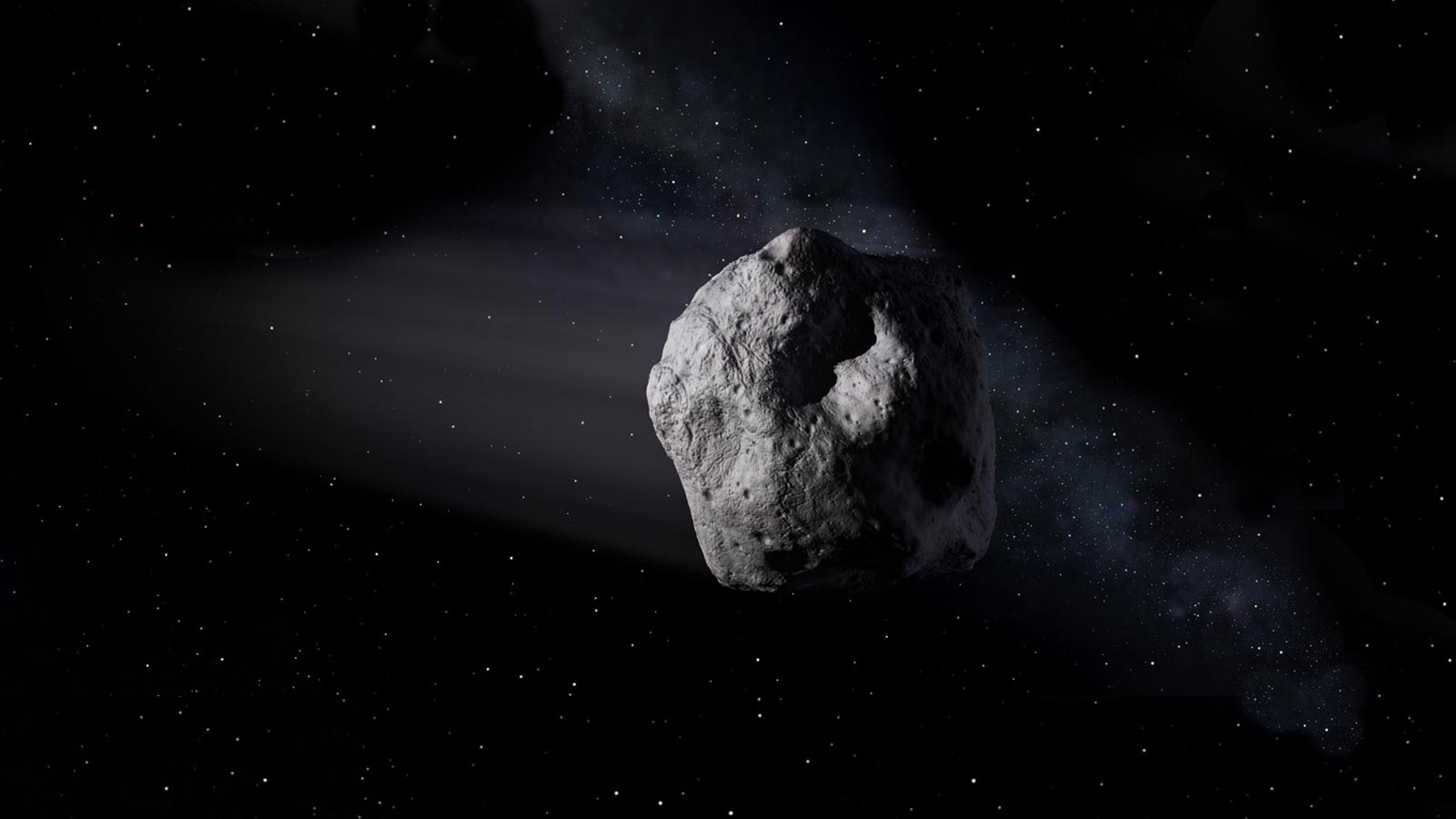
Asteroid 2024 PT5, a near-Earth object discovered last year, has captivated scientists with its potential lunar origins.
Likely ejected into space after a massive impact on the Moon thousands of years ago, the asteroid’s orbit closely matches Earth’s. Researchers confirmed its composition resembles lunar rock, providing a rare opportunity to study both asteroids and the Moon’s history.
Clues Pointing to a Lunar Origin of Asteroid 2024 PT5
The small near-Earth asteroid 2024 PT5 drew global attention last year as a “temporary mini-moon” when a NASA-funded telescope spotted it lingering close to Earth for several months—though it never actually entered our orbit. Measuring about 33 feet (10 meters) across, the asteroid poses no threat to our planet. However, its orbit around the Sun closely mirrors Earth’s, suggesting it may have originated nearby.
According to a study published on January 14 in Astrophysical Journal Letters, new evidence indicates that 2024 PT5 likely came from the Moon. Researchers believe the asteroid is made of lunar rock that was ejected into space after a significant impact event on the Moon’s surface.
Analyzing the Asteroid’s Composition
“We had a general idea that this asteroid may have come from the Moon, but the smoking gun was when we found out that it was rich in silicate minerals — not the kind that are seen on asteroids but those that have been found in lunar rock samples,” said Teddy Kareta, an astronomer at Lowell Observatory in Arizona, who led the research. “It looks like it hasn’t been in space for very long, maybe just a few thousand years or so, as there’s a lack of space weathering that would have caused its spectrum to redden.”
The asteroid was first detected on August 7, 2024, by the NASA-funded Sutherland, South Africa, telescope of the University of Hawai’i’s Asteroid Terrestrial-impact Last Alert System (ATLAS). Kareta’s team then used observations from the Lowell Discovery Telescope and the NASA Infrared Telescope Facility (IRTF) at the Mauna Kea Observatory in Hawai’i to show that the spectrum of reflected sunlight from the small object’s surface didn’t match that of any known asteroid type; instead, the reflected light more closely matched rock from the Moon.

Not (Old) Rocket Science: Ruling Out Space Junk
A second clue came from observing how the object moves. Along with asteroids, Space Age debris, such as old rockets from historic launches, can also be found in Earth-like orbits.
The difference in their orbits has to do with how each type responds to solar radiation pressure, which comes from the momentum of photons — quantum particles of light from the Sun — exerting a tiny force when they hit a solid object in space. This momentum exchange from many photons over time can push an object around ever so slightly, speeding it up or slowing it down. While a human-made object, like a hollow rocket booster, will move like an empty tin can in the wind, a natural object, such as an asteroid, will be much less affected.
To rule out 2024 PT5 being space junk, scientists at NASA’s Center for Near Earth Object Studies (CNEOS), which is managed by the agency’s Jet Propulsion Laboratory in Southern California, analyzed its motion. Their precise calculations of the object’s motion under the force of gravity ultimately enabled them to search for additional motion caused by solar radiation pressure. In this case, the effects were found to be too small for the object to be artificial, proving 2024 PT5 is most likely of natural origin.
“Space debris and space rocks move slightly differently in space,” said Oscar Fuentes-Muñoz, a study coauthor and NASA postdoctoral fellow at JPL working with the CNEOS team. “Human-made debris is usually relatively light and gets pushed around by the pressure of sunlight. That 2024 PT5 doesn’t move this way indicates it is much denser than space debris.”
Comparisons to Other Lunar Asteroids
The discovery of 2024 PT5 doubles the number of known asteroids thought to originate from the Moon. Asteroid 469219 Kamo’oalewa was found in 2016 with an Earth-like orbit around the Sun, indicating that it may also have been ejected from the lunar surface after a large impact. As telescopes become more sensitive to smaller asteroids, more potential Moon boulders will be discovered, creating an exciting opportunity not only for scientists studying a rare population of asteroids, but also for scientists studying the Moon.
If a lunar asteroid can be directly linked to a specific impact crater on the Moon, studying it could lend insights into cratering processes on the pockmarked lunar surface. Also, material from deep below the lunar surface — in the form of asteroids passing close to Earth — may be accessible to future scientists to study.
“This is a story about the Moon as told by asteroid scientists,” said Kareta. “It’s a rare situation where we’ve gone out to study an asteroid but then strayed into new territory in terms of the questions we can ask of 2024 PT5.”
Reference: “On the Lunar Origin of Near-Earth Asteroid 2024 PT5” by Theodore Kareta, Oscar Fuentes-Muñoz, Nicholas Moskovitz, Davide Farnocchia and Benjamin N. L. Sharkey, 14 January 2025, The Astrophysical Journal Letters.
DOI: 10.3847/2041-8213/ad9ea8
The ATLAS, IRTF, and CNEOS projects are funded by NASA’s planetary defense program, which is managed by the Planetary Defense Coordination Office at NASA Headquarters in Washington.
Never miss a breakthrough: Join the SciTechDaily newsletter.
Follow us on Google and Google News.