
Close Menu
    Facebook X (Twitter) Instagram
    SciTechDaily
    • Biology
    • Chemistry
    • Earth
    • Health
    • Physics
    • Science
    • Space
    • Technology
    Facebook X (Twitter) Pinterest YouTube RSS
    SciTechDaily
    Home»Space»Mars Ablaze: Witness Retrograde, Opposition, and a Cosmic Dance With the Moon
    Space

    Mars Ablaze: Witness Retrograde, Opposition, and a Cosmic Dance With the Moon

    By Kat Troche, Astronomical Society of the PacificJanuary 8, 2025No Comments4 Mins Read
    Facebook Twitter Pinterest Telegram LinkedIn WhatsApp Email Reddit
    Share
    Facebook Twitter LinkedIn Pinterest Telegram Email Reddit
    Moon Mars Occultation January 2025
    A simulated view of the Moon as Mars begins its occultation on January 13, 2025. Credit: Stellarium

    Discover the red planet like never before!

    This month offers a unique opportunity to witness Mars in stunning detail. From tracking its retrograde motion to experiencing a rare occultation by the Moon, the skies provide a front-row seat to cosmic events. Don’t miss Mars at its brightest during opposition, revealing more of its mysterious surface.

    Have you looked up at the night sky this season and noticed a bright object sporting a reddish hue to the left of Orion? This is none other than the planet Mars! January will be an excellent opportunity to spot this planet and some of its details with a medium-sized telescope. Be sure to catch these three events this month.

    Martian Retrograde

    Mars entered retrograde (or backward movement relative to its usual direction) on December 7, 2024, and will continue throughout January into February 23, 2025. You can track the planet’s progress by sketching or photographing Mars’ position relative to nearby stars. Be consistent with your observations, taking them every few nights or so as the weather permits. You can use free software like Stellarium or Stellarium Web (the browser version) to help you navigate the night as Mars treks around the sky. You can find Mars above the eastern horizon after 8:00 PM local time.
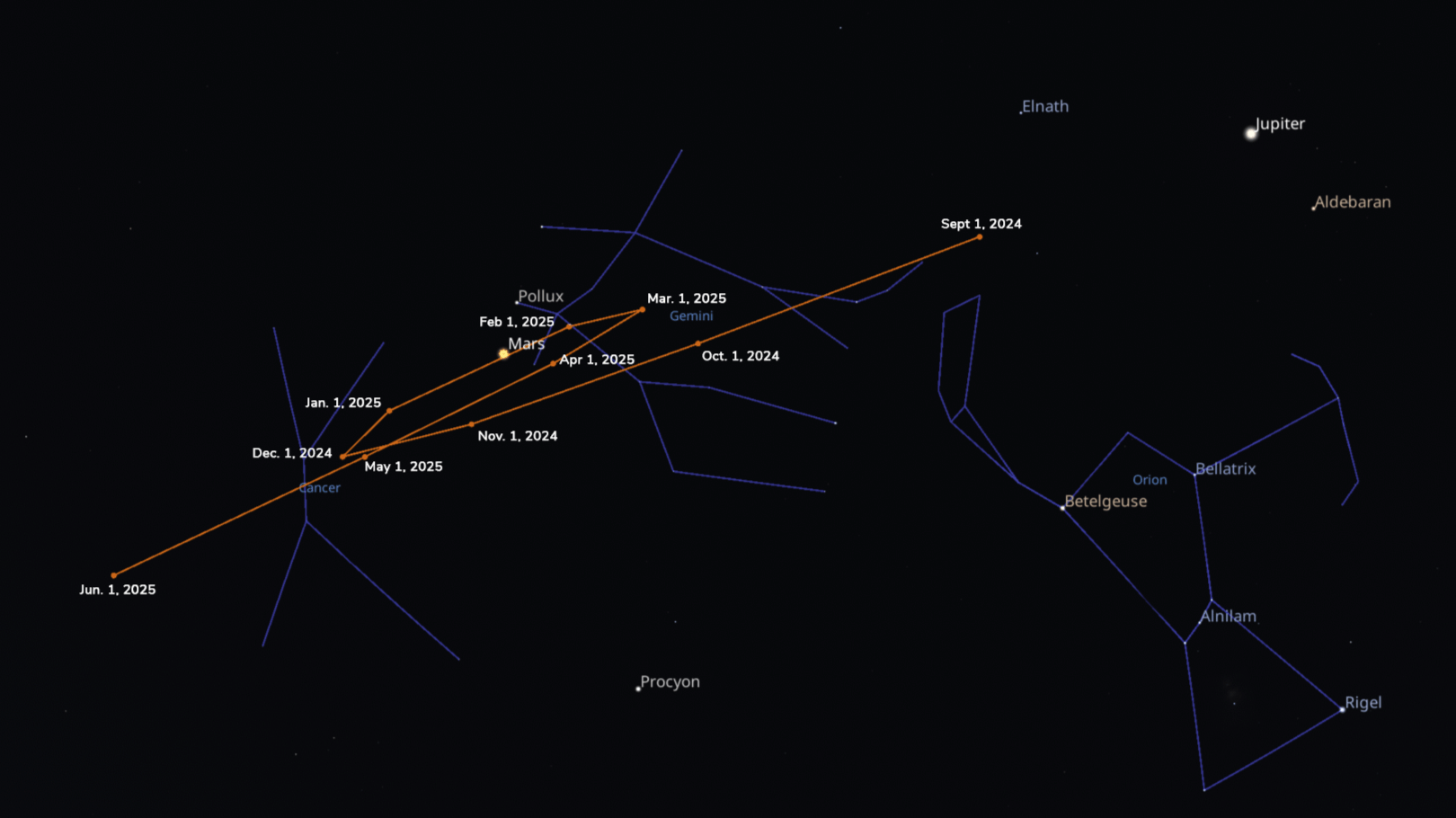
    Stellarium Mars Retrograde Map
    This mid-January chart shows the path of Mars from September 2024 to June 2025 as it enters and then exits in retrograde motion. Mars appears to change its direction of motion in the sky because Earth is passing the slower-moving Mars in its orbit. Credit: Stellarium

    Witness the Occultation of Mars

    On the night of January 13th, you can watch Mars ‘disappear’ behind the Moon during an occultation. An occultation is when one celestial object passes directly in front of another, hiding the background object from view. This can happen with planets and stars in our night sky, depending on the orbit of an object and where you are on Earth, similar to eclipses.

    Depending on where you are within the contiguous United States, you can watch this event with the naked eye, binoculars, or a small telescope. The occultation will happen for over an hour in some parts of the US. You can use websites like Stellarium Web or the Astronomical League’s ‘Moon Occults Mars’ chart to calculate the best time to see this event.

    Mars Planet Globe
    A mosaic of the Valles Marineris hemisphere of Mars projected into point perspective, a view similar to that which one would see from a spacecraft. The mosaic is composed of 102 Viking Orbiter images of Mars. Credit: NASA/JPL-Caltech

    Mars at Opposition

    As you observe Mars this month to track its retrograde movement, you will notice that it will increase in brightness. This is because Mars will reach opposition by the evening of January 16th. Opposition happens when a planet is directly opposite the Sun, as seen from Earth. You don’t need to be in any specific city to observe this event; you only need clear skies to observe that it gets brighter. It’s also when Mars is closest to Earth, so you’ll see more details in a telescope.

    Want a quick and easy way to illustrate what opposition is for Jupiter, Saturn, Mars, or other outer worlds? Follow the instructions on our Toolkit Hack: Illustrating Opposition with Exploring the Solar System page using our Exploring Our Solar System activity!

    Mars Through the Ages

    Mars has fascinated humanity for centuries, with its earliest recorded observations dating back to the Bronze Age. By the 17th century, astronomers were able to identify features of the Martian surface, such as its ice caps and darker regions. Since the 1960s, exploration of the Red Planet has intensified with robotic missions from various space organizations. Currently, NASA has five active missions, including rovers and orbiters, with the future focused on human exploration and habitation. Mars will always fill us with a sense of wonder and adventure as we reach for its soil through initiatives such as the Moon to Mars Architecture and the Mars Sample Return campaign.

    Never miss a breakthrough: Join the SciTechDaily newsletter.
    Follow us on Google and Google News.

    Astronomy Moon NASA Popular
    Share. Facebook Twitter Pinterest LinkedIn Email Reddit

    Related Articles

    Don’t Miss: Mars and the Wolf Moon Align in Epic Sky Spectacle

    Last Chance To See a Supermoon in 2024 – What Makes This “Beaver” Moon Special

    Tonight’s Must-See: The Hunter’s Moon Shines As 2024’s Brightest Supermoon

    Look Up! A Blue Supermoon Will Light Up the Sky

    Don’t Miss the Strawberry Moon in June’s Night Sky!

    NASA’s Artemis Moon Telescope Could Explore the Cosmos in Unprecedented Detail

    NASA Spacecraft Confirms Existence of Neon in Lunar Atmosphere

    NASA’s GRAIL Mission Solves a Lunar Mystery Almost as Old as the Moon Itself

    Hubble Data Reveals a New Neptune Moon

    Leave A Reply Cancel Reply

    • Facebook
    • Twitter
    • Pinterest
    • YouTube

    Don't Miss a Discovery

    Subscribe for the Latest in Science & Tech!

    Trending News

    The Universe Is Expanding Too Fast and Scientists Can’t Explain Why

    “Like Liquid Metal”: Scientists Create Strange Shape-Shifting Material

    Early Warning Signals of Esophageal Cancer May Be Hiding in Plain Sight

    Common Blood Pressure Drug Shows Surprising Power Against Deadly Antibiotic-Resistant Superbug

    Scientists Uncover Dangerous Connection Between Serotonin and Heart Valve Disease

    Scientists Discover a “Protector” Protein That Could Help Reverse Hair Loss

    Bone-Strengthening Discovery Could Reverse Osteoporosis

    Scientists Uncover Hidden Trigger Behind Stem Cell Aging

    Follow SciTechDaily
    • Facebook
    • Twitter
    • YouTube
    • Pinterest
    • Newsletter
    • RSS
    SciTech News
    • Biology News
    • Chemistry News
    • Earth News
    • Health News
    • Physics News
    • Science News
    • Space News
    • Technology News
    Recent Posts
    • A Common Diabetes Drug May Hold the Key to Stopping HIV From Coming Back
    • Ancient “Syphilis-Like” Disease in Vietnam Challenges Key Scientific Assumptions
    • Drinking Alcohol To Cope in Your 20s Could Damage Your Brain for Life
    • Scientists Crack Alfalfa’s Chromosome Mystery After Decades of Debate
    • Ancient Ant-Plant Alliance Collapses As Predatory Wasps Move In
    Copyright © 1998 - 2026 SciTechDaily. All Rights Reserved.
    • Science News
    • About
    • Contact
    • Editorial Board
    • Privacy Policy
    • Terms of Use

    Type above and press Enter to search. Press Esc to cancel.