
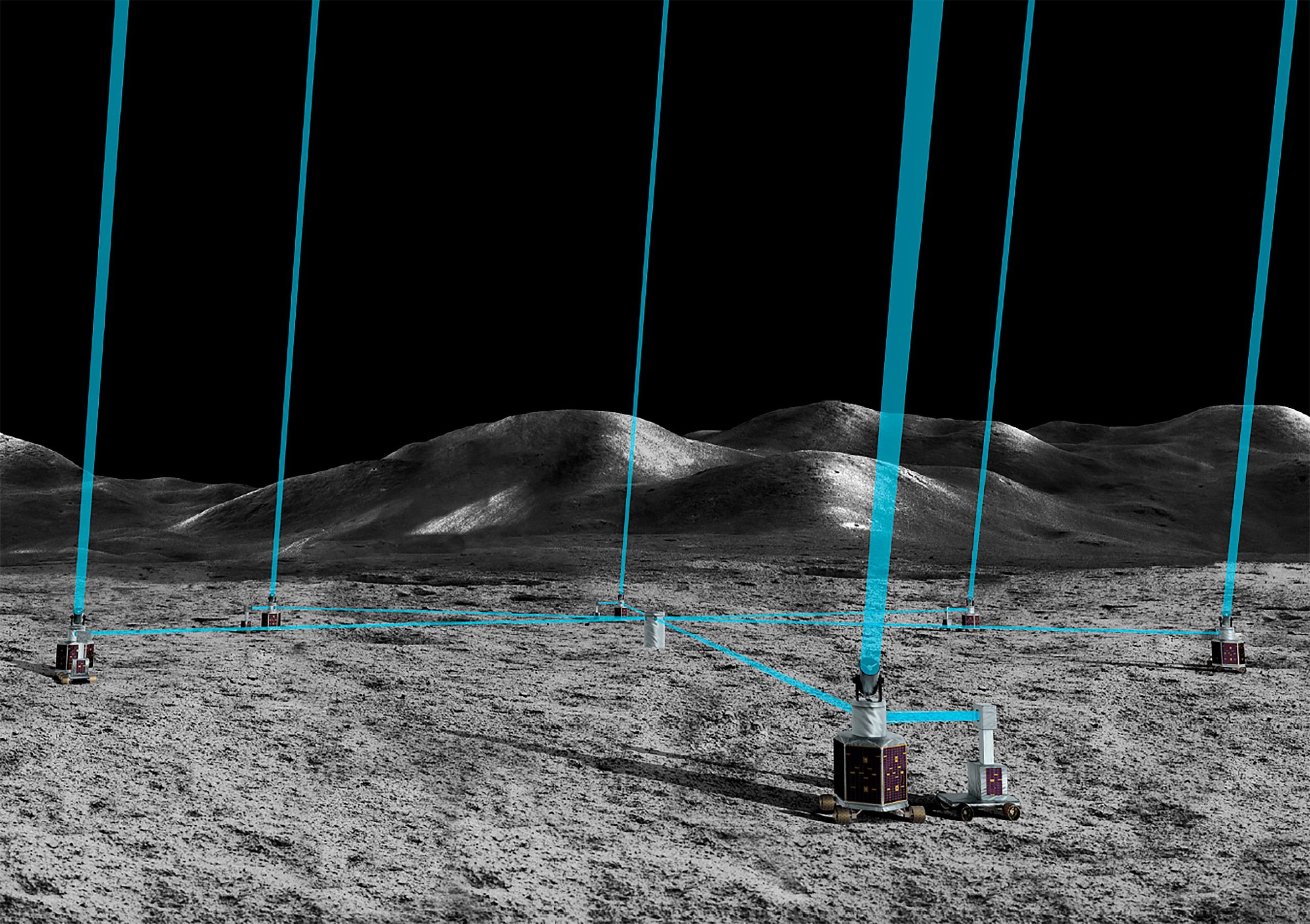
NASA’s proposal for a lunar-based interferometric imaging facility aims to revolutionize astrophysical research, leveraging the Artemis Program’s infrastructure to study celestial phenomena in unprecedented detail.
NASA’s return to the Moon offers significant opportunities to take practical steps towards high-impact scientific capabilities. One obvious candidate is extremely high-resolution interferometric imaging at visible and ultraviolet wavelengths. This can resolve the surfaces of stars, probe the inner accretion disks surrounding nascent stars and black holes, and begin the technical journey toward resolving surface features and weather patterns on the nearest exoplanets.
A fully developed facility will be large and expensive, but it need not start that way. The technologies can be developed and tested with 2 or 3 small telescopes on short baselines. Once the technology is developed, baselines can be lengthened, larger telescopes can be inserted, and the number of telescopes can be increased. Each of these upgrades can be accomplished with minimal disruption to the rest of the system.
Proposal for NIAC Support
We therefore request NIAC support to investigate the details of building a high-resolution, long-baseline, optical imaging interferometer on the lunar surface in conjunction with the Artemis Program. A 1996 study examined the trade-offs between placing kilometric-sized interferometers on the lunar surface vs. designing them as free-flyers in open space. They concluded that, in the absence of a pre-existing human infrastructure on the lunar surface to provide power and ongoing maintenance, it was better to pursue space-based free-flyers.
Advantages of Lunar Interferometers
Thus, previous studies of interferometers in space concentrated on free-flying designs. However, now that a lunar infrastructure is foreseeable under the Artemis Program, it is compelling and timely that we investigate building interferometers on the lunar surface. Our goal is the same level of detailed study as was done for large baseline, free-flying interferometers during the 2003-2005 NASA Vision Missions Studies, in order to be prepared to take advantage of such lunar infrastructure.
Potential Scientific and Societal Impact
Our study of a lunar surface-based interferometer will be a huge step forward to larger arrays on both the moon and free-flying in space, over a wide variety of wavelengths and science topics. It will determine, given the current and anticipated state of our space technology and human exploration plans, whether it is better to pursue designs for the lunar surface or deep space.
We envision advancements in Astrophysics (study of stellar magnetic activity, the nuclei of active galaxies, dynamics on many scales) and in engineering such a facility, by determining the best way to incorporate variable-length optical delay lines combining beams from variable array configurations on the lunar surface, study the advantages and disadvantages of various size individual mirror elements and find the optimal size for meeting both the mission’s technical and scientific goals.
We will also develop a plan for maintaining and evolving the facility over time, using a mix of human and robotic support. This lunar facility will foster technical advances that would help enable not only an UV-optical interferometer, but also other large space interferometers like Black Hole Imager (X-ray, black hole event horizons), Life Finder (searching for signs of life), and Planet Imager (imaging terrestrial type planets around other stars).
The excitement of building a major facility like this on the Moon, in conjunction with the human spaceflight program, and the science accomplished with it, will generate tremendous public and community interest in the same way as did the collaboration between the Space Shuttle Program and Hubble Space Telescope Project.
Finally, this effort will make people dream again – and remember that we can do great things, even in face of difficult times. Our study will help keep the focus on the grandeur of the Universe and what humans can do if they work hard together. Our project will excite generations of future Science Technology Engineering Art Mathematics (STEAM) workers, who will be inspired by this bold vision.
Never miss a breakthrough: Join the SciTechDaily newsletter.
Follow us on Google and Google News.
3 Comments
Why should more money be spent on space toys when we already have a handful of them? These “space telescopes” from OAO-2 to the JWST have all proved worthless. Why not rather spend the money on recomended glasses which are worth their weight in gold for night-sky gazers like Sarneczy in order that they can see the cosmos more clearly. I can hardly believe that with all these telescopes and observatories, we can’t detect and preclude harzards from outer space just like the 2024 bx1. If it weren’t for competent night-sky gazers like him the asteroid would have gone unnoticed. For this reason, I suggest the money should be spent on teams of night-sky gazers with good recomended glasses.
Say no to drug abuse!
“Our project will excite generations of future Science Technology Engineering Art Mathematics (STEAM) workers, who will be inspired by this bold vision.”
So now *Art* is to be lumped in with Science. Technology, Engineering & Mathematics? Seems illogical. Might as well find a few other items to tack onto this abbreviation so it reads STEAMPUNK.