
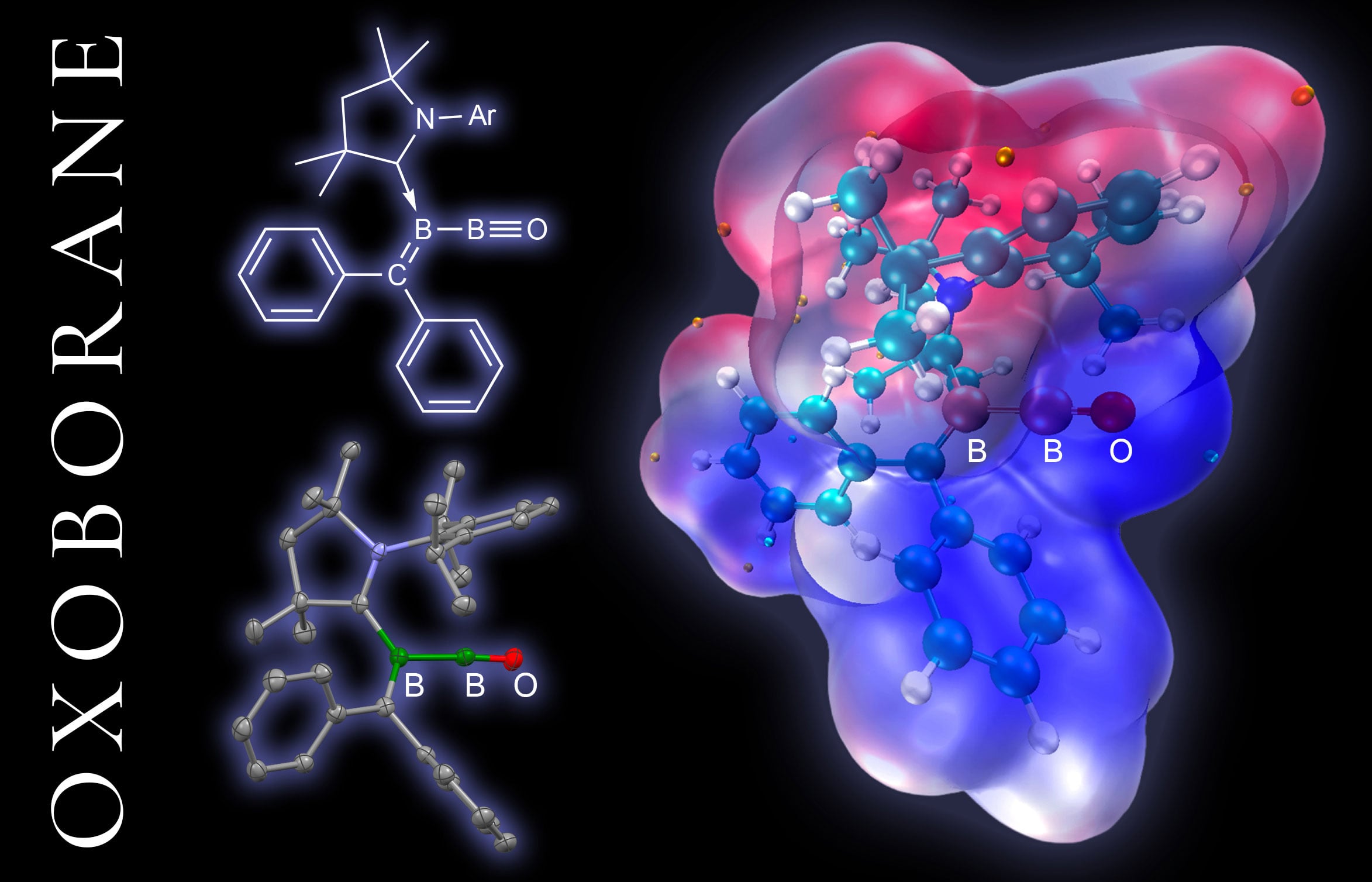
After more than six decades of failed attempts, chemists have achieved a breakthrough involving a class of molecules long considered too unstable to isolate.
Chemists have succeeded in isolating a group of molecules that researchers have struggled to capture for more than 60 years. Known as oxoboranes, these compounds contain an unusual triple bond between boron and oxygen, a combination long considered too unstable to isolate in a lasting form.
Researchers led by Professor Holger Braunschweig at the University of Würzburg have now developed a method that produces three surprisingly stable oxoboranes. Published in Nature Chemistry, the work was supported by computational research from Professor Ashwini K. Phukan’s team at Tezpur University in India.
An Unexpected Reaction Produces Elusive Molecules
The breakthrough began when Würzburg doctoral students Lukas Lubczyk and Christian Markl independently reacted a compound called a diboracumulene with different ketones, chemicals commonly used in organic synthesis. Instead of the anticipated products, they obtained unusual orange or yellow solids. The reactions had unexpectedly produced oxoboranes as their main products.
“The discovery was a pleasant surprise. I never thought the diboracumulene would react the way it did, let alone with multiple different, simple substrates. And when Christian came to me with his compound, I knew we were onto something,” says Lukas Lubczyk.
Solving a 60-Year Challenge in Chemistry
Boron has a strong tendency to avoid forming triple bonds, making these molecules particularly difficult to synthesize. Braunschweig has spent more than 15 years investigating this type of chemical bonding. His team created the first molecule containing a boron-boron triple bond in 2012, followed by the first neutral molecule with a boron-carbon triple bond in 2025. Organic oxoboranes represented the remaining challenge involving triple bonds between boron and other elements in the first row of the periodic table’s p-block.
Chemists have pursued oxoboranes since at least the early 1960s. Although previous experiments detected or trapped them under extreme conditions, inferred their presence from chemical reactions, or produced related derivatives, researchers had been unable to isolate stable examples.
“Nearly everybody in the field had given up on oxoboranes, as they were thought to be just too unstable to be isolated. So we were stunned to see them spontaneously form in these reactions and stick around long enough that we could study them,” says Holger Braunschweig.
The successful preparation of three oxoboranes suggests that the new approach could provide access to additional members of this difficult-to-synthesize molecular family. The researchers are now investigating whether the method can be extended to produce other elusive compounds involving elements across the periodic table.
Reference: “Synthesis and isolation of stable oxoboranes” by Lukas Lubczyk, Christian Markl, Mudit Jain, Sourav Kar, Thomas Kupfer, Rian D. Dewhurst, Ashwini K. Phukan and Holger Braunschweig, 27 October 2026, Nature Chemistry.
DOI: 10.1038/s41557-026-02272-w
The work was funded by the German Research Foundation (DFG), the German Academic Exchange Service (DAAD) and the Department of Science & Technology (DST) of India.
Never miss a breakthrough: Join the SciTechDaily newsletter.
Follow us on Google and Google News.
1 Comment
It seems material sciences are likely to transform our world even faster than anyone anticipated. Good use of research and most likely AI….looking forward to more discoveries. Can something like this be eventually used to expand “recycling” tch? Sort of reverse build from the used or discarded products?