
Close Menu
    Facebook X (Twitter) Instagram
    SciTechDaily
    • Biology
    • Chemistry
    • Earth
    • Health
    • Physics
    • Science
    • Space
    • Technology
    Facebook X (Twitter) Pinterest YouTube RSS
    SciTechDaily
    Home»Chemistry»Breakthrough Material Separates Heavy Water From Normal Water at Room Temperature
    Chemistry

    Breakthrough Material Separates Heavy Water From Normal Water at Room Temperature

    By Kyoto UniversityDecember 28, 20222 Comments3 Mins Read
    Facebook Twitter Pinterest Telegram LinkedIn WhatsApp Email Reddit
    Share
    Facebook Twitter LinkedIn Pinterest Telegram Email Reddit
    Separate Water From Heavy Water
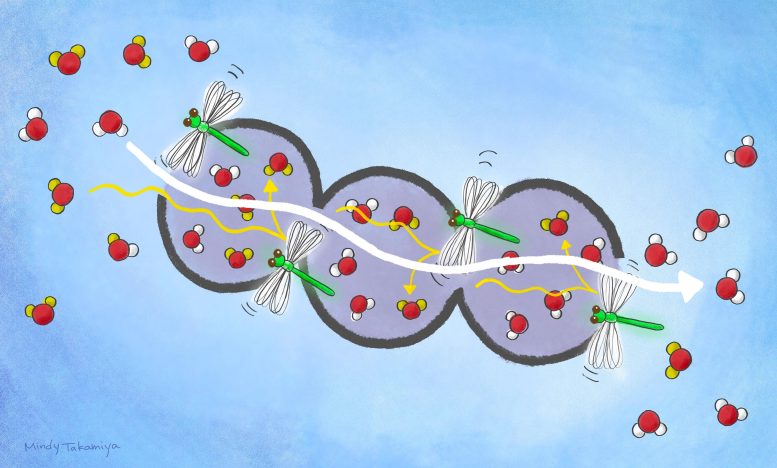
    Incorporating dragonfly-shaped gate molecules into PCP/MOFs makes it a hundred times more efficient than before to separate water from heavy water, which has been difficult to separate due to their similar properties. Credit: Mindy Takamiya/Kyoto University iCeMS

    A flipping action in a porous material facilitates the passage of normal water to separate it out from heavy water.

    A research group led by Susumu Kitagawa of Kyoto University’s Institute for Cell-Material Sciences (iCeMS), Japan and Cheng Gu of South China University of Technology, China have made a material that can effectively separate heavy water from normal water at room temperature. Until now, this process has been very difficult and energy intensive. The findings have implications for industrial – and even biological – processes that involve using different forms of the same molecule. The scientists reported their results in the journal Nature.

    Isotopologues are molecules that have the same chemical formula and whose atoms bond in similar arrangements, but at least one of their atoms has a different number of neutrons than the parent molecule. For example, a water molecule (H2O) is formed of one oxygen and two hydrogen atoms. The nucleus of each of the hydrogen atoms contains one proton and no neutrons. In heavy water (D2O), on the other hand, the deuterium (D) atoms are hydrogen isotopes with nuclei containing one proton and one neutron. Heavy water has applications in nuclear reactors, medical imaging, and in biological investigations.

    “Water isotopologues are among the most difficult to separate because their properties are so similar,” explains materials scientist Cheng Gu. “Our work provided an unprecedented mechanism for separating water isotopologues using an adsorption-separation method.”

    Innovative Use of Porous Coordination Polymers (PCPs)

    Gu and chemist Susumu Kitagawa, together with colleagues, based their separation technique on a copper-based porous coordination polymer (PCP). PCPs are porous crystalline materials formed of metal nodes connected by organic linkers. The team tested two PCPs made with different types of linkers.

    What makes their PCPs especially important for isotopologue separation is that the linkers flip when moderately heated. This flipping action acts like a gate, allowing molecules to pass from one ‘cage’ in the PCP to another. Movement is blocked when the material is cooled.

    When the scientists exposed their ‘flip-flop dynamic crystals’ to vapour containing a mixture of normal, heavy and semi-heavy water and then slightly warmed it, they adsorbed normal water much faster than they did the other two isotopologues. Crucially, this process happened within room temperature ranges.

    “The adsorptive separation of water isotopologues in our work is substantially superior to conventional methods due to very high selectivity at room temperature operation,” says Kitagawa. “We are optimistic that new materials guided by our work will be developed to separate other isotopologues.”

    Reference: “Separating water isotopologues using diffusion-regulatory porous materials” by Yan Su, Ken-ichi Otake, Jia-Jia Zheng, Satoshi Horike, Susumu Kitagawa and Cheng Gu, 9 November, Nature.
    DOI: 10.1038/s41586-022-05310-y

    Never miss a breakthrough: Join the SciTechDaily newsletter.
    Follow us on Google and Google News.

    Kyoto University Materials Science Organic Chemistry Water
    Share. Facebook Twitter Pinterest LinkedIn Email Reddit

    Related Articles

    Shape-Shifting Membrane Transforms Carbon Capture Technology

    Revolutionizing Cancer Care With Bendable X-Ray Detectors

    Electron Affinity Unleashed: The Surprising Chemical Capabilities of Flat Fullerene Fragments

    Entirely New, Inexpensive Catalyst Speeds the Production of Oxygen From Water

    Revolutionary Carbon-Based Magnetic Material Finally Synthesized After 70 Years

    “Opposite Action” Strategy Could Improve Industrial Gas Separation

    New Nanoparticle Material Developed for Efficient Water Desalination

    A Chance Discovery Leads to a Simple Process That Can Control Perovskite Oxynitride Properties

    Near Infrared-Absorbing Hydrocarbon Revealed by Molecular Design Strategy

    2 Comments

    1. jms on December 28, 2022 6:47 pm

      Guess we won’t be needing oranges anymore….

      Reply
    2. Blaze on December 30, 2022 3:53 am

      So they just assume it’s a good thing cause it works with water…. Is it gonna grow into a big thing they use them down the line they’re like oh well it allows the things needed through but doesn’t do such and such cause it’s a non living thing unconnected to human biology….. Kinda like when they recalled blood pressure meds weirdly used cause of cancer risks….

      Reply
    Leave A Reply Cancel Reply

    • Facebook
    • Twitter
    • Pinterest
    • YouTube

    Don't Miss a Discovery

    Subscribe for the Latest in Science & Tech!

    Trending News

    Popular Sugar-Free Sweetener Linked to Liver Disease, Study Warns

    What Is Hantavirus? The Deadly Disease Raising Alarm Worldwide

    Scientists Just Discovered How the Universe Builds Monster Black Holes

    Scientists Unveil New Treatment Strategy That Could Outsmart Cancer

    A Simple Vitamin May Hold the Key to Treating Rare Genetic Diseases

    Scientists Think the Real Fountain of Youth May Be Hiding in Your Gut

    Ravens Don’t Follow Wolves, They Predict Them

    This Common Knee Surgery May Be Doing More Harm Than Good

    Follow SciTechDaily
    • Facebook
    • Twitter
    • YouTube
    • Pinterest
    • Newsletter
    • RSS
    SciTech News
    • Biology News
    • Chemistry News
    • Earth News
    • Health News
    • Physics News
    • Science News
    • Space News
    • Technology News
    Recent Posts
    • Why Are So Many New Fathers Dying? Scientists Say the U.S. Has a Dangerous Blind Spot
    • Scientists Identify Simple Supplement That Greatly Reduces Alzheimer’s Damage
    • You May Have a Dangerous Type of Cholesterol Even if Your Tests Look Normal
    • Study Reveals Dangerous Flaw in AI Symptom Checkers
    • New MRI Breakthrough Captures Stunningly Clear Images of the Eye and Brain
    Copyright © 1998 - 2026 SciTechDaily. All Rights Reserved.
    • Science News
    • About
    • Contact
    • Editorial Board
    • Privacy Policy
    • Terms of Use

    Type above and press Enter to search. Press Esc to cancel.