
Close Menu
    Facebook X (Twitter) Instagram
    SciTechDaily
    • Biology
    • Chemistry
    • Earth
    • Health
    • Physics
    • Science
    • Space
    • Technology
    Facebook X (Twitter) Pinterest YouTube RSS
    SciTechDaily
    Home»Biology»Variation of PM20D1 Gene Linked To Increased Risk of Developing Alzheimer’s Disease
    Biology

    Variation of PM20D1 Gene Linked To Increased Risk of Developing Alzheimer’s Disease

    By Gemma Fornons, IDIBELLMay 14, 2018No Comments3 Mins Read
    Facebook Twitter Pinterest Telegram LinkedIn WhatsApp Email Reddit
    Share
    Facebook Twitter LinkedIn Pinterest Telegram Email Reddit
    PM20D1
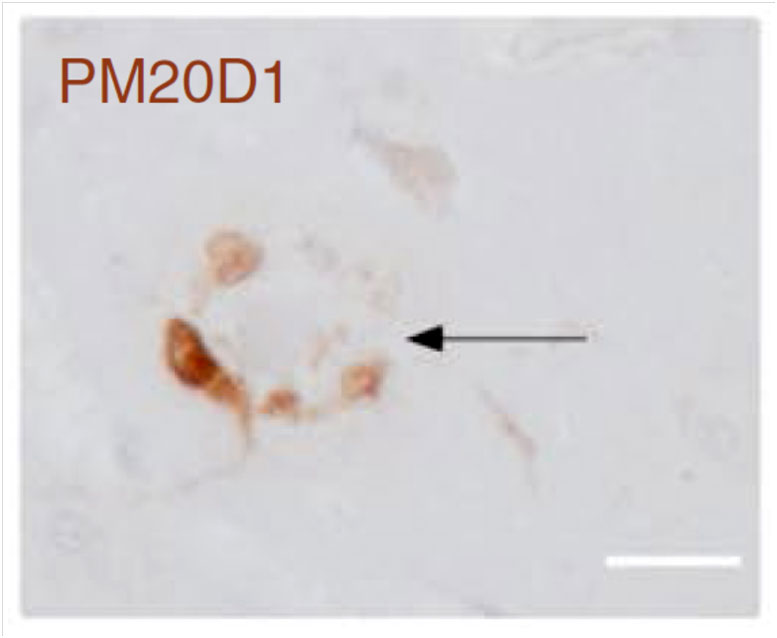
    Example of cells of a patient with advanced Alzheimer affected by the alteration of the PM20D1 gene. IDIBELL

    An article published in Nature Medicine with the collaboration of the research group of Dr. Manel Esteller, director of the Epigenetics and Cancer Biology Program of the Bellvitge Biomedical Research Institute (IDIBELL), ICREA Researcher and Professor of Genetics of the University of Barcelona, and Drs. Dave Monk and Isidre Ferrer, from the same center, shows that the inheritance of small changes in DNA alters the expression of the PM20D1 gene and is associated with an increased risk of developing Alzheimer’s disease.

    “Over the last seven years, we have created a detailed map of the epigenetic alterations that occur in the brain of people affected by Alzheimer’s and other dementias such as those associated with the so-called Lewy bodies or Parkinson’s disease. That allowed us to collaborate with Dr. Johannes Gräff’s group in Lausanne, who noticed how one of the molecular lesions we had discovered was caused by inheriting a variation in the DNA sequence” – states Dr. Manel Esteller, co-author of the Nature Medicine study.

    “This variation is associated with the loss of activity of a neuroprotective gene called PM20D1; whoever possesses the variation has a greater probability of suffering from Alzheimer’s disease, so people carrying these variants could be excellent candidates for clinical prevention trials of the disease in the future” – adds the IDIBELL researcher.

    “The results obtained demonstrate the need for international scientific collaboration, mixing the different areas of experience in epigenetics, genetics, bioinformatics, and neurosciences of each group. We are looking at an example of the usefulness of multidisciplinary research to tackle diseases as complex and devastating as dementia,” concludes Esteller.

    Alzheimer’s disease is a neurodegenerative pathology increasingly frequent due to the progressive aging of the population in Western countries. There are no effective treatments for its cure and only certain drugs are able to relatively slow the progression of the disease if they are administered in the early stages. Beyond advanced age, the factors that cause it are unknown. The hereditary factor associated with high risk constitutes a minimum proportion of cases, but there appears to be a certain aggregation of cases in the same family higher than what would be expected by chance.

    Reference: “PM20D1 is a quantitative trait locus associated with Alzheimer’s disease” by Jose V. Sanchez-Mut, Holger Heyn, Bianca A. Silva, Lucie Dixsaut, Paula Garcia-Esparcia, Enrique Vidal, Sergi Sayols, Liliane Glauser, Ana Monteagudo-Sánchez, Jordi Perez-Tur, Isidre Ferrer, David Monk, Bernard Schneider, Manel Esteller and Johannes Gräff, 7 May 2018, Nature Medicine.
    DOI: 10.1038/s41591-018-0013-y

    Never miss a breakthrough: Join the SciTechDaily newsletter.
    Follow us on Google and Google News.

    Alzheimer's Disease Disease Epigenetics Genetics Medicine
    Share. Facebook Twitter Pinterest LinkedIn Email Reddit

    Related Articles

    New Test for Alzheimer’s Disease Directly Measures Synaptic Loss

    Neuroscientists Link APOE4 Gene to Alzheimer’s

    Scientists Discover Gene Function Linked to Familial ALS

    Boosting TREM2 Protein Levels Improves Alzheimer’s Symptoms

    Scientists Reveal How Mutations in Genes Give Rise to Face-Specific Birth Defects

    Researchers Identify Role of Mesp1 Gene in Cardiovascular Lineage Segregation

    New Approach Identifies Genetic Markers Linked to Complex Diseases

    New Epigenetic Algorithm Accurately Predicts Male Sexual Orientation

    ML-SA1 Increases Trafficking and Reduces Lysosome Storage

    Leave A Reply Cancel Reply

    • Facebook
    • Twitter
    • Pinterest
    • YouTube

    Don't Miss a Discovery

    Subscribe for the Latest in Science & Tech!

    Trending News

    This Deadly Disease Was Wiping Out Humans 5,500 Years Ago

    Beyond DNA: Scientists Discover Inheritance That Breaks the Rules of Genetics

    Scientists Just Discovered the Eye Defies a Long-Held Rule of Vision

    What if Time Isn’t Fundamental? Physicists Just Tested the Idea in the Lab

    Scientists Say We’ve Been Wrong About the Aging Brain

    68 Quadrillion Miles: Scientists Map Earth’s Vast Hidden Fungal Network for the First Time

    Hidden Damage From Youth May Explode Into Disease Later in Life

    Climate Models May Be Wrong About How Trees Store Carbon

    Follow SciTechDaily
    • Facebook
    • Twitter
    • YouTube
    • Pinterest
    • Newsletter
    • RSS
    SciTech News
    • Biology News
    • Chemistry News
    • Earth News
    • Health News
    • Physics News
    • Science News
    • Space News
    • Technology News
    Recent Posts
    • Scientists Rediscover Rare Island Fox Not Seen for More Than 20 Years
    • The Amazon’s Mysterious “Ghost Dog” Has Been Hiding a Big Secret
    • Scientists Say Frequent Ejaculation May Improve Sperm Quality and Fertility
    • Antarctica’s Future May Be More Predictable Than Scientists Thought
    • Sea Level Rise Is Swallowing Farmland at Alarming Rates
    Copyright © 1998 - 2026 SciTechDaily. All Rights Reserved.
    • Science News
    • About
    • Contact
    • Editorial Board
    • Privacy Policy
    • Terms of Use

    Type above and press Enter to search. Press Esc to cancel.