

Close Menu
    Facebook X (Twitter) Instagram
    SciTechDaily
    • Biology
    • Chemistry
    • Earth
    • Health
    • Physics
    • Science
    • Space
    • Technology
    Facebook X (Twitter) Pinterest YouTube RSS
    SciTechDaily
    Home»Physics»Scientists Unlock a New Way To Photograph Events That Vanish in Trillionths of a Second
    Physics

    Scientists Unlock a New Way To Photograph Events That Vanish in Trillionths of a Second

    By University of TokyoNovember 15, 2026No Comments4 Mins Read
    Facebook Twitter Pinterest Telegram LinkedIn WhatsApp Email Reddit
    Share
    Facebook Twitter LinkedIn Pinterest Telegram Email Reddit
    Concept of Logarithmic Ultrafast Photography Across Multiple Timescales
    Instead of recording images at equal time intervals, the logarithmic ultrafast photography method places frames more closely at early times and farther apart at later times. This allows a limited number of frames to connect ultrafast dynamics across approximately five orders of magnitude in time. Credit: Keitaro Shimada et al./The University of Tokyo

    Eleven carefully timed images can connect the early and later stages of an ultrafast event, offering scientists a way to investigate fleeting processes that are difficult to repeat.

    A limited set of images can leave gaps in a laser pulse or shock wave’s story. Its first moments and later development may unfold on very different timescales, so taking snapshots at regular intervals can miss changes that connect one stage to the next.

    Conventional imaging methods operate on microsecond, or millionth-of-a-second, and millisecond, or thousandth-of-a-second, timescales, usually capturing images at evenly or nearly evenly spaced intervals. Single-shot ultrafast imaging typically uses a uniform interval within a selected time window. With only a finite number of frames available, that choice can favor a detailed view of one brief stage over a record of the broader process.
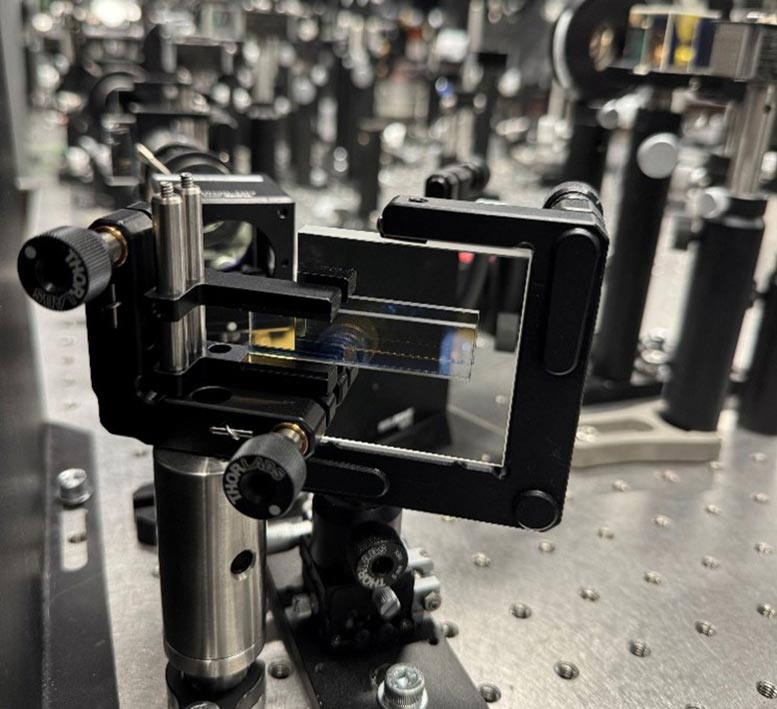
    Optical Setup for Ultrafast Single Shot Imaging
    This experimental optical setup captures ultrafast dynamics across widely different timescales and records multiple moments of a rapidly changing event in a single shot by carefully controlling the timing of ultrashort light pulses. Credit: Keitaro Shimada et al./The University of Tokyo

    Connecting the stages of ultrafast events

    A team led by Keiichi Nakagawa, an associate professor in the Department of Bioengineering at the University of Tokyo, developed an approach that gives researchers more control over where those frames fall. Called logarithmic ultrafast photography, it distributes a fixed number of images across time, concentrating them around moments when characteristic changes occur.

    “We wanted to find a way to connect these very different timescales in a single measurement. In other words, we wanted to see both the first instance and what follows, without having to choose one or the other,” said Keitaro Shimada, a postdoctoral researcher in the Nakagawa Group and lead author of the study.

    The team implemented the approach in sequentially timed all-optical mapping photography, or STAMP, a technique that combines ultrafast imaging with high image quality. To adjust the timing, they used band-resolved individual delay generation, or BRIDGE. It extracts wavelength bands, which are portions of the light spectrum, in sequence and allows their timing to be adjusted independently. Each band remains linked to a specific instant in the process being recorded.
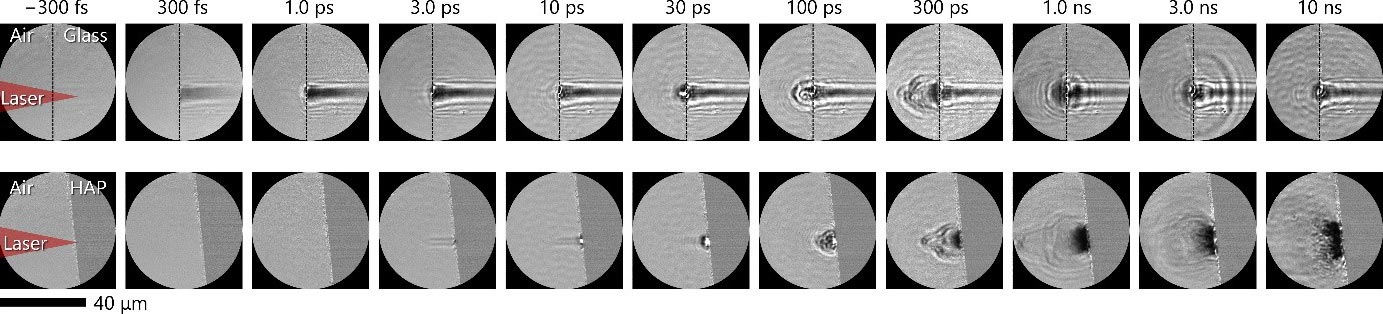
    Single Shot Images of Laser Induced Material Changes
    The single-shot image sequences show how glass (top) and hydroxyapatite (HAP), a major mineral component of bone and teeth (bottom), respond after irradiation with an ultrashort laser pulse. Eleven frames connect the earliest changes after laser irradiation with later shock waves and material ejection over timescales from femtoseconds to nanoseconds. Credit: Keitaro Shimada et al./The University of Tokyo

    That control lets researchers place frames at selected moments on timescales ranging from femtoseconds, or quadrillionths of a second, to nanoseconds, or billionths of a second. Instead of maintaining a regular interval, they can customize the gaps between images to resolve rapid changes and follow subsequent stages within the same recording.

    The technique can capture key moments with 11 frames spanning five orders of magnitude in time, a 100,000-fold range. The report also describes this as equivalent to an approximately 260-frames-per-second exposure, although it does not explain the basis for that comparison.

    Connecting stages without repeating the experiment

    “We are particularly interested in phenomena that are difficult to reproduce exactly. In those cases, recording the early and later stages of the same event can reveal relationships that might be lost when a sequence is reconstructed from separate experiments,” said Nakagawa, a co-author and principal investigator of the study.

    The researchers’ targets include short-lived phenomena whose peaks are difficult to catch and connections between phases of a physical process that have remained unseen because they occur on different timescales. They propose using the technique in laser processing, material dynamics, plasma and shock-wave research, and biomedical applications.

    Reference: “Logarithmic ultrafast photography with band-resolved individual delay generation” by 19 October 2026, Optica.
    DOI: 10.1364/OPTICA.610944

    Funding: Japan Science and Technology Agency (JPMJAX22K8); Ministry of Education, Culture, Sports, Science and Technology (JPMXS0118067246)

    Never miss a breakthrough: Join the SciTechDaily newsletter.
    Follow us on Google and Google News.

    Imaging Lasers Optics Photonics University of Tokyo
    Share. Facebook Twitter Pinterest LinkedIn Email Reddit

    Related Articles

    Revolutionary Imaging Technique Unlocks Secrets of Matter at Extreme Speeds

    Next-Gen Spectroscopy: New Tunable Laser Method Achieves Unprecedented Precision

    Beyond the Limits: The Surprising Power of Water in Laser Development

    Ultrafast Electronic Characterization of Proteins and Materials

    Advancing Optical Signal Processing: Using Magnets To Toggle Nanolasers Leads to Better Photonics

    Free Electron Laser Insight: Fundamental Process of Free Electron Lasing Revealed

    Nanostructures Enable Record High-Harmonic Generation From Ultra-Intense Laser Pulses

    A New Way To Observe Laser Interactions Could Improve Laser-Based Manufacturing

    High-Speed Atomic Video: Single Molecules Captured at a Staggering 1,600 Frames per Second

    Leave A Reply Cancel Reply

    • Facebook
    • Twitter
    • Pinterest
    • YouTube

    Don't Miss a Discovery

    Subscribe for the Latest in Science & Tech!

    Trending News

    Ancient Tomb Reveals That People Were Getting High on Cannabis 2,800 Years Ago

    Scientists Discover New Form of Prostate Cancer

    Mars May Not Be Dead After All, New Discovery Suggests

    A Tiny Region Deep Inside Your Brain Helps Decide What You Remember

    Scientists Develop a Groundbreaking Rechargeable Battery That Runs on Vitamin B12

    Scientists Discover a Hidden Immune System Difference That Could Explain Why Obesity Affects Men and Women Differently

    More Than a Billion Years of Earth’s History Is Missing – Scientists May Finally Know Why

    Popular Weight-Loss Drugs May Have a Surprising Effect on Your Brain

    Follow SciTechDaily
    • Facebook
    • Twitter
    • YouTube
    • Pinterest
    • Newsletter
    • RSS
    SciTech News
    • Biology News
    • Chemistry News
    • Earth News
    • Health News
    • Physics News
    • Science News
    • Space News
    • Technology News
    Recent Posts
    • Scientists Unlock a New Way To Photograph Events That Vanish in Trillionths of a Second
    • A 120-Year-Old Gap in Einstein’s Physics May Hold the Key to the Universe’s Earliest Matter
    • Scientists Discover That Immune Cells May Be Secretly Helping Pancreatic Cancer Hide
    • Why Do We Feel Colder As We Get Older? New Study Uncovers a Hidden Mechanism
    • Alzheimer’s Breakthrough Reveals What Happens When the Brain’s Cleaning System Fails
    Copyright © 1998 - 2026 SciTechDaily. All Rights Reserved.
    • Science News
    • About
    • Contact
    • Editorial Board
    • Privacy Policy
    • Terms of Use

    Type above and press Enter to search. Press Esc to cancel.