
Close Menu
    Facebook X (Twitter) Instagram
    SciTechDaily
    • Biology
    • Chemistry
    • Earth
    • Health
    • Physics
    • Science
    • Space
    • Technology
    Facebook X (Twitter) Pinterest YouTube RSS
    SciTechDaily
    Home»Physics»A New Way To Observe Laser Interactions Could Improve Laser-Based Manufacturing
    Physics

    A New Way To Observe Laser Interactions Could Improve Laser-Based Manufacturing

    By University of TokyoMarch 29, 2021No Comments4 Mins Read
    Facebook Twitter Pinterest Telegram LinkedIn WhatsApp Email Reddit
    Share
    Facebook Twitter LinkedIn Pinterest Telegram Email Reddit
    Laser Measuring Holes
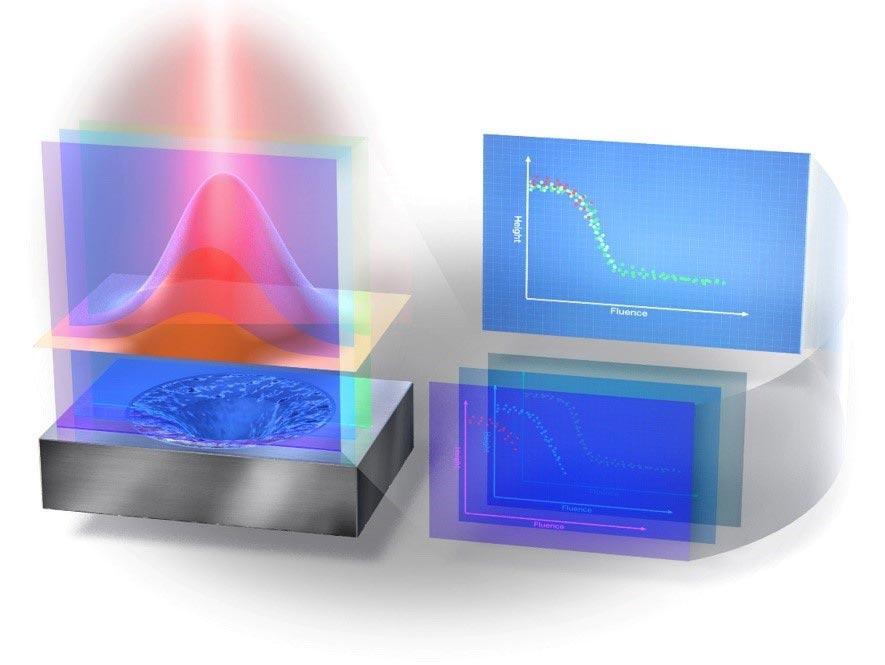
    (Lower left) The laser makes a hole in a material. (Upper left) The fluence of the laser is measured. (Lower right) Measurements of the fluence and the hole depth are superimposed. (Upper right) The relationship between these measurements is then determined so that hole depth can be calculated based solely on the fluence. Credit: © 2021 Sakurai et al.

    Raspberry Pi-powered breakthrough enables ultra-precise laser cutting with just one measurement.

    Despite the enormous amount of research over the decades into lasers and their applications, there have been few ways to accurately, efficiently, and directly observe fine details of their interactions with materials. For the first time, researchers have found a way to acquire such data from a production laser using low-cost equipment that could vastly improve the accuracy of items cut or etched with lasers. Given the ubiquity of lasers, this could have wide-ranging implications in laboratory, commercial, and industrial applications.

    Lasers are used in an extraordinarily wide range of applications in the modern world. One area in particular that is increasingly important is in manufacturing, the reason being the level of precision at which a laser can operate is far greater than that of the equivalent physical tool. However, this level of precision could be even higher in theory, leading to a new generation of yet unimagined technologies. There are some hurdles to overcome, though. One significant way in which laser precision could be improved is if there was a better means to obtain feedback on the way the laser interacts with a material. That way, there would be greater control and less uncertainty in the cutting and etching actions of a production laser. This problem has proven surprisingly difficult to tackle until now.

    “To measure how far into a surface a laser has cut often requires tens or hundreds of depth readings to take place. This is a substantial barrier for fast, automated laser-based production systems,” said Professor Junji Yumoto from the Department of Physics at the University of Tokyo. “So we have devised a new way to determine and predict the depth of a hole produced by laser pulses based on a single observation rather than tens or hundreds. This finding is an important step forward in improving the controllability of laser processing.”

    A New Solution Using Simple Tools

    Yumoto and his team wondered how to determine the depth of a laser hole using the minimal amount of information possible. This led them to look at what is known as the fluence of a laser pulse, which is the optical energy the pulse delivers over a given area. Until recently, expensive imaging apparatus would have been required to observe this fluence, and this usually lacked sufficient resolution. But thanks to developments in other areas of electronics and optics, a relatively simple Raspberry Pi Camera Version 2 proved ample for the job.

    As their test laser apparatus made a hole on sapphire, the camera recorded directly the fluence distribution of a laser pulse. Then a laser microscope measured the hole shape. By superimposing these two results and using some modern numerical methods, the team produced a large and reliable data set that could accurately tell you the relation between fluence and hole depth.

    “This would be correspondent with the extraction of about 250,000 data points from a single measurement,” said Yumoto. “Our new method could efficiently provide big data for machine learning and new numerical simulation methods to improve the accuracy and controllability of laser processing for manufacturing.”

    Reference: “Direct correlation of local fluence to single-pulse ultrashort laser to ablated morphology” by Haruyuki Sakurai, Kuniaki Konishi, Hiroharu Tamaru, Junji Yumoto and Makoto Kuwata-Gonokami, 29 March 2021, Communications Materials.
    DOI: 10.1038/s43246-021-00138-x

    Never miss a breakthrough: Join the SciTechDaily newsletter.
    Follow us on Google and Google News.

    Electrical Engineering Lasers Optics University of Tokyo
    Share. Facebook Twitter Pinterest LinkedIn Email Reddit

    Related Articles

    Solid-State Laser Refrigeration of Nanoscale Sensors Achieved – Could Revolutionize Bio-Imaging and Quantum Communication

    Record-Breaking Terahertz Laser Beam Turns Air Into Glowing Plasma

    Terahertz Laser May Enable “T-Ray Vision” – High Resolution Images & Far Safer Than X-Rays

    Milestone in Ultrashort-Pulse Laser Oscillators Paves Way to Even More Powerful Lasers

    New Method for Detecting the Invisible Properties of Nano-Structured Light Fields

    New Hunt for Dark Matter – This Time With Lasers

    Newly Discovered Property of Cadmium Could Lead to the Most Accurate Clock Ever

    Researchers Use Light to Control High-Speed Chemical Reactions in a New Way

    Fastest Laser Blast – 67 Quintillionths of a Second

    Leave A Reply Cancel Reply

    • Facebook
    • Twitter
    • Pinterest
    • YouTube

    Don't Miss a Discovery

    Subscribe for the Latest in Science & Tech!

    Trending News

    Popular Sugar-Free Sweetener Linked to Liver Disease, Study Warns

    What Is Hantavirus? The Deadly Disease Raising Alarm Worldwide

    Scientists Just Discovered How the Universe Builds Monster Black Holes

    Scientists Unveil New Treatment Strategy That Could Outsmart Cancer

    A Simple Vitamin May Hold the Key to Treating Rare Genetic Diseases

    Scientists Think the Real Fountain of Youth May Be Hiding in Your Gut

    Ravens Don’t Follow Wolves, They Predict Them

    This Common Knee Surgery May Be Doing More Harm Than Good

    Follow SciTechDaily
    • Facebook
    • Twitter
    • YouTube
    • Pinterest
    • Newsletter
    • RSS
    SciTech News
    • Biology News
    • Chemistry News
    • Earth News
    • Health News
    • Physics News
    • Science News
    • Space News
    • Technology News
    Recent Posts
    • Why Are So Many New Fathers Dying? Scientists Say the U.S. Has a Dangerous Blind Spot
    • Scientists Identify Simple Supplement That Greatly Reduces Alzheimer’s Damage
    • You May Have a Dangerous Type of Cholesterol Even if Your Tests Look Normal
    • Study Reveals Dangerous Flaw in AI Symptom Checkers
    • New MRI Breakthrough Captures Stunningly Clear Images of the Eye and Brain
    Copyright © 1998 - 2026 SciTechDaily. All Rights Reserved.
    • Science News
    • About
    • Contact
    • Editorial Board
    • Privacy Policy
    • Terms of Use

    Type above and press Enter to search. Press Esc to cancel.