
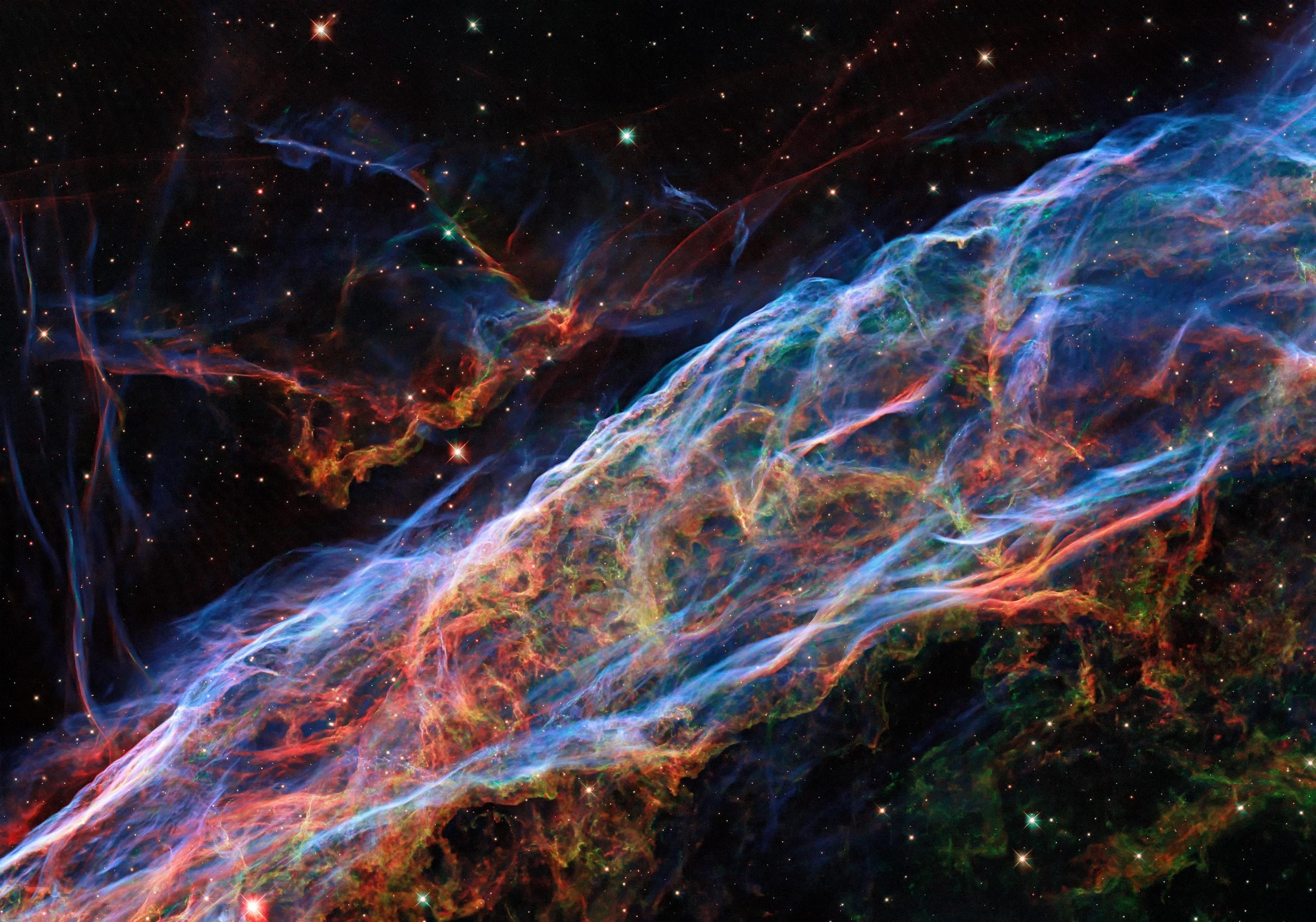
New Hubble imaging highlights the Veil Nebula’s detailed gas filaments, remnants of a 10,000-year-old supernova.
This Hubble Picture of the Week revisits the Veil Nebula, a popular subject for Hubble images! This object was featured in a previous Hubble photo release, but now new processing techniques have been applied, bringing out fine details of the nebula’s delicate threads and filaments of ionized gas.
To create this colorful image, observations taken by Hubble’s Wide Field Camera 3 instrument through 5 different filters were used. The new post-processing methods have further enhanced details of emissions from doubly ionized oxygen (seen here in blues), ionized hydrogen, and ionized nitrogen (seen here in reds).
The Veil Nebula lies around 2100 light-years from Earth in the constellation of Cygnus (The Swan), making it a relatively close neighbor in astronomical terms. Only a small portion of the nebula was captured in this image.
The Veil Nebula is the visible portion of the nearby Cygnus Loop, a supernova remnant formed roughly 10,000 years ago by the death of a massive star. The Veil Nebula’s progenitor star — which was 20 times the mass of the Sun — lived fast and died young, ending its life in a cataclysmic release of energy. Despite this stellar violence, the shockwaves and debris from the supernova sculpted the Veil Nebula’s delicate tracery of ionized gas — creating a scene of surprising astronomical beauty.
Never miss a breakthrough: Join the SciTechDaily newsletter.
Follow us on Google and Google News.
5 Comments
… spectacular, indeed …
One day world sciencist Will only mention “a”.for more than 10 lightsyears away and “c” for les thans 10.lightyears away
Thank you for your stunning and mindblowing pictures of the Cosmos.We are so luckyto be living at a time when technology
is moving at such a pace allowing us to see these marvels.
I wonder what we will be seeing in10,20or 30 years from now. The mind boggles !!!
Not!
I actually going to block this website I think because it’s so f(ing) irritating that you post a picture but then you don’t link directly to the page that actually has like the full resolution one on it or to the NASA article, you just link to other articles you’ve copied and pasted from their page or shat out with an LLM
And if you are linking it which I feel like I’ve clicked one before that did take me to the website but it is way too obfuscated and it’s really annoying and scummy and stupid