
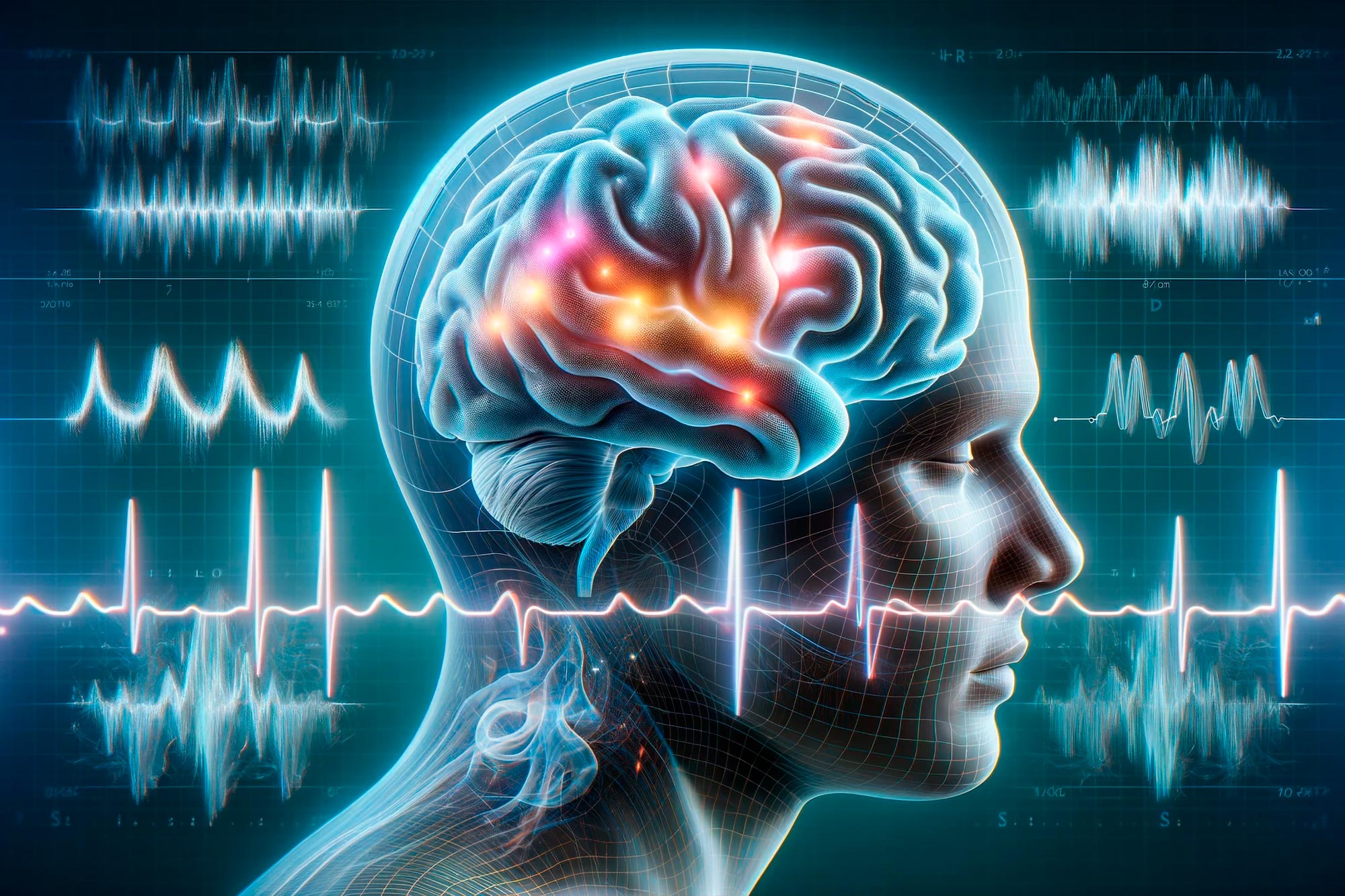
UCL researchers find that slow brain waves, common in sleep, also occur in awake epilepsy patients, protecting against seizures but affecting memory, hinting at new epilepsy treatments.
Slow waves that usually only occur in the brain during sleep are also present during wakefulness in people with epilepsy and may protect against increased brain excitability associated with the condition, finds a new study led by researchers at University College London (UCL).
Methodology and Findings
The research, published today (November 30) in the journal Nature Communications and involving the National Institute for Health and Care Research (NIHR) UCLH Biomedical Research Centre, examined electroencephalogram (EEG) scans from electrodes in the brains of 25 patients with focal epilepsy (a type of epilepsy characterized by seizures arising from a specific part of the brain), while they carried out an associative memory task.
The electrodes were placed in the patients’ brains to localize abnormal activity and inform surgical treatment.
During the task, participants were presented with 27 pairs of images that remained on a screen for six seconds. The images were in nine groups of three – each group featuring a picture of a person, a place, and an object. In each case, participants had to remember which images had been grouped together. EEG data were recorded continuously throughout the task.
After reviewing the EEG data, the team found that the brains of people with epilepsy were producing slow waves – lasting less than one second – while they were awake and taking part in the task.
The occurrence of these “wake” slow waves increased in line with increases in brain excitability and decreased the impact of epileptic spikes on brain activity.
In particular, there was a decrease in the “firing” of nerve cells, which the researchers say could protect against epileptic activity.
Implications and Future Research
Senior author, Professor Matthew Walker (UCL Queen Square Institute of Neurology), said: “Sleep is crucial for repair, maintenance and resetting brain activity. When we are awake we experience a progressive increase in brain excitability, which is redressed during sleep.
“Recent studies have indicated that a specific form of brain activity, slow waves during sleep, play a crucial role in these restorative functions. We wanted to address whether these ‘sleep’ slow waves could occur during wakefulness in response to abnormal increases in brain activity associated with epilepsy.
“This study unveils, for the first time, a potential protective mechanism, ‘wake’ slow waves, employed by the brain to counteract epileptic activity. This mechanism takes advantage of protective brain activity that normally occurs during sleep, but, in people with epilepsy, can occur during wakefulness.”
As part of the research, the team also wanted to test if the occurrence of “wake” slow waves had any negative effects on cognitive function.
During the memory task, researchers found that the “wake” slow waves reduced nerve cell activity and so affected cognitive performance – increasing the length of time required by patients to complete the task.
The team reported that for each increase of one slow wave per second, the reaction time increased by 0.56 seconds.
Professor Walker said: “This observation suggests that the cognitive difficulties – in particularly, memory deficits – experienced by individuals with epilepsy may be attributed, in part, to the brief impairments induced by these slow waves.”
The team hopes that future studies will be able to increase such activity as a potential novel treatment for people with epilepsy.
Lead author, Dr. Laurent Sheybani (UCL Queen Square Institute of Neurology), said: “The parallel between the function of slow waves during sleep and, here, their beneficial impact in a pathological condition, is particularly interesting.
“Our study suggests that a naturally occurring activity is employed by the brain to offset pathological activities; however, this comes with a price, since ‘wake’ slow waves are shown to impact on memory performance.
“From a purely neurobiological perspective, the research also reinforces the idea that sleep activity can happen in specific areas of the brain, rather than occurring evenly throughout the brain.”
Reference: “Wake slow waves in focal human epilepsy impact network activity and cognition” by Laurent Sheybani, Umesh Vivekananda, Roman Rodionov, Beate Diehl, Fahmida A. Chowdhury, Andrew W. McEvoy, Anna Miserocchi, James A. Bisby, Daniel Bush, Neil Burgess and Matthew C. Walker, 29 November 2023, Nature Communications.
DOI: 10.1038/s41467-023-42971-3
The research was funded by the Medical Research Council, Wellcome, UCLH Biomedical Research Centre, and The Swiss National Science Foundation.
Never miss a breakthrough: Join the SciTechDaily newsletter.
Follow us on Google and Google News.