
Close Menu
    Facebook X (Twitter) Instagram
    SciTechDaily
    • Biology
    • Chemistry
    • Earth
    • Health
    • Physics
    • Science
    • Space
    • Technology
    Facebook X (Twitter) Pinterest YouTube RSS
    SciTechDaily
    Home»Health»Neuroscientists Find Long COVID Smell Loss Linked to Changes in the Brain
    Health

    Neuroscientists Find Long COVID Smell Loss Linked to Changes in the Brain

    By University College LondonApril 17, 20232 Comments4 Mins Read
    Facebook Twitter Pinterest Telegram LinkedIn WhatsApp Email Reddit
    Share
    Facebook Twitter LinkedIn Pinterest Telegram Email Reddit
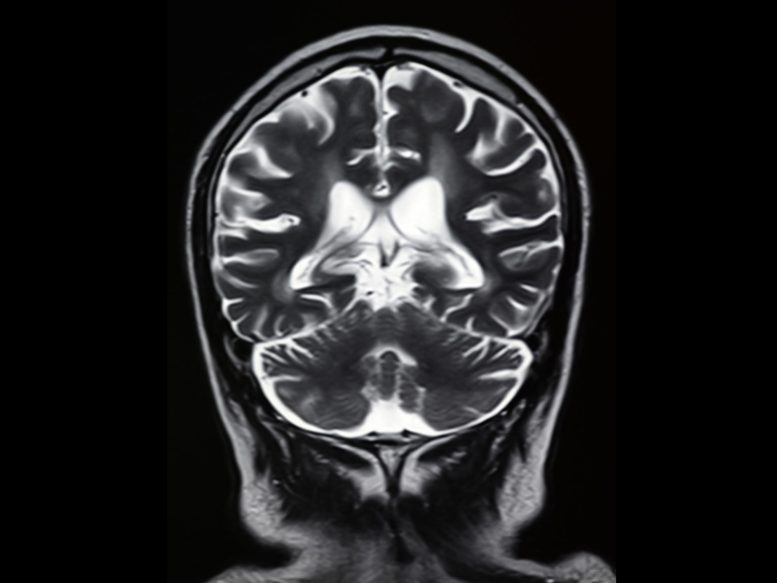
    Front Brain Scan MRI Image
    A recent study led by UCL researchers has found that people living with long COVID and experiencing anosmia (loss of smell) show different brain activity patterns compared to those who have recovered their sense of smell or never had COVID-19. The observational study used MRI scans and discovered reduced brain activity and impaired communication between the orbitofrontal cortex and the pre-frontal cortex in people with long COVID anosmia. This connection was not impaired in those who had regained their sense of smell after COVID. The findings suggest that long COVID anosmia may be linked to a change in the brain that prevents smells from being processed properly, but since it is clinically reversible, olfactory training might help the brain recover this sense. The study also found that the brains of people with long Covid anosmia may be compensating by boosting connections with other sensory regions.

    A UCL study links long COVID smell loss to reduced brain connectivity in smell-processing regions and suggests the potential for recovery through brain retraining.

    People living with long COVID who suffer from loss of smell show different patterns of activity in certain regions of the brain, a new study led by University College London (UCL) researchers has found.

    The research used MRI scanning to compare the brain activity of people with long COVID who lost their sense of smell, those whose smell had returned to normal after COVID infection, and people who had never tested positive for COVID-19.

    Published in the journal eClinicalMedicine, the observational study found that people with long COVID smell loss had reduced brain activity and impaired communication between two parts of the brain that process important smell information: the orbitofrontal cortex and the pre-frontal cortex. This connection was not impaired in people who had regained their sense of smell after COVID.

    Potential for Smell Recovery Through Brain Retraining

    The findings suggest smell loss, known as anosmia, caused by long COVID is linked to a change in the brain that stops smells from being processed properly. Because it’s clinically reversible, as shown in some subjects, it may be possible to retrain the brain to recover its sense of smell in people suffering the side effects of long COVID.

    Dr. Jed Wingrove (UCL Department of Medicine) the lead author of the study, said: “Persistent loss of smell is just one way long COVID is still impacting people’s quality of life – smell is something we take for granted, but it guides us in lots of ways and is closely tied to our overall wellbeing. Our study gives reassurance that, for the majority of people whose sense of smell comes back, there are no permanent changes to brain activity.”

    Joint senior author, Professor Claudia Wheeler-Kingshott (UCL Queen Square Institute of Neurology), said: “Our findings highlight the impact COVID-19 is having on brain function. They raise the intriguing possibility that olfactory training – that is, retraining the brain to process different scents – could help the brain to recover lost pathways, and help people with long COVID recover their sense of smell.”

    Researchers say their findings also suggest that the brains of people with long COVID smell loss might be compensating for this lost sense by boosting connections with other sensory regions: their brains had increased activity between the parts of the brain that process smell and areas that process sight (the visual cortex).

    “This tells us that the neurons that would normally process smell are still there, but they’re just working in a different way,” said Dr. Wingrove.

    Professor Rachel Batterham (UCL Division of Medicine), also joint senior author of the study said: “This is the first study to our knowledge that looks at how brain activity changes in people with long COVID smell loss. It builds on the work we undertook during the first wave of the pandemic, which was one of the first to describe the link between COVID-19 infection with both loss of smell and taste.”

    Reference: “Aberrant olfactory network functional connectivity in people with olfactory dysfunction following COVID-19 infection: an exploratory, observational study” by Jed Wingrove, Janine Makaronidis, Ferran Prados, Baris Kanber, Marios C. Yiannakas, Cormac Magee, Gloria Castellazzi, Louis Grandjean, Xavier Golay, Carmen Tur, Olga Ciccarelli, Egidio D’Angelo, Claudia A.M. Gandini Wheeler-Kingshott and Rachel L. Batterham, 2 March 2023, eClinicalMedicine.
    DOI: 10.1016/j.eclinm.2023.101883

    The study was funded by the National Institute for Health and Care Research (NIHR). 

    Never miss a breakthrough: Join the SciTechDaily newsletter.
    Follow us on Google and Google News.

    Brain COVID-19 Long COVID Neuroscience Popular University College London
    Share. Facebook Twitter Pinterest LinkedIn Email Reddit

    Related Articles

    Long COVID Breakthrough: Spike Proteins Persist in Brain for Years

    Leaky Blood Vessels: Underlying Cause of Long COVID “Brain Fog” Discovered

    Decoding Long COVID: NIH Study Exposes the Inner Workings of Neurological Symptoms

    New Side Effect of COVID-19 Discovered: “Face Blindness”

    Significant Post-COVID Brain Abnormalities Revealed by Special MRI

    COVID-19 Infections Increase Risk of Long-Term Brain Problems: Strokes, Depression, Anxiety, Migraines

    Even Mild COVID Can Cause Brain Shrinkage and Disrupt Mental Function

    Alzheimer’s Disease and COVID-19 Share a Genetic Risk Factor

    Neurologist Explores Link Between COVID and “Brain Fog,” Memory Loss and Dementia

    2 Comments

    1. michael on April 18, 2023 7:20 pm

      Did they compare this phenomenon among so-called long covid patients with a control group of “vaccinated” individuals? Of course not, despite the fact that research has shown the jabs can sometimes cause a loss of smell.

      Reply
    2. Manije Kashian on April 22, 2023 8:57 am

      I got corona two years ago and lost my sense of smell. If possible, help me. What should I do to return my sense of smell? Please guide me.

      Reply
    Leave A Reply Cancel Reply

    • Facebook
    • Twitter
    • Pinterest
    • YouTube

    Don't Miss a Discovery

    Subscribe for the Latest in Science & Tech!

    Trending News

    Largest-Ever Study Finds Medicinal Cannabis Ineffective for Anxiety, Depression, PTSD

    250-Million-Year-Old Egg Solves One of Evolution’s Biggest Mysteries

    Living With Roommates Might Be Changing Your Gut Microbiome Without You Knowing

    Century-Old Cleaning Chemical Linked to 500% Increased Risk of Parkinson’s Disease

    What if Your Memories Never Happened? Physicists Take a New Look at the Boltzmann Brain Paradox

    One of the Universe’s Largest Stars May Be Getting Ready To Explode

    Scientists Discover Enzyme That Could Supercharge Ozempic-Like Weight Loss Drugs

    Popular Sweetener Linked to DNA Damage – “It’s Something You Should Not Be Eating”

    Follow SciTechDaily
    • Facebook
    • Twitter
    • YouTube
    • Pinterest
    • Newsletter
    • RSS
    SciTech News
    • Biology News
    • Chemistry News
    • Earth News
    • Health News
    • Physics News
    • Science News
    • Space News
    • Technology News
    Recent Posts
    • Want Less Stress? Landmark Study Points to a Simple Habit
    • Scientists Reveal Eating Fruits and Vegetables May Increase Your Risk of Lung Cancer
    • AI Reveals Explosive Growth of Floating Algae Across the World’s Oceans
    • 5.5 Million Bees Discovered Living Beneath a New York Cemetery
    • Scientists Reverse Brain Aging With Simple Nasal Spray
    Copyright © 1998 - 2026 SciTechDaily. All Rights Reserved.
    • Science News
    • About
    • Contact
    • Editorial Board
    • Privacy Policy
    • Terms of Use

    Type above and press Enter to search. Press Esc to cancel.