

Researchers developed a nano-excitonic transistor, promising efficient, heat-free optical computing for AI-driven data processing.
What allows Ant-Man, a character in the Marvel movies, to generate such formidable energy out of his small body? The answer can be found in the transistors on his suit, which enhance weak signals for processing. Traditional transistors that amplify electrical signals often result in heat energy loss and slow down signal transfer, compromising performance. However, what if it were possible to create a high-performing suit that is both lightweight and compact without sacrificing heat energy?
A team of researchers from POSTECH, led by Professor Kyoung-Duck Park and Yeonjeong Koo from the Department of Physics, along with a team from ITMO University in Russia under the guidance of Professor Vasily Kravtsov, have collaborated to develop a “nano-excitonic transistor.” This innovative device utilizes intralayer and interlayer excitons in heterostructure-based semiconductors, addressing the limitations present in traditional transistors.
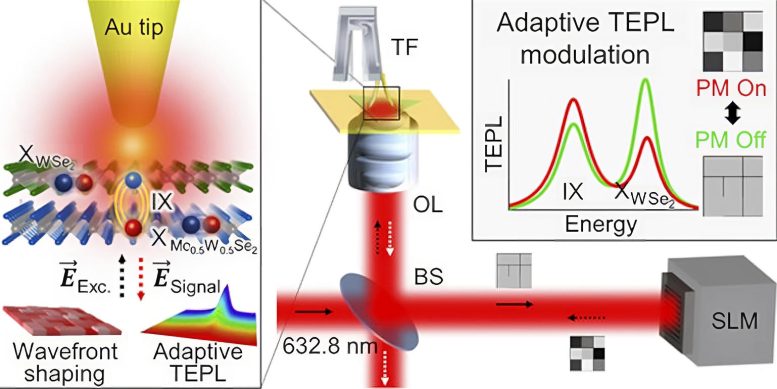
The Role of Excitons in Semiconductor Technology
“Excitons” are responsible for light emission of semiconductor materials and are key to developing a next-generation light-emitting element with less heat generation and a light source for quantum information technology due to the free conversion between light and material in their electrically neutral states. There are two types of excitons in a semiconductor heterobilayer, which is a stack of two different semiconductor monolayers: the intralayer excitons with horizontal direction and the interlayer excitons with vertical direction.
Optical signals emitted by the two excitons have different lights, durations, and coherence times. This means that selective control of the two optical signals could enable the development of a two-bit exciton transistor. However, it was challenging to control intra- and interlayer excitons in nano-scale spaces due to the non-homogeneity of semiconductor heterostructures and low luminous efficiency of interlayer excitons in addition to the diffraction limit of light.

Breakthrough in Exciton Control with Polarized Light
The team in its previous research had proposed technology for controlling excitons in nano-level spaces by pressing semiconductor materials with a nano-scale tip. This time, for the first time ever, the researchers were able to remotely control the density and luminance efficiency of excitons based on polarized light on the tip without directly touching the excitons. The most significant advantage of this method, which combines a photonic nanocavity and a spatial light modulator, is that it can reversibly control excitons, minimizing physical damage to the semiconductor material. Also, the nano-excitonic transistor that utilizes “light” can help process massive amounts of data at the speed of light while minimizing heat energy loss.
Artificial intelligence (AI) has made inroads into our lives more quickly than we ever expected, and it requires huge volumes of data for learning in order to provide good answers that are actually helpful for users. The ever-increasing volume of information should be collected and processed as more and more fields utilize AI. This research is expected to propose a new data processing strategy befitting an era of data explosion. Yeonjeong Koo, one of the co-first authors of the research paper, said, “The nano-excitonic transistor is expected to play an integral role in realizing an optical computer, which will help process the huge amounts of data driven by AI technology.
Reference: “Nanocavity-Integrated van der Waals Heterobilayers for Nano-excitonic Transistor” by Yeonjeong Koo, Hyeongwoo Lee, Tatiana Ivanova, Roman S. Savelev, Mihail I. Petrov, Vasily Kravtsov and Kyoung-Duck Park, 1 March 2023, ACS Nano.
DOI: 10.1021/acsnano.2c11509
The study was funded by the Samsung Science and Technology Foundation and the National Research Foundation of Korea.
Never miss a breakthrough: Join the SciTechDaily newsletter.
Follow us on Google and Google News.