
Close Menu
    Facebook X (Twitter) Instagram
    SciTechDaily
    • Biology
    • Chemistry
    • Earth
    • Health
    • Physics
    • Science
    • Space
    • Technology
    Facebook X (Twitter) Pinterest YouTube RSS
    SciTechDaily
    Home»Earth»Red Sea Rainforests: Coral Reef Ecosystems Thrive off the Coast of Saudi Arabia
    Earth

    Red Sea Rainforests: Coral Reef Ecosystems Thrive off the Coast of Saudi Arabia

    By NASA Earth ObservatoryMarch 29, 2021No Comments3 Mins Read
    Facebook Twitter Pinterest Telegram LinkedIn WhatsApp Email Reddit
    Share
    Facebook Twitter LinkedIn Pinterest Telegram Email Reddit
    Northwest Coastline of Saudi Arabia From ISS Annotated
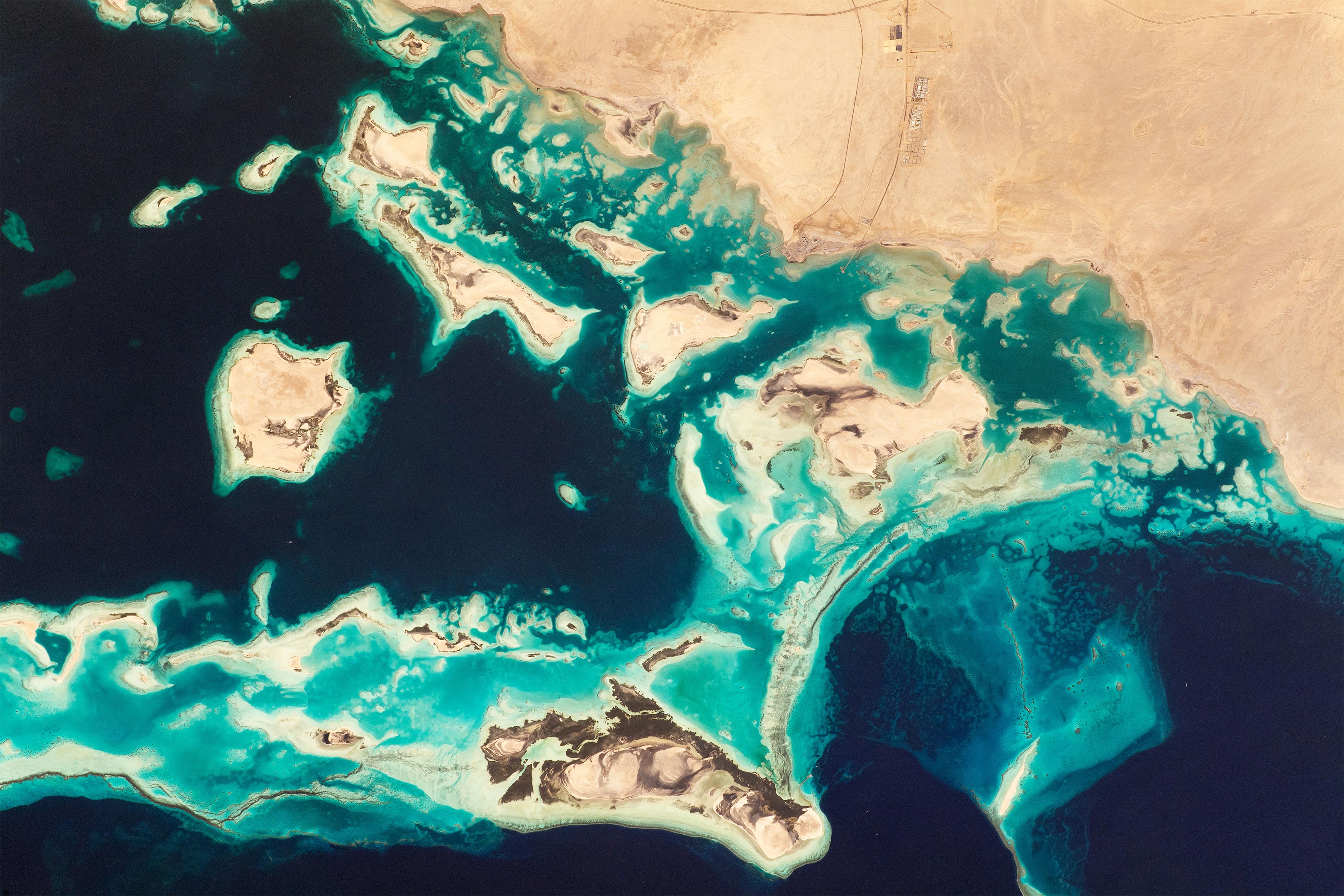
    Northwest coastline of Saudi Arabia from ISS, November 26, 2020

    Coral reefs off Saudi Arabia’s Red Sea coast, vividly captured from space, showcase stunning marine biodiversity. 

    Looking down from the International Space Station (ISS), an astronaut captured this view of the northwest coastline of Saudi Arabia, where up to 260 coral reef species thrive. The salty, warm waters off the coast of the Arabian Peninsula create an optimal environment for coral reefs to grow, mainly in shallow lagoons where the shoreline meets the Red Sea. The water transitions from bright turquoise in the lagoons to deep blue as depth increases.

    Fringing reefs, which start at the shore and grow toward the sea, line the northwestern Saudi Arabian coastline. Coral reef biodiversity increases to the south, where patch and barrier reefs combine with fringing reefs to form rich ecosystems. Coral reefs are known as “rainforests of the sea” for their biodiversity and their functionality in nature—providing a food source for other sea life and humans, while also protecting shorelines.

    With the human population growing on the arid Arabian Peninsula, there is increasing demand for a freshwater supply. That demand is often met by the use of desalination plants. Currently, the country is home to the world’s largest desalination plants, which produce freshwater and brine, a salty wastewater byproduct. Some brine flows back into the Red Sea and can decrease the dissolved oxygen in aquatic ecosystems. This is known as hypoxia, and it can pose a serious threat to coral reef ecosystems and biodiversity in the Red Sea.

    Astronaut photograph ISS064-E-6296 was acquired on November 26, 2020, with a Nikon D5 digital camera using a 400 millimeter lens and is provided by the ISS Crew Earth Observations Facility and the Earth Science and Remote Sensing Unit, Johnson Space Center. The image was taken by a member of the Expedition 64 crew. The image has been cropped and enhanced to improve contrast, and lens artifacts have been removed. The International Space Station Program supports the laboratory as part of the ISS National Lab to help astronauts take pictures of Earth that will be of the greatest value to scientists and the public, and to make those images freely available on the Internet. Additional images taken by astronauts and cosmonauts can be viewed at the NASA/JSC Gateway to Astronaut Photography of Earth. Caption by Amber Turner, Jacobs, JETS Contract at NASA-JSC.

    Never miss a breakthrough: Join the SciTechDaily newsletter.
    Follow us on Google and Google News.

    Geography International Space Station NASA NASA Earth Observatory Popular
    Share. Facebook Twitter Pinterest LinkedIn Email Reddit

    Related Articles

    Breathtaking Night Views From Space: Korea’s Stark Economic Divide

    NASA Picturing Earth: Behind the Scenes [Video]

    Ecologically Important El Bibane Lagoon Photographed by Astronaut Aboard the Space Station

    Huacachina: The Only Natural Oasis in South America

    NASA Picturing Earth: Astronaut Photography In Focus [Video]

    Coloring the Great Salt Lake – Astronaut Takes Beautiful Photograph From Space Station

    Aurora, Meet Airglow: Two of Earth’s Most Colorful Atmospheric Phenomena Meet in Stunning Photo From Space Station

    NASA Scientists Map Beirut Blast Damage – Devastating Explosion Rocked Port Area

    NASA Advanced Rapid Imaging Satellite Maps Blast Damage: Beirut Explosion Aftermath

    Leave A Reply Cancel Reply

    • Facebook
    • Twitter
    • Pinterest
    • YouTube

    Don't Miss a Discovery

    Subscribe for the Latest in Science & Tech!

    Trending News

    Long COVID Brain Scans Reveal Damage to Dopamine Neurons

    Scientists Warn a Silent Oxygen Crisis Is Spreading Through Earth’s Waters

    James Webb Telescope Discovers Hidden Giant Planet in Famous Star System

    Scientists Build the First 3D Cloak That Makes Objects Invisible To Heat

    Common Food Additive Linked To Gut Inflammation

    Black Hole Collisions May Follow a Surprisingly Simple Rule

    The Eye Has a Hidden Cleanup System and Scientists Just Discovered It

    The Truth About Vikings Is More Complicated Than Museums Admit

    Follow SciTechDaily
    • Facebook
    • Twitter
    • YouTube
    • Pinterest
    • Newsletter
    • RSS
    SciTech News
    • Biology News
    • Chemistry News
    • Earth News
    • Health News
    • Physics News
    • Science News
    • Space News
    • Technology News
    Recent Posts
    • “Zombie Cells” Reveal a Hidden Weakness That Could Help Fight Aging
    • A Fiber Frozen at -196°C Unlocks a New Way To Store Light
    • Scientists Solve a Decades-Old Mystery Inside Atomic Nuclei
    • Alien Signals May Be Hiding in a Radio Band SETI Has Barely Explored
    • Scientists Crack the Code for Making “Impossible” Nanocrystals
    Copyright © 1998 - 2026 SciTechDaily. All Rights Reserved.
    • Science News
    • About
    • Contact
    • Editorial Board
    • Privacy Policy
    • Terms of Use

    Type above and press Enter to search. Press Esc to cancel.