
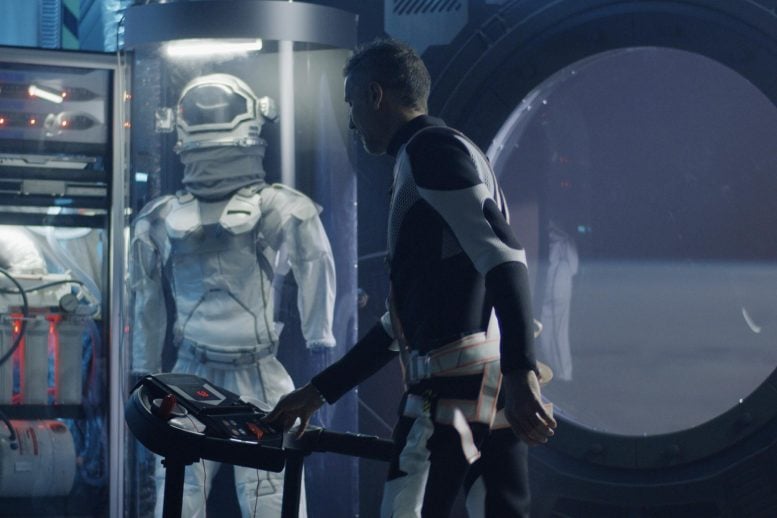
- Sustained low-intensity exercise does not completely counteract the effects of weightlessness on the heart muscle, which will atrophy over time in a gravity-free environment.
- Short bursts of repeated high-intensity activity during shorter space missions may be more successful in keeping the heart healthy.
As NASA seeks to build a lunar outpost, visit Mars and commercialize spaceflight, the long-term effects of weightlessness on the human heart are of critical importance, according to researchers. By analyzing data from astronaut Scott Kelly’s year in space and comparing it to information from extreme long-distance swimming, which simulates weightlessness, of Benoît Lecomte, researchers found that low-intensity exercise was not enough to counteract the effects of prolonged weightlessness on the heart, according to new research published today in the American Heart Association’s flagship journal Circulation.
Gravity’s Crucial Influence on Cardiac Health
Each time a person sits or stands, gravity draws blood into the legs. The work the heart does to keep blood flowing as it counters Earth’s gravity helps it maintain its size and function. Removing gravitational effects causes the heart to shrink.
Researchers examined data from retired astronaut Scott Kelly’s stint aboard the International Space Station from 2015 to 2016 and elite endurance swimmer Benoît Lecomte’s swim across the Pacific Ocean in 2018.
In this new study, researchers evaluated the effects of long-term weightlessness on the structure of the heart and to help understand whether extensive periods of low-intensity exercise can prevent the effects of weightlessness.
“The heart is remarkably plastic and especially responsive to gravity or its absence. Both the impact of gravity as well as the adaptive response to exercise play a role, and we were surprised that even extremely long periods of low-intensity exercise did not keep the heart muscle from shrinking,” said Benjamin D. Levine, M.D., the study’s senior author and a professor of internal medicine at UT Southwestern Medical Center and director of Texas Health Presbyterian’s Institute for Exercise and Environmental Medicine, both in Dallas.

The research team examined the health data of Kelly’s year in space aboard the International Space Station and Lecomte’s swim across the Pacific Ocean to investigate the impact of long-term weightlessness on the heart. Water immersion is an excellent model for weightlessness since water offsets gravity’s effects, especially in a prone swimmer, a specific swimming technique used by long-distance endurance swimmers.
Exercise Alone Not Enough to Preserve Heart Mass
Kelly exercised six days a week, one to two hours per day during his 340 days in space, March 27, 2015 to March 1, 2016, using a stationary bike, a treadmill, and resistance activities. Researchers hoped Lecomte’s 159-day swim from June 5 to November 11, 2018 of 1,753 miles (2,821 kilometers) from Choshi, Japan, during which he averaged nearly six hours a day swimming, would keep his heart from shrinking and weakening. Doctors performed various tests to measure the health and effectiveness of both Kelly’s and Lecomte’s hearts before, during, and after each man embarked on his respective expeditions.
The analysis found:
- Both Kelly and Lecomte lost mass from their left ventricles over the course of the experiences (Kelly 0.74 grams/week; Lecomte 0.72 grams/week).
- Both men suffered an initial drop in the diastolic diameter of their heart’s left ventricle (Kelly’s dropped from 5.3 to 4.6 cm; Lecomte’s reduced from 5 to 4.7 cm.).
- Even the most sustained periods of low-intensity exercise were not enough to counteract the effects of prolonged weightlessness.
- Left ventricle ejection fraction (LVEF) and markers of diastolic function did not consistently change in either individual throughout their campaign.
This case study examined two extraordinary feats by two unique individuals. While it is important to understand how the body responds to extreme circumstances, more study is required to understand how these results can be applied to the general population. Analysis of Lecomte’s cardiac MRIs from before and after his swim are forthcoming and will also be helpful for the researchers to further understand whether long-term effects of weightlessness can be reversed. Kelly did not receive cardiac MRIs, and currently, there are no further follow up plans with him.
Reference: “Cardiac Effects of Repeated Weightlessness During Extreme Duration Swimming Compared With Spaceflight” by James P. MacNamara, Katrin A. Dias, Satyam Sarma, Stuart M. C. Lee, David Martin, Maks Romeijn, Vlad G. Zaha and Benjamin D. Levine, 29 March 2021, Circulation: Journal of the American Heart Association.
DOI: 10.1161/CIRCULATIONAHA.120.050418
Co-authors are James P. MacNamara, M.D., M.S.C.S.; Katrin A. Dias, Ph.D.; Satyam Sarma, M.D.; Stuart M.C. Lee, Ph.D., David Martin, M.S., R.D.C.S.; Maks Romeijn, M.D.; and Vlad G. Zaha, M.D., Ph.D.
Never miss a breakthrough: Join the SciTechDaily newsletter.
Follow us on Google and Google News.
2 Comments
Anyone who seriously believes in living far away from earth should learn about the energy consequences to make life in the new environment as pleasant as just a walk in the park.
The energy requirements per person are likely going be 100s times greater than on earth, so there is little point wasting time on studying off earth living if the energy and propulsion systems are just ignored.
On earth a comfortable US living standard needs 10KW of primary power or 300GJ/yr. Just look on Wikipedea or the web for “per capita energy use” and the LLNL energy flow graph.
And the Biosphere 2 in AZ was a great learning tool, never mind that it failed on earth with a few people in it at $2B cost. It learned some of its lesson from …Biospere 3.
The even earlier Soviet Biospere 3 project was for just 3 people with a tiny amount of space it needed 400KWe powered by external hydro power to grow plants, and recycle the air, so yea, 130KWe per person.
We are just not made for space. Robots can do everything people can do safer and cheaper. Let’s abandon human space flight and get excited about robot space exploration and eventually economic exploitation of space.