
Close Menu
    Facebook X (Twitter) Instagram
    SciTechDaily
    • Biology
    • Chemistry
    • Earth
    • Health
    • Physics
    • Science
    • Space
    • Technology
    Facebook X (Twitter) Pinterest YouTube RSS
    SciTechDaily
    Home»Space»Finding Exoplanets in Debris Disks
    Space

    Finding Exoplanets in Debris Disks

    By Harvard-Smithsonian Center for AstrophysicsJanuary 5, 2022No Comments3 Mins Read
    Facebook Twitter Pinterest Telegram LinkedIn WhatsApp Email Reddit
    Share
    Facebook Twitter LinkedIn Pinterest Telegram Email Reddit
    Gas Rich Debris Disk Around 49 Ceti
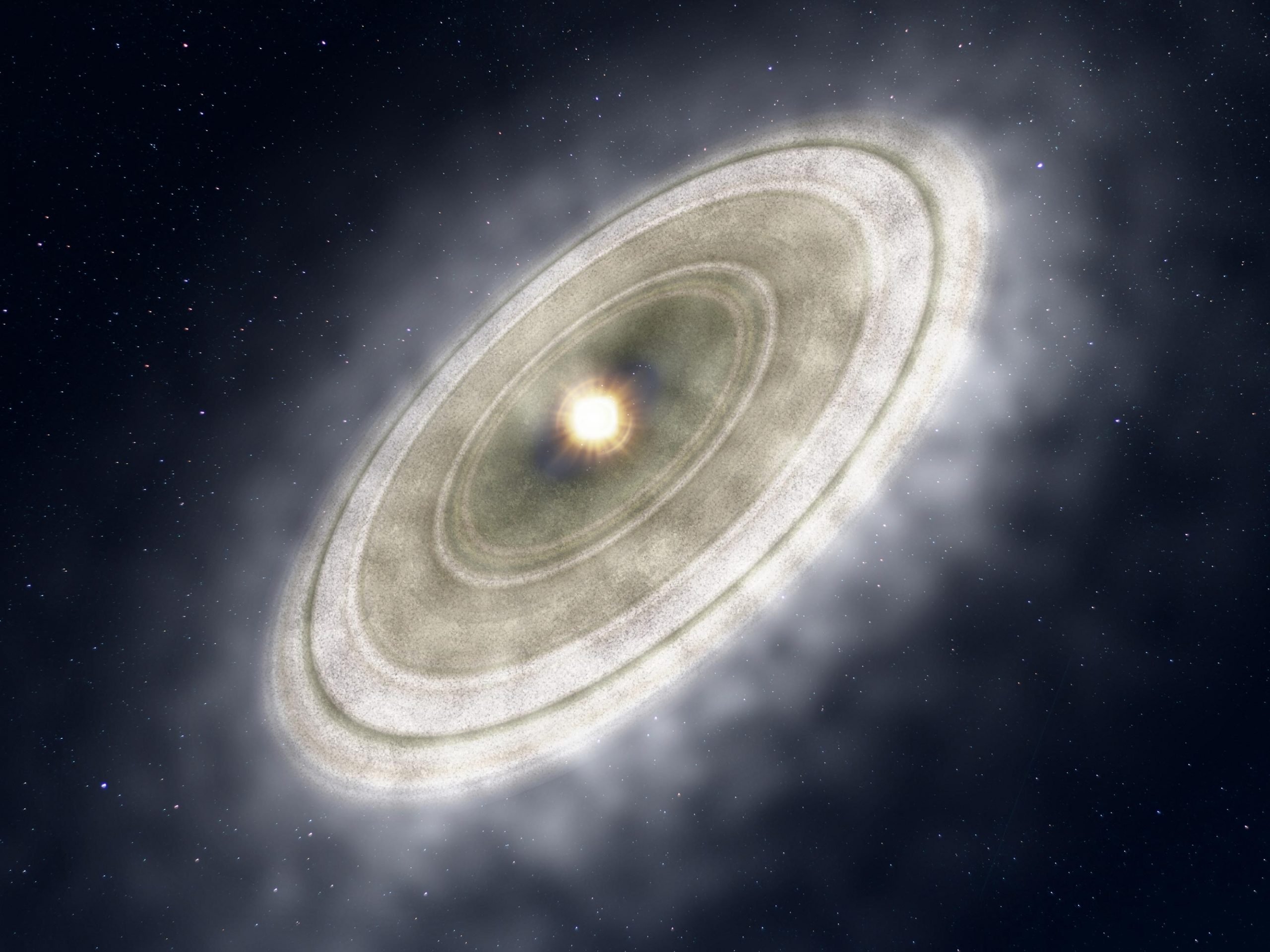
    An artist’s impression of a star’s dusty debris disk, thought to be produced when asteroids or other planetesimals collide and fragment. Astronomers studying the debris disk around the star HD 206893 have imaged a wide gap in the disk extending from about 50 to 185 au from the star. After modeling the system, they conclude it contains a 1.4 Jupiter-mass planet orbiting about 79 au from the central star. Credit: NAOJ

    Using ALMA, astronomers found a gap in a star’s debris disk indicating a likely exoplanet, showing the importance of these disks in discovering new planets.

    Debris disks around main-sequence stars are tenuous belts of dust thought to be produced when asteroids or other planetesimals collide and fragment. They are common: more than about a quarter of all main-sequence stars have debris disks and, since these disks can be hard to detect, it is likely that the fraction is even higher. Current instruments are only able to detect debris disks in systems that are at least an order of magnitude more luminous than the disk generated by the solar system’s Kuiper Belt (the region extending from the orbit of Neptune at about thirty astronomical units out to about fifty au).

    The dust in debris disks is worthy of study in its own right but also offers an opportunity to trace the properties of planetary systems. The largest dust grains (those as big as a millimeter), whose collective thermal emission is measured with telescopes like ALMA (Atacama Large Millimeter/submillimeter Array), are relatively unaffected by stellar winds or radiation pressure. Rather, their distribution reveals the effects of gravity and collisions. The “chaotic zone” is the extended region around a planet within which dust has no stable gravitational orbits, resulting in a gap whose width depends among other things on the planet’s mass. A planet in a debris disk can create such a gap, and measurements of the gap’s dimensions can thus be used to deduce the mass of the planet – a key exoplanet parameter that is otherwise difficult to obtain.

    CfA astronomers Sean Andrews and David Wilner were members of a team that used ALMA to study the known debris disk around the star HD 206893 about 135 light-years away from us. The star also has a brown dwarf binary companion orbiting at about 10au and whose mass is about 15-30 Jupiter-masses. The ALMA images spatially resolve the disk — it extends from about 50 -185 au — and the astronomers find evidence for a gap stretching from about 63 – 94 au. If the gap was carved by a single planet in a circular orbit, chaotic zone theory implies the planet should have a mass of about 1.4 Jupiter-masses and orbit at about 79 au. Future, higher resolution ALMA observations have the potential to help constrain the dynamical behavior of the brown dwarf as well as to improve the characterization of the inferred new exoplanet.

    Reference: “Resolving Structure in the Debris Disk around HD 206893 with ALMA” by Ava Nederlander, A. Meredith Hughes, Anna J. Fehr, Kevin M. Flaherty, Kate Y. L. Su, Attila Moór, Eugene Chiang, Sean M. Andrews, David J. Wilner and Sebastian Marino, 6 August 2021, The Astrophysical Journal.
    DOI: 10.3847/1538-4357/abdd32

    Never miss a breakthrough: Join the SciTechDaily newsletter.
    Follow us on Google and Google News.

    Astronomy Astrophysics Exoplanet Harvard-Smithsonian Center for Astrophysics
    Share. Facebook Twitter Pinterest LinkedIn Email Reddit

    Related Articles

    Never-Before-Seen Molecule: Webb Reveals a “Hot Saturn” Exoplanet Atmosphere

    Astronomers Uncover New Evidence of Baby Planet in the Making

    A Giant Planet Microlensing Event

    Astronomers May Have Discovered the First Extragalactic Planet

    Stellar Winds, Magnetic Activity, and Evaporating Exoplanet Atmospheres

    Astrophysicists Spot an Exoplanet With the Potential To Form Moons

    How Habitable Are Planets That Orbit Red Dwarfs – The Most Common Type of Stars in the Galaxy?

    Four Exoplanets – Including a Super-Earth Planet – Discovered by High School Students

    Astronomers Discover First Cloudless, Jupiter-Like Planet – “Smoking Gun Evidence”

    Leave A Reply Cancel Reply

    • Facebook
    • Twitter
    • Pinterest
    • YouTube

    Don't Miss a Discovery

    Subscribe for the Latest in Science & Tech!

    Trending News

    Popular Sugar-Free Sweetener Linked to Liver Disease, Study Warns

    What Is Hantavirus? The Deadly Disease Raising Alarm Worldwide

    Scientists Just Discovered How the Universe Builds Monster Black Holes

    Scientists Unveil New Treatment Strategy That Could Outsmart Cancer

    A Simple Vitamin May Hold the Key to Treating Rare Genetic Diseases

    Scientists Think the Real Fountain of Youth May Be Hiding in Your Gut

    Ravens Don’t Follow Wolves, They Predict Them

    This Common Knee Surgery May Be Doing More Harm Than Good

    Follow SciTechDaily
    • Facebook
    • Twitter
    • YouTube
    • Pinterest
    • Newsletter
    • RSS
    SciTech News
    • Biology News
    • Chemistry News
    • Earth News
    • Health News
    • Physics News
    • Science News
    • Space News
    • Technology News
    Recent Posts
    • Why Are So Many New Fathers Dying? Scientists Say the U.S. Has a Dangerous Blind Spot
    • Scientists Identify Simple Supplement That Greatly Reduces Alzheimer’s Damage
    • You May Have a Dangerous Type of Cholesterol Even if Your Tests Look Normal
    • Study Reveals Dangerous Flaw in AI Symptom Checkers
    • New MRI Breakthrough Captures Stunningly Clear Images of the Eye and Brain
    Copyright © 1998 - 2026 SciTechDaily. All Rights Reserved.
    • Science News
    • About
    • Contact
    • Editorial Board
    • Privacy Policy
    • Terms of Use

    Type above and press Enter to search. Press Esc to cancel.