

A new study suggests that gamma-ray bursts may reveal atomic-sized primordial black holes formed after the Big Bang. Unlike stellar black holes, these tiny objects emit Hawking radiation and may be detectable when consumed by supermassive black holes—offering a potential explanation for dark matter.
Since the earliest times, human beings have wanted to explain the most unpredictable and disturbing phenomena in the universe. Although the study of astronomy has been a constant in all civilizations, astronomical events of a more “unpredictable” nature, such as comets or eclipses, were considered an “omen of misfortune” and/or “actions of the gods.”
The fall of the Saxon king Harold II in 1066, during the Norman invasion of William the Conqueror, was attributed to the bad omen from the passage of a comet (later baptized as “Halley”). And during the battle of Simancas (Valladolid, Spain) between the troops of León Ramiro II and the Caliph Ad al-Rahman in 939, a total solar eclipse caused panic among the troops on both sides, delaying the battle for several days.

How would our ancestors have reacted, then, to the existence in the universe of objects – so-called black holes – capable of swallowing everything that fell into them, including light?
While the biggest black holes have been already detected and even photographed, there is now also feasible evidence – as I show in my recent study – for tiny black holes the size of potassium atoms (with a radius of about 0.23 nanometers, equivalent to 0.23 billionth of a meter). These atomic-sized black holes were formed in the first moments of the Big Bang and may even comprise the totality of the dark matter of the universe.
Taking Photos
In 2019, a collaboration of eight radio telescopes located in different parts of the world was able to take the first photo of a gigantic black hole (6.5 billion times more massive than our Sun). It is located about 55 million light-years from us (a light-year corresponding to a distance of about 9.5 trillion kilometers or 5.9 trillion miles) at the center of the Messier 87 galaxy.
The italics of the word photograph is no coincidence: how can a photograph be taken of an object that catches light and, therefore, would not be able to be seen by cameras, which use light to create a picture? The answer is simple: we are not observing the object itself, but the remains of star that are being swallowed up by these black holes.
This stellar matter rotates at enormous velocities around the black hole and its brightness can be detected when it reaches temperatures of the order of a million degrees Celsius. The disk of matter that surrounds the black hole is called the “accretion disk” and is considered the edge of the black hole – once it is passed, nothing can escape, something we call an event horizon.
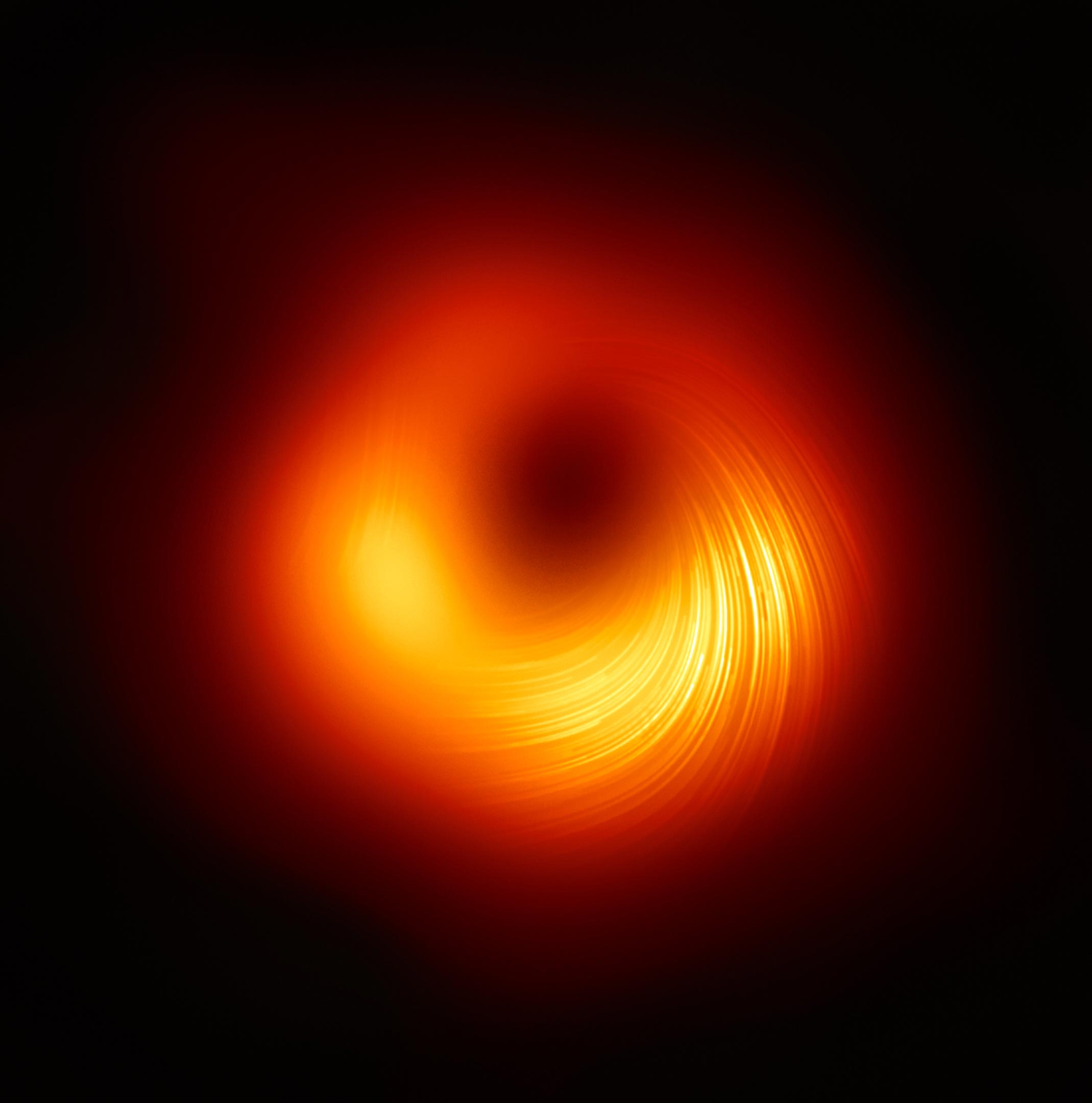
In the image above you can see the accretion disk and the event horizon of the black hole located in M87.
Primordial Black Holes
Significant parts of the black holes in the universe were formed by the gravitational collapse of stars consuming all their fuel in their final stages: these are called “stellar black holes.” Not all stars will turn into black holes at the end of their lifetime; when the core of a star is less than two or three solar masses, a stellar black hole cannot be created.
That is, there exists a minimum stellar mass below which a star cannot collapse into a black hole. As an example, our Sun will never turn into a black hole at the end of its life, but other massive stars like the red supergiant Betelgeuse will inevitably become black holes.
There are also other black holes called “primitive” or “primordial” black holes, which – as their name indicates – were created in the first moments of the Big Bang, when the universe first began, and can theoretically possess any mass. They may range in size from a subatomic particle to several hundred kilometers.
And when it comes to black holes, supermassive ones emit practically no radiation, while the smallest ones emit the most radiation. But, how is this phenomenon possible: supermassive black holes that emit practically no radiation and trap everything, even light?
The answer was provided by physicist Stephen Hawking in the mid-1970s. He postulated that the quantum effects near the event horizon of a black hole might produce the emission of particles that could escape from it. That is, black holes that do not gain mass by any other means will progressively lose their mass and finally evaporate.
This Hawking radiation is more evident in low-mass black holes: the evaporation time of a million-solar-mass supermassive black hole is 36×10 to the power of 91 seconds (much longer than the current age of the universe).
On the other hand, a black hole with a mass equivalent to a 1,000-ton ship would evaporate in about 46 seconds.
In the last stages of a black hole’s evaporation, they would explode and generate a huge amount of gamma rays (a radiation even more intense than X-rays).
Capturing an Atomic-Sized Primordial Black Hole
So how can atomic-sized holes be evidenced before they evaporate completely?
In the recent study of atomic-sized black holes, an astrophysical scenario is proposed where one of these tiny black holes is captured by a supermassive one. As the atomic-sized black hole approaches the event horizon of the supermassive one, the fraction of Hawking radiation that might be detected from the Earth gradually decreases, until it reaches the size of a ray of light.
The following animation shows the above process in more detail.
The capture of an atomic-sized primordial black hole by a supermassive black hole.
This beam is compatible with thermal gamma-ray bursts (GRBs) already measured at astronomical observatories. It is these GRBs that constitute an experimental evidence for such tiny black holes, which are serious candidates for the dark matter of a yet unexplored and fascinating universe.
Written by Oscar del Barco Novillo, Profesor asociado en el área de Óptica, Universidad de Murcia.
This article was first published in The Conversation.
Never miss a breakthrough: Join the SciTechDaily newsletter.
Follow us on Google and Google News.
18 Comments
why limit yourself to one species of black hole
whay dont you consider
1 h hydrogen 1.008 reactive nonmetal group 1
trihydrogen or h3 in earth diamonds 4.5 billion years old
quatrohydrogen or h4 in earth diamonds 4.5 billion years old
2 he helium 4.0026 noble gas group 18
3 li lithium 6.94 solid alkali metal group 1
Burning litium produces a vivid crimson red colour
4 be berryllium 9.0122 alkaline earth metal group 2
5 b boron 10.81 metalloid group 13
6 c carbon 12.011 reactive nonmetal group 14
Neter sodium carbonate
7 n nitrogen 14.007 reactive non metal pnictogens group 15
nitrogen 14 neutrons
nitrogen 15 neutrons
8 o oxygen 15.999 reactive nonmetal chalogens group 16
9 f fluorine 18.998 reactive nonmetal halogens group 17
Halogens from super volcanoes into the atmosphere will destroy the ozone layer
10 ne neon 20.180 noble gas group 18
11 na sodium 22.990 alkali metal group 1
Burning sodium a yellow colour with water a vicious reaction
Salt Sodium and chloride
Neter sodium carbonate
Indian third largest salt producer western state of gujarat Bhavnagar and
adjacent to the gulf of Khambhat salt evaporation ponds salt producing region
¾ of indias annual salt production output
Botswana Makgadikgadi pan salts near Kalahari desert
Tanzania lifeless lake natron full of warm salty alkaline water shines a bright red
when seen from space
China Shandong province bo hai coast salt producing
Southern France rhone river salt ponds
France aigues mortes salt marshes harvested for industrial chemical and
pharmaceutical uses
12 mg magnesium 24.305 alkaline earth metal group 2 eight most abundant
element in the universe
magnesium 12 protons 12 neutrons and 12 electrons
mg 36
mg 38
mg 40 12 protons 28 neutrons
13 al aluminium 26.982 post transitional metal group 13
aluminium 26
aluminum 41
14 si silicon 28.085 metalloid group 14
15 p phosphorous 30.974 reactive non metal pnictogens group 15
16 s sulphur 32.06 reactive non metal chalcogens group 16
sulphur 32s 16 protons 16 neutrons stable
sulphur 33s 16 protons 17 neutrons stable
sulphur 34s 16 protons 18 neutrons stable
17 cl chlorine 35.45 reactive non metal halogens group 17
Salt Sodium and chloride
18 ar argon 39.948 noble gas group 18
19 k potassium 39.098 alkali metal group 1
a possible 20 other versions of the type
If a Black Hole is very small (less than the size of an electron), could Quantum Mechanica interfere with these very small black hole with eating? How can you eat 1/2 of an electron? Could QM stop tiny black holes from eating? These tiny black hols could possibly merge, and make a larger black hole. But what does Quantum Mechanics say about tiny black holes feeding?
Wonder is a tiny black hole could get clogged solid to for a very hard rod.and the explosion your observing from what you think is it totally collapsed is just it being struck by other violent media happenstance within it’s region and basically doing a flint strike affect but with gamma rays…AHH there’s always the potential!rod of god comes to mind.a constipated black hole! EUREKA!
If a black hole the mass of a ship evaporates in 46 seconds, then surely there can be no free floating atom sized black holes in the universe. They would all have evaporated long ago
There is a note at the bottom of the calculator you link to regarding the evaporation that indicates that in fact the calculation does not take into account the fact that a black hole with a mass greater than about 0.75% of the earth is colder than the cosmic microwave background radiation bathing it. Therefore, whatever little energy it radiates, it actually receives more in the form of heat from the cosmos. So rather than shrinking, it would continue to grow and its mass would increase for now. As the universe expands and cools, however, eventually the black hole may begin to lose mass-energy through Hawking radiation. I don’t know the effect on your ship sized blackhole but suspect it is non trivial.
Its not that difficult really has anyone actually considered what they imagine just like Einstein actually comes true.(spooky right) Just like the Multi verse we imprint anything we imagine on to and intertwined into the web. I can sit here all day and imagine the impossible. Good job I stuck to art. For the time being. One fell swoop from the sun will take us back to the dark ages. Where will your research be then? Insted of trying for silly gains of power and ego . Put your research aside. And investigate Love. Human kind depends on it. Not only are there atomic black holes…..atomic explosions happen in humans. All size is relative. Dotty.
If they were created long ago and they only last a short time, why do they still exist?
Im no expert but seeing a vid on Hawking radiation i get as much that it depends on (~virtual quantum) half-particles getting caught in the BH. Perhaps if it hits a small enough size it just can’t catch theese anymore?
But tbh i don’t understand why the evaporation speeds up as it shrinks either. Just trying a sober guess.
“How would our ancestors have reacted, then, to the existence in the universe of objects – so-called black holes – capable of swallowing everything that fell into them, including light?”
Uh the smart asperger geeks of the day were as inbred as today? Just a guess. What is art?
.. oops wrong website you have no idea! Morons.
Spyroe theory claims all energy has a backside component. Humans see a sphere in our limited 3D perception. Put a sphere on all the 3 axis. You can only perceive one not three. Now invert the spheres as if you had the ability to see from outside the universe. Viola. Spyroe theory’s model.
Title says experimental evidence suggests.
Then proceeds to say the sub-atomic blackholes can’t even exist due to H-radiation and refuses to elaborate. Also says that theese can have – in theory – any amount of mass which just sounds bs without further explanation.
Clickbait is clickbait.
Great article, there aren’t 9 points in a black hole, there are nine points around it. Proving what was seen in Hubble’s Zoomwicky 18 is definitely worth further study and twin stars are always interesting, you can’t miss it from a distance it looks like it’s hidden in the centre of the eye of ra. And far more beautiful than a black hole, but who doesn’t like things that shimmer bright blue like Radium.
There must be a black hole close if Melbourne Australia is getting an earthquake.where not even close to fault lines.
I say it seems there is a hole lot about it. Perhaps all of the speculation is in a hole itself. ☺
Wow amazing how even possible to have such a black hole a far as I know normal black hole was created from enormous big dying star and the other thing that’s interesting for me how we can risk to do experiment of the big bang in cern without knowing konsequenses. I read that it’s not dangerous becouse after creating small black hole it will be disapiered in other dimension, but this is mean that the other dimension are real then, and are we sure that in this case we don’t broke fabric of space time and will have consequences in future?
Italics are quotations.
Maybe Black Holes are not what we think at all. Perhaps just holes or entrances to somewhere else; other deminsions, back to the center of the universe to expand the universe, Etc.
David makes sense (comment)