
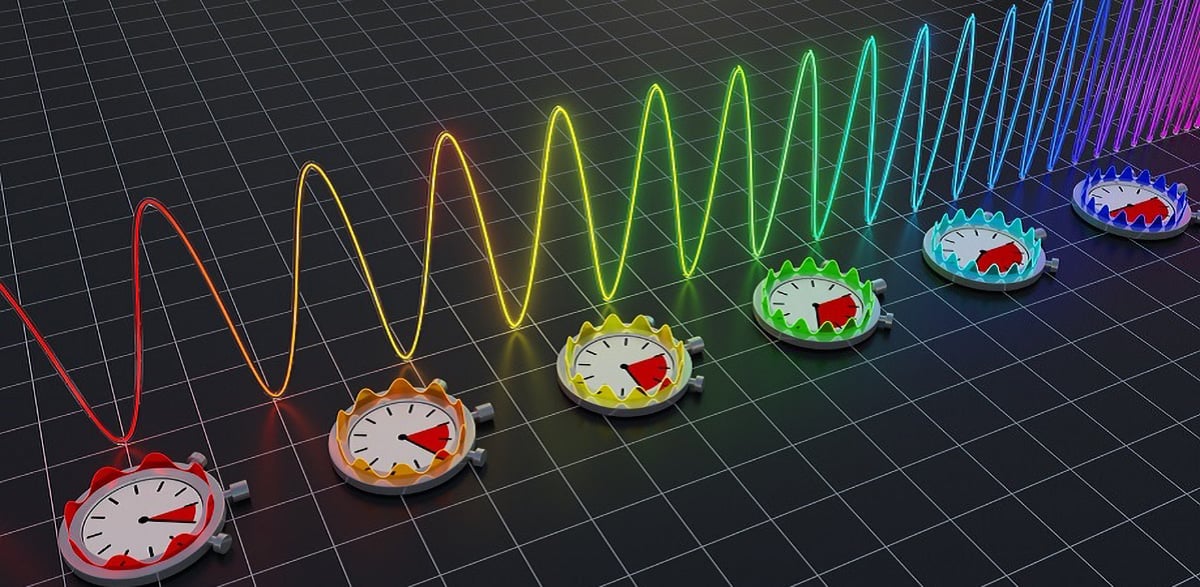
Innovative diode laser spectroscopy provides precise monitoring of the color changes in the sweeping laser at each moment, establishing new benchmarks for frequency metrology and practical applications.
Since the laser’s debut in the 1960s, laser spectroscopy has evolved into a crucial technique for investigating the intricate structures and behaviors of atoms and molecules. Advances in laser technology have significantly expanded its potential. Laser spectroscopy primarily consists of two key types: frequency comb-based laser spectroscopy and tunable continuous-wave (CW) laser spectroscopy.
Comb-based laser spectroscopy enables extremely precise frequency measurements, with an accuracy of up to 18 digits. This remarkable precision led to a Nobel Prize in Physics in 2005 and has applications in optical clocks, gravity sensing, and the search for dark matter. Frequency combs also enable high-precision, high-speed broadband spectroscopy because they combine large bandwidth with high spectral resolution.
However, one drawback is the low power per comb mode, which makes detecting trace gases difficult. The gaps between the comb modes also require additional techniques for measuring spectrally narrow features. In addition, high-precision measurements require comb sources with long-term coherence, which demands complex and sophisticated stabilization systems.
Tunable Continuous-Wave Laser Spectroscopy
Tunable CW lasers offer high photon flux, long interaction paths, and frequency agility, making them ideal for sensitive molecular spectroscopy, gas sensing, and LIDAR applications with high signal-to-noise ratios (SNR). However, these systems often suffer from fluctuations in the laser frequency scan speed.
Various methods, including interferometric approaches, single-sideband modulation, and optical frequency combs, have been developed to address these fluctuations. Frequency-comb-calibrated tunable laser spectroscopy combines the accuracy of a frequency comb with the tunability and high power of a CW laser. Nonetheless, this method requires a reference frequency comb with a flat optical spectrum and stable polarization over a wide range, which can be challenging to achieve.
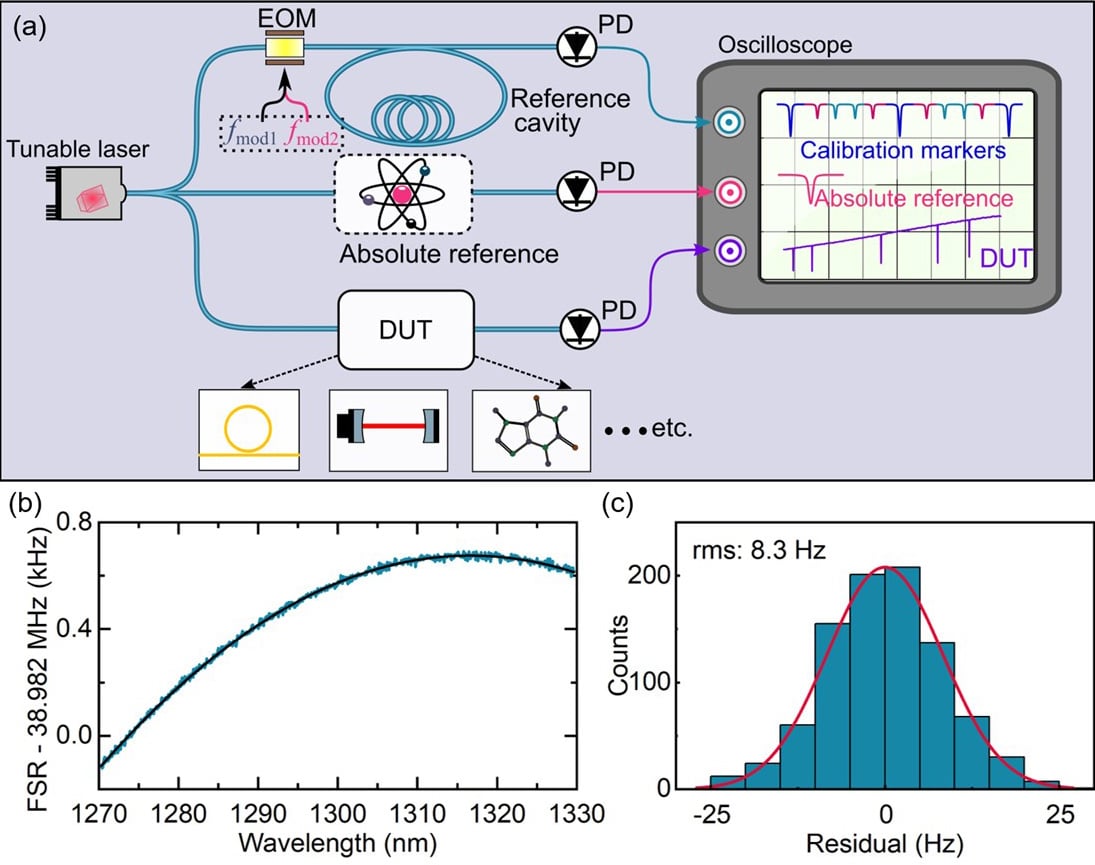
Researchers at the Max Planck Institute for the Science of Light have developed a new, straightforward broadband spectroscopy method with Hz-level precision using a tunable laser. As reported in Advanced Photonics, this technique involves on-the-fly calibration of the laser frequency using a fiber cavity and a dual radio frequency (RF) modulation technique. This approach enables the precise tracking of the color of the sweeping laser at every point in time. It provides calibration markers, that serve as an easy-to-use optical frequency ruler in order to measure optical frequency distances between spectral features with ultra-high precision.
New Method’s Impact and Applications
Using this method, the researchers measured minuscule deviations in the free spectral range of a fiber loop cavity over an 11-THz frequency range with sub-10-Hz precision, an order of magnitude improvement over existing tunable laser spectroscopy methods. The measurement speed was 1 THz/s, limited by the reference cavity’s linewidth. Compared to frequency comb-based spectroscopy, this technique offers higher optical probe power and better spectral flatness and polarization stability.
The new method was also used to characterize spectral features of integrated photonic devices like microresonators and measuring the molecular absorption spectrum of HF gas with two orders of magnitude improvement in precision compared to existing methods. This robust and straightforward method does not require mode locking or phase locking, making it suitable for out-of-lab applications, including LIDAR systems, 3D imaging, open-path trace gas sensing, characterization of photonic devices, and calibration of astrophysical spectrometers. Its simplicity and robustness make it an excellent choice for use in challenging environments.
Reference: “On-the-fly precision spectroscopy with a dual-modulated tunable diode laser and Hz-level referencing to a cavity” by Shuangyou Zhang, Toby Bi and Pascal Del’Haye, 9 August 2024, Advanced Photonics.
DOI: 10.1117/1.AP.6.4.046003
Never miss a breakthrough: Join the SciTechDaily newsletter.
Follow us on Google and Google News.
1 Comment
This robust and straightforward method does not require mode locking or phase locking, making it suitable for out-of-lab applications, including LIDAR systems, 3D imaging, open-path trace gas sensing, characterization of photonic devices, and calibration of astrophysical spectrometers.
VERY GOOD!
Please ask researchers to think deeply:
1. Is 3D imaging related to 2D?
2. Is high-dimensional spacetime related to low dimensional spacetime?
Scientific research guided by correct theories can help humanity avoid detours, failures, and pomposity. Please witness the exemplary collaboration between theoretical physicists and experimentalists (https://scitechdaily.com/microscope-spacecrafts-most-precise-test-of-key-component-of-the-theory-of-general-relativity/#comment-854286). Some people in contemporary physics has always lived in a self righteous children’s story world. Whose values have been overturned by such a comical and ridiculous reality? CP violation opened the dirtiest and ugliest era in the history of physics.
Space has physical properties of zero viscosity and absolute incompressibility. Zero viscosity and absolute incompressibility are physical characteristics of ideal fluids. The space with ideal fluid physical characteristics forms vortices via topological phase transitions, which is not difficult to understand mathematically. Once the topological vortex is formed, it occupies space and maintains its presence in time. This is the transition from chaos to order via two bidirectional coupled continuous chaotic systems.
Symmetry of topological vortex can be used to explore particle behavior under spatial, temporal, and quantum number reversals, involving quantum gravity, discrete and continuous changes. It underpins the consistency of natural laws and experiment reproducibility.
The perpetually swirling topological vortices defy traditional physics’ expectations potentially unveiling new particles and forces, and can have an heavily influencing to traditional physics theories.