

EPFL researchers have developed a compact, high-performance chip-scale erbium-doped laser, broadening potential applications in technology and medicine.
Lasers have transformed the world since the 1960s and have become essential in modern applications, including advanced surgery, precision manufacturing, and data transmission through optical fibers.
But as the need for laser-based applications grows, so do challenges. For example, there is a growing market for fiber lasers, which are currently used in industrial cutting, welding, and marking applications.
Fiber lasers use an optical fiber doped with rare-earth elements (erbium, ytterbium, neodymium, etc) as their optical gain source (the part that produces the laser’s light). They emit high-quality beams, they have high power output, and they are efficient, low-maintenance, durable, and they are typically smaller than gas lasers. Fiber lasers are also the ‘gold standard’ for low-phase noise, meaning that their beams remain stable over time.
But despite all that, there is a growing demand for miniaturizing fiber lasers on a chip-scale level. Erbium-based fiber lasers are especially interesting, as they meet all the requirements for maintaining a laser’s high coherence and stability. But miniaturizing them has been met by challenges in maintaining their performance at small scales.
Now, scientists led by Dr Yang Liu and Professor Tobias Kippenberg at EPFL have built the first ever chip-integrated erbium-doped waveguide laser that approaches the performance with fiber-based lasers, combining wide wavelength tunability with the practicality of chip-scale photonic integration. The breakthrough is published in Nature Photonics.
Building a chip-scale laser
The researchers developed their chip-scale erbium laser using a state-of-the-art fabrication process. They began by constructing a meter-long, on-chip optical cavity (a set of mirrors that provide optical feedback) based on an ultralow-loss silicon nitride photonic integrated circuit.
“We were able to design the laser cavity to be meter-scale in length despite the compact chip size, thanks to the integration of these microring resonators that effectively extend the optical path without physically enlarging the device,” says Dr. Liu.
The team then implanted the circuit with high-concentration erbium ions to selectively create the active gain medium necessary for lasing. Finally, they integrated the circuit with a III-V semiconductor pump laser to excite the erbium ions to enable them to emit light and produce the laser beam.
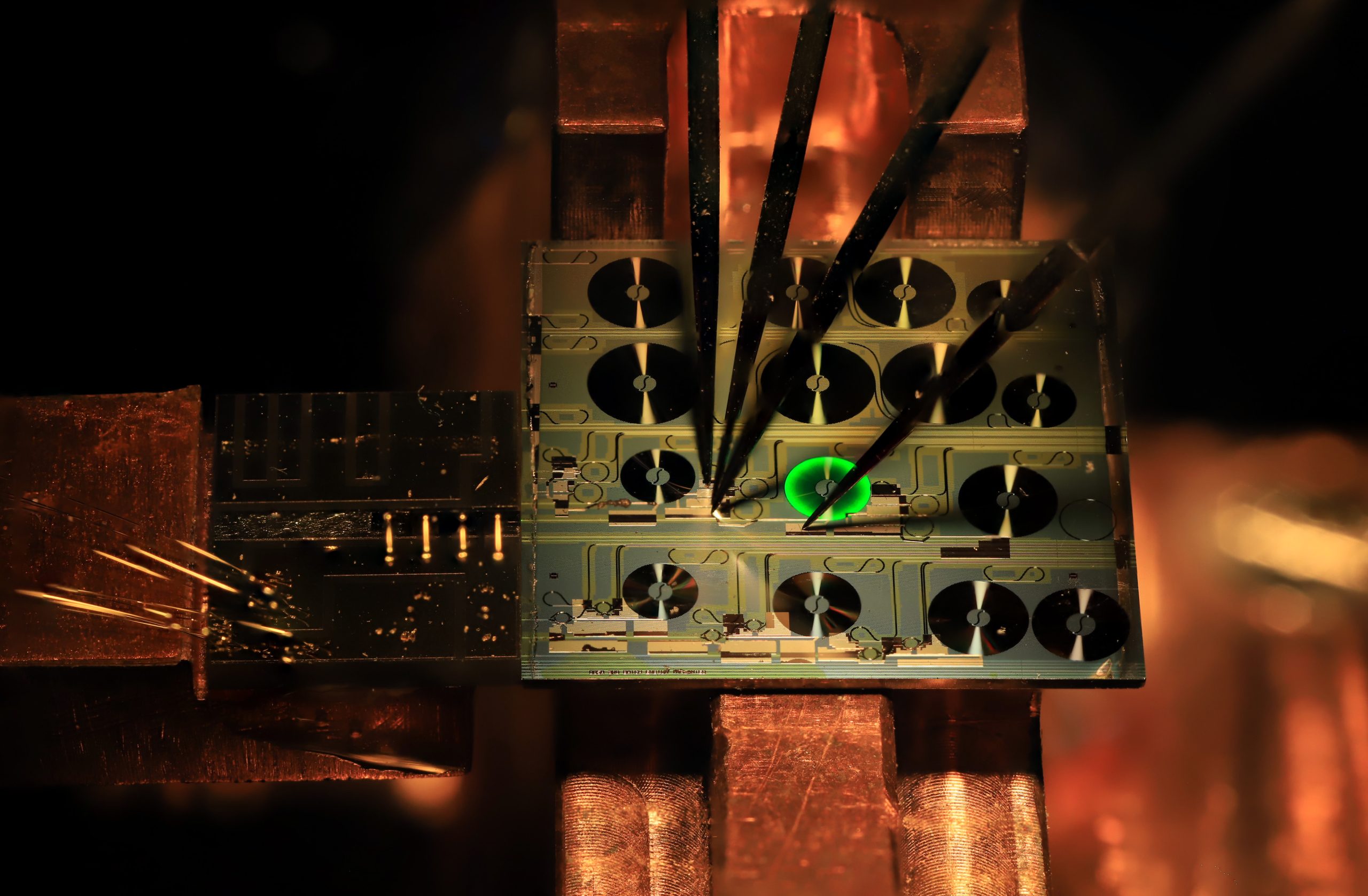
To refine the laser’s performance and achieve precise wavelength control, the researchers engineered an innovative intra-cavity design featuring microring-based Vernier filters, a type of optical filter that can select specific frequencies of light.
The filters allow for dynamic tuning of the laser’s wavelength over a broad range, making it versatile and usable in various applications. This design supports stable, single-mode lasing with an impressively narrow intrinsic linewidth of just 50 Hz.
It also allows for significant side mode suppression – the laser’s ability to emit light at a single, consistent frequency while minimizing the intensity of other frequencies (‘side modes’). This ensures “clean” and stable output across the light spectrum for high-precision applications.
Power, precision, stability, and low noise
The chip-scale erbium-based fiber laser features output power exceeding 10 mW and a side mode suppression ratio greater than 70 dB, outperforming many conventional systems.
It also has a very narrow linewidth, which means the light it emits is very pure and steady, which is important for coherent applications such as sensing, gyroscopes, LiDAR, and optical frequency metrology.
The microring-based Vernier filter gives the laser broad wavelength tunability across 40 nm within the C- and L-bands (ranges of wavelengths used in telecommunications), surpassing legacy fiber lasers in both tuning and low spectral spurs metrics (“spurs” are unwanted frequencies), while remaining compatible with current semiconductor manufacturing processes.
Next-generation lasers
Miniaturizing and integrating erbium fiber lasers into chip-scale devices can reduce their overall costs, making them accessible for portable and highly integrated systems across telecommunications, medical diagnostics, and consumer electronics.
It can also scale down optical technologies in various other applications, such as LiDAR, microwave photonics, optical frequency synthesis, and free-space communications.
“The application areas of such a new class of erbium-doped integrated lasers are virtually unlimited,” says Liu.
Reference: “A fully hybrid integrated erbium-based laser” by Yang Liu, Zheru Qiu, Xinru Ji, Andrea Bancora, Grigory Lihachev, Johann Riemensberger, Rui Ning Wang, Andrey Voloshin and Tobias J. Kippenberg, 10 June 2024, Nature Photonics.
DOI: 10.1038/s41566-024-01454-7
The lab spin-off, EDWATEC SA, is an Integrated Device Manufacturer that can now offer Rare-Earth Ion-Doped Photonic Integrated Circuit-based Devices including high-performance amplifiers and lasers.
Never miss a breakthrough: Join the SciTechDaily newsletter.
Follow us on Google and Google News.