
Nearly 2,000 years ago, someone scratched a name into a bowl on Rome’s northern frontier. That name is now one of the clues archaeology students have uncovered about the people who lived at the edge of the empire.
In Redesdale, Northumberland, a Newcastle University excavation is looking at what it took to keep Roman troops supplied. The team is studying the roads, workshops, and buildings that supported the military and the civilians who lived and worked alongside it.
The summer 2026 dig brought together 52 first-year Newcastle University students, split into two groups that each spent two weeks on site. They worked alongside volunteers from the Redesdale Archaeology Group (RAG), with The Archaeological Practice Ltd. directing the excavations.
A Roman Gold Chain on the First Day
On the first day of her first dig, student Elise Zallu unearthed a fragment of Roman gold chain. The delicate strand measures about 7 centimeters (2.8 inches) and is so well preserved that it could still be worn if it were complete. A Roman goldsmith made it by pinching individual rings into figure eights, folding them, and weaving them together. Known as loop-in-loop, the technique produced flexible chains typically made of exceptionally pure gold for fine jewelry, military amulets, or decorative fittings.
“Finding the gold chain was really surreal, especially given it was the first day of my first dig,” Zallu said. “I didn’t expect to find anything like that my whole career, so it was definitely a surprise. I’m really grateful that studying archaeology at Newcastle has given me the opportunity to gain such valuable experience in the field which I feel will really benefit me in the future.”
“Finding a gold artifact is something many archaeologists can go an entire career without experiencing,” said Eric Tourigny of Newcastle University’s School of History, Classics and Archaeology. “For a first-year student to discover a beautifully preserved Roman gold chain on their first day in the trench is truly remarkable.”
A Folded Inscription and a Gilded Cavalry Fitting
Also on the first day, student Shannon Wood found a folded sheet of lead with partly obscured cursive Latin lettering scratched into its surface. Archaeologists suspect it was a commercial seal used to mark ownership or track goods, possibly through the military supply network. It could also have carried a personal message or served as a curse tablet. Across the Roman world, people scratched prayers, grievances, and sometimes curses onto thin lead sheets, then folded them and left them at sacred sites. Further study of the inscription may clarify its purpose.
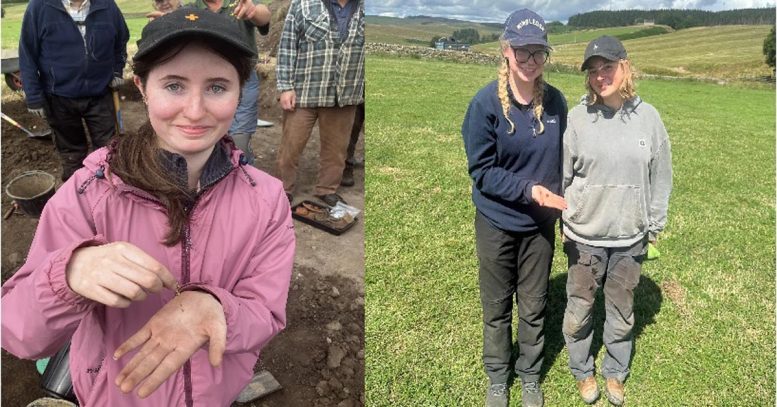
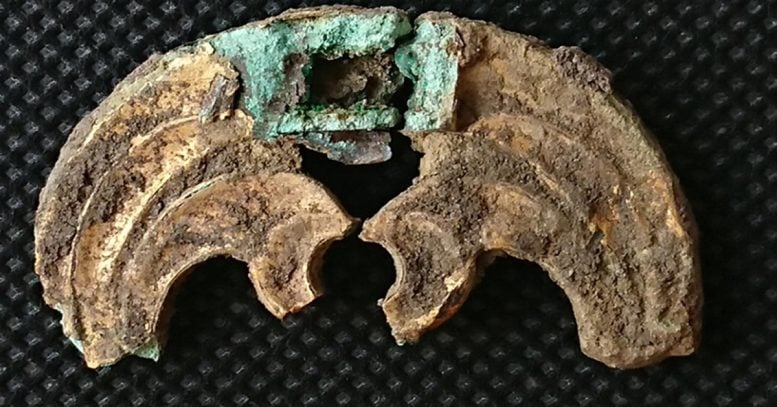
On the second day, Megan Potter uncovered a crescent-shaped bronze ornament known as a peltate cavalry dangler. Its inward-curving tips echo the shape of an ancient shield, and concentric ridges decorate its face. Much of its gold gilding survives despite corrosion. The ornament may have hung from a military belt (cingulum), a horse harness, or the lower end of a sword scabbard. Its workmanship suggests it could have belonged to a cavalry officer or another high-ranking individual.
The Name on a Bowl and the God on a Seal
Among the coins, spearheads, and pottery, students found a Samian ware (terra sigillata) bowl with a name scratched into it. The inscription reads either “MARTIN[I]” or “MARTIN[US],” both pointing to someone named Martinus. Several other fragments appear to bear the same name, suggesting that someone who lived or worked at the site nearly 2,000 years ago may have marked the vessels as their own.
In the final week, students Maisy Watmough and Zoe Yuill found a polished orange carnelian engraved with Jupiter. The king of the Roman gods holds a scepter and a miniature figure of Victory, with an eagle at his feet. A gem carved this way, known as an intaglio, could be set in a ring and pressed into warm wax to authenticate documents. This is the fourth intaglio recovered at the site. Two turned up in 2025, and the first was found in the 19th century.
“It was so exciting to find the intaglio,” Watmough said. “Studying archaeology at Newcastle has benefited me in terms of experience and working in a professional setting. Working with archaeologists has allowed be to gain a better understanding of the practice and engage with new people.” Yuill added, “I loved my time at the field school, especially as everyone there was so friendly and helpful.”
How Rome’s Northern Frontier Worked
Newcastle University researchers and their partners have investigated the Redesdale site since the early 1990s, with major excavations from 1992 to 1998 and again in 2010. The current project began in 2021 and has explored two large enclosures, or ‘annexes’, documenting their defenses, buildings, roads, and traces of industrial activity.
“These finds are exciting not only because of their quality but also because of the stories they tell. A gold chain, a signet gemstone, inscribed pottery, and a decorated brooch illuminate the lives of the people who made this site work almost two millennia ago. Combined with the buildings and industrial features the team is excavating, they also help us understand how the frontier operated and how Roman and Native communities interacted,” said Richard Carlton, the site director and a visiting fellow in archaeology at Newcastle University.
Never miss a breakthrough: Join the SciTechDaily newsletter.
Follow us on Google and Google News.