
Close Menu
    Facebook X (Twitter) Instagram
    SciTechDaily
    • Biology
    • Chemistry
    • Earth
    • Health
    • Physics
    • Science
    • Space
    • Technology
    Facebook X (Twitter) Pinterest YouTube RSS
    SciTechDaily
    Home»Biology»Neurologists Discover Mechanism That Helps Brain Cells Communicate
    Biology

    Neurologists Discover Mechanism That Helps Brain Cells Communicate

    By Bill Hathaway, Yale UniversityJuly 6, 20181 Comment2 Mins Read
    Facebook Twitter Pinterest Telegram LinkedIn WhatsApp Email Reddit
    Share
    Facebook Twitter LinkedIn Pinterest Telegram Email Reddit
    Neurologists Find Mechanism That Helps Brain Cells Communicate
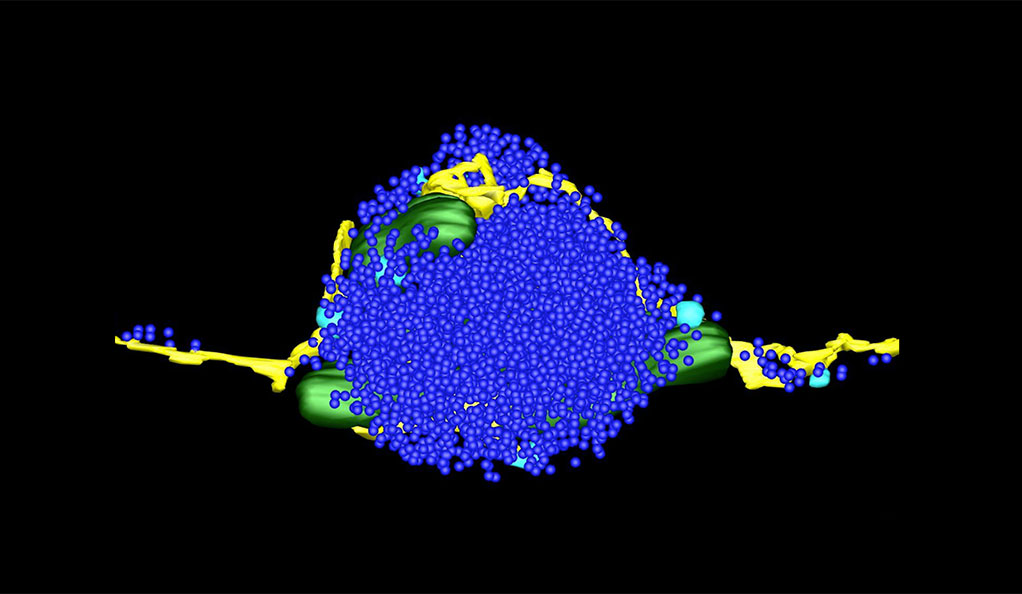
    Synaptic vesicles (blue) that harbor chemical messengers form tight clusters within cells. (Image courtesy of Dr. Yumel Wu, Yale School of Medicine)

    The nervous system depends upon the tightly regulated spatial and temporal communication that occurs between neurons at specialized connections called synapses. Chemical signals called neurotransmitters, the molecules responsible for communication between neurons, are packed into hundreds of membrane sacks known as synaptic vesicles. These vesicles form tight clusters at the nerve terminal. Despite being held together, vesicles are highly mobile within these clusters, so that they can be randomly recruited to the surface of the cell to release their content upon activation of the neuron.

    In a new paper published July 5 in the journal Science, Yale researchers describe how this compact but highly mobile structure is achieved. They found that synaptic vesicles organize themselves into a liquid compartment within interior of the cell, much as oil does when mixed with water. The new research shows groups of synaptic vesicles can “demix” in the presence of a common nerve terminal protein synapsin, explaining how vesicles can both remain tightly clustered yet rapidly fuse with membrane of neurons when activated, said Yale’s Dragomir Milovanovic, lead author of the study and postdoctoral researcher in the lab of Pietro De Camilli.

    Reference: “A liquid phase of synapsin and lipid vesicles” by Dragomir Milovanovic, Yumei Wu, Xin Bian and Pietro De Camilli, 5 July 2018, Science.
    DOI: 10.1126/science.aat5671

    Never miss a breakthrough: Join the SciTechDaily newsletter.
    Follow us on Google and Google News.

    Brain Activity Neurology Yale University
    Share. Facebook Twitter Pinterest LinkedIn Email Reddit

    Related Articles

    Yale Study Shows Risk Avoidance in Older Adults is Related to Brain Anatomy, Not Age

    Study Shows A Widespread Disruption of Brain Activity During Absence Seizures

    Yale Researchers Track How the Brain Routes Visual Signals

    New Research Shows Individual Brain Activity Is As Unique As Fingerprints

    Yale Maps Evolutionary Changes of the Human Brain

    Yale Neurobiologists Discover Surprising Trigger of New Brain Cell Growth

    Neurobiologists Block the Effects of Stress

    Study Shows Human Brain Development is Divided into Three Major Phases

    GATA1 Plays a Role in the Loss of Connections Between Neurons and in Symptoms of Depression

    1 Comment

    1. png to ico on September 9, 2020 1:45 am

      Despite being held together, vesicles are highly mobile within these clusters, so that they can be randomly recruited to the surface of the cell to release their content upon activation of the neuron.

      Reply
    Leave A Reply Cancel Reply

    • Facebook
    • Twitter
    • Pinterest
    • YouTube

    Don't Miss a Discovery

    Subscribe for the Latest in Science & Tech!

    Trending News

    Scientists Built a Programmable Chip That Can Slow Light on Command

    The Backyard “Silly Sprinkler” That Cracked One of Physics’ Biggest Puzzles

    This Common Sleep Habit Could Be Making You Gain Weight

    Mathematician Offers New Solution to a Fundamental Cosmic Paradox

    Scientists Turn Plastic Waste Into Clean Hydrogen Fuel

    Long COVID Brain Scans Reveal Damage to Dopamine Neurons

    Scientists Warn a Silent Oxygen Crisis Is Spreading Through Earth’s Waters

    James Webb Telescope Discovers Hidden Giant Planet in Famous Star System

    Follow SciTechDaily
    • Facebook
    • Twitter
    • YouTube
    • Pinterest
    • Newsletter
    • RSS
    SciTech News
    • Biology News
    • Chemistry News
    • Earth News
    • Health News
    • Physics News
    • Science News
    • Space News
    • Technology News
    Recent Posts
    • NASA Astronaut Comes Home After 3,856 Orbits of Earth
    • A Rare and Deadly Cancer May Have an Unexpected New Vulnerability
    • Sleep Disorders Don’t Just Exhaust You. New Research Shows They Change Your Brain
    • THC-CBD Treatment Dramatically Reduces Agitation in Dementia Trial
    • Rare 8,000-Year-Old Rock Shelter Captures a Turning Point in Human History
    Copyright © 1998 - 2026 SciTechDaily. All Rights Reserved.
    • Science News
    • About
    • Contact
    • Editorial Board
    • Privacy Policy
    • Terms of Use

    Type above and press Enter to search. Press Esc to cancel.