
Close Menu
    Facebook X (Twitter) Instagram
    SciTechDaily
    • Biology
    • Chemistry
    • Earth
    • Health
    • Physics
    • Science
    • Space
    • Technology
    Facebook X (Twitter) Pinterest YouTube RSS
    SciTechDaily
    Home»Biology»Yale Neurobiologists Discover Surprising Trigger of New Brain Cell Growth
    Biology

    Yale Neurobiologists Discover Surprising Trigger of New Brain Cell Growth

    By Bill Hathaway, Yale UniversityFebruary 19, 2015No Comments2 Mins Read
    Facebook Twitter Pinterest Telegram LinkedIn WhatsApp Email Reddit
    Share
    Facebook Twitter LinkedIn Pinterest Telegram Email Reddit
    Researchers Find Trigger of New Brain Cell Growth
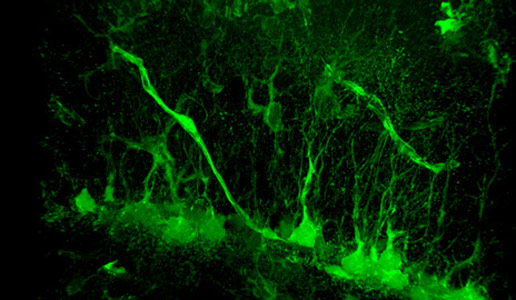
    Neural stem cells and nearby blood vessels that express key molecule VEGFR3 are seen in green. VEGFR3 appears to play a role in both formation of new brain cells as well as blood vessels. Credit: Yale University

    A newly published study from Yale University shows that adult hippocampal neural stem cells (NSCs) express vascular endothelial growth factor receptor (VEGFR) 3 and its ligand VEGF-C, which activates quiescent NSCs to enter the cell cycle and generate progenitor cells.

    Scientists have discovered that the human brain can produce new neurons, but exactly how those cells are produced and what purpose they serve are not well understood. Now a study by Yale researchers shows that key developmental factors that control the formation of blood vessels are also necessary for activating brain stem cells.

    Yale neurobiologist Jean-Leon Thomas and colleagues, in collaboration with vascular biologist Anne Eichmann, found that neural stem cells lacking a receptor for vascular endothelial growth factor (VEGFR3) produce fewer new brain cells in the hippocampus of mice. In addition, mice lacking VEGFR3 exhibit more anxiety than mice with intact receptors in stem cells.

    Surprisingly, said the researchers, a related VEGF molecule does not stimulate brain blood vessels at doses that activate brain stem cells, which suggests that this factor may be used specifically in the treatment of neurological diseases. The team, including first author Jinah Han, reported their findings February 19 in the journal Cell Reports.

    Reference: “Vascular Endothelial Growth Factor Receptor 3 Controls Neural Stem Cell Activation in Mice and Humans” by Jinah Han, Charles-Félix Calvo, Tae Hyuk Kang, Kasey L. Baker, June-Hee Park, Carlos Parras, Marine Levittas, Ulrick Birba, Laurence Pibouin-Fragner, Pascal Fragner, Kaya Bilguvar, Ronald S. Duman, Harri Nurmi, Kari Alitalo, Anne C. Eichmann and Jean-Léon Thomas, 19 February 2015, Cell Reports.
    DOI: 10.1016/j.celrep.2015.01.049


    Never miss a breakthrough: Join the SciTechDaily newsletter.
    Follow us on Google and Google News.

    Brain Activity Neurology Neuroscience Yale University
    Share. Facebook Twitter Pinterest LinkedIn Email Reddit

    Related Articles

    Yale Researchers Examine How the Brain Weighs Value

    Laminin Alpha 5 is Crucial to Adolescent Brain Maturation

    Yale Study Shows Risk Avoidance in Older Adults is Related to Brain Anatomy, Not Age

    Yale Researchers Track How the Brain Routes Visual Signals

    New Research Shows Individual Brain Activity Is As Unique As Fingerprints

    Yale Maps Evolutionary Changes of the Human Brain

    Neurobiologists Block the Effects of Stress

    Study Shows Human Brain Development is Divided into Three Major Phases

    GATA1 Plays a Role in the Loss of Connections Between Neurons and in Symptoms of Depression

    Leave A Reply Cancel Reply

    • Facebook
    • Twitter
    • Pinterest
    • YouTube

    Don't Miss a Discovery

    Subscribe for the Latest in Science & Tech!

    Trending News

    Long COVID Brain Scans Reveal Damage to Dopamine Neurons

    Scientists Warn a Silent Oxygen Crisis Is Spreading Through Earth’s Waters

    James Webb Telescope Discovers Hidden Giant Planet in Famous Star System

    Scientists Build the First 3D Cloak That Makes Objects Invisible To Heat

    Common Food Additive Linked To Gut Inflammation

    Black Hole Collisions May Follow a Surprisingly Simple Rule

    The Eye Has a Hidden Cleanup System and Scientists Just Discovered It

    The Truth About Vikings Is More Complicated Than Museums Admit

    Follow SciTechDaily
    • Facebook
    • Twitter
    • YouTube
    • Pinterest
    • Newsletter
    • RSS
    SciTech News
    • Biology News
    • Chemistry News
    • Earth News
    • Health News
    • Physics News
    • Science News
    • Space News
    • Technology News
    Recent Posts
    • THC-CBD Treatment Dramatically Reduces Agitation in Dementia Trial
    • Rare 8,000-Year-Old Rock Shelter Captures a Turning Point in Human History
    • The Lost “Golden Age” of Human Language
    • Scientists Say Love Follows Mathematical Patterns
    • Long-Term Money Problems May Accelerate Brain Aging
    Copyright © 1998 - 2026 SciTechDaily. All Rights Reserved.
    • Science News
    • About
    • Contact
    • Editorial Board
    • Privacy Policy
    • Terms of Use

    Type above and press Enter to search. Press Esc to cancel.