
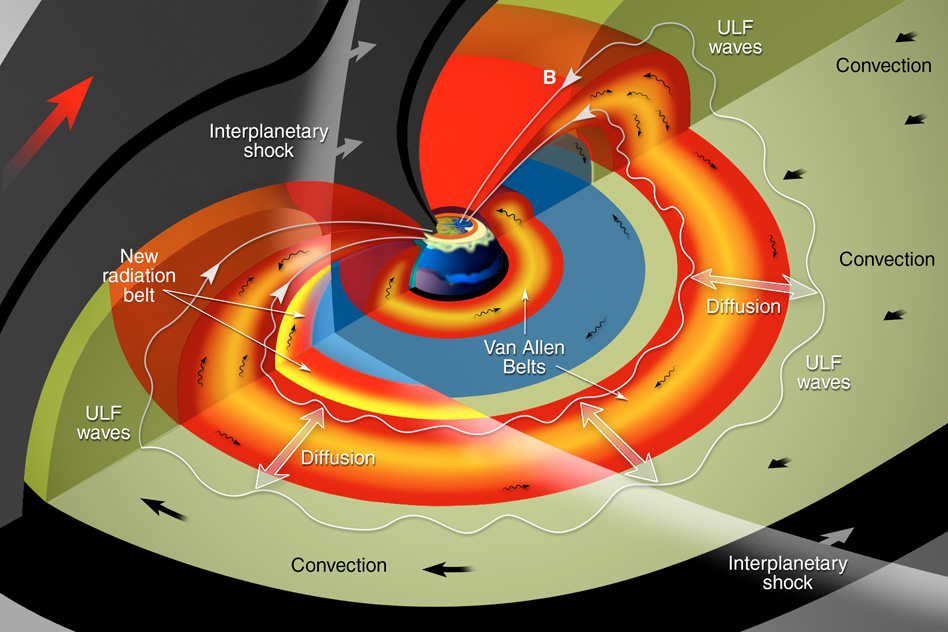
NASA’s Van Allen Probes have captured the effects of a solar shockwave on Earth’s radiation from beginning to end for the first time.
On October 8, 2013, an explosion on the sun’s surface sent a supersonic blast wave of solar wind out into space. This shockwave tore past Mercury and Venus, blitzing by the moon before streaming toward Earth. The shockwave struck a massive blow to the Earth’s magnetic field, setting off a magnetized sound pulse around the planet.
NASA’s Van Allen Probes, twin spacecraft orbiting within the radiation belts deep inside the Earth’s magnetic field, captured the effects of the solar shockwave just before and after it struck.
Now scientists at MIT’s Haystack Observatory, the University of Colorado, and elsewhere have analyzed the probes’ data, and observed a sudden and dramatic effect in the shockwave’s aftermath: The resulting magnetosonic pulse, lasting just 60 seconds, reverberated through the Earth’s radiation belts, accelerating certain particles to ultrahigh energies.
“These are very lightweight particles, but they are ultrarelativistic, killer electrons — electrons that can go right through a satellite,” says John Foster, associate director of MIT’s Haystack Observatory. “These particles are accelerated, and their number goes up by a factor of 10, in just one minute. We were able to see this entire process taking place, and it’s exciting: We see something that, in terms of the radiation belt, is really quick.”
The findings represent the first time the effects of a solar shockwave on Earth’s radiation belts have been observed in detail from beginning to end. Foster and his colleagues have published their results in the Journal of Geophysical Research.
Catching a shockwave in the act
Since August 2012, the Van Allen Probes have been orbiting within the Van Allen radiation belts. The probes’ mission is to help characterize the extreme environment within the radiation belts, so as to design more resilient spacecraft and satellites.
One question the mission seeks to answer is how the radiation belts give rise to ultrarelativistic electrons — particles that streak around the Earth at 1,000 kilometers (620 miles) per second, circling the planet in just five minutes. These high-speed particles can bombard satellites and spacecraft, causing irreparable damage to onboard electronics.
The two Van Allen probes maintain the same orbit around the Earth, with one probe following an hour behind the other. On October 8, 2013, the first probe was in just the right position, facing the sun, to observe the radiation belts just before the shockwave struck the Earth’s magnetic field. The second probe, catching up to the same position an hour later, recorded the shockwave’s aftermath.
Dealing a “sledgehammer blow”
Foster and his colleagues analyzed the probes’ data, and laid out the following sequence of events: As the solar shockwave made impact, according to Foster, it struck “a sledgehammer blow” to the protective barrier of the Earth’s magnetic field. But instead of breaking through this barrier, the shockwave effectively bounced away, generating a wave in the opposite direction, in the form of a magnetosonic pulse — a powerful, magnetized sound wave that propagated to the far side of the Earth within a matter of minutes.
In that time, the researchers observed that the magnetosonic pulse swept up certain lower-energy particles. The electric field within the pulse accelerated these particles to energies of 3 to 4 million electronvolts, creating 10 times the number of ultrarelativistic electrons that previously existed.
Taking a closer look at the data, the researchers were able to identify the mechanism by which certain particles in the radiation belts were accelerated. As it turns out, if particles’ velocities as they circle the Earth match that of the magnetosonic pulse, they are deemed “drift resonant,” and are more likely to gain energy from the pulse as it speeds through the radiation belts. The longer a particle interacts with the pulse, the more it is accelerated, giving rise to an extremely high-energy particle.
Foster says solar shockwaves can impact Earth’s radiation belts a couple of times each month. The event in 2013 was a relatively minor one.
“This was a relatively small shock. We know they can be much, much bigger,” Foster says. “Interactions between solar activity and Earth’s magnetosphere can create the radiation belt in a number of ways, some of which can take months, others days. The shock process takes seconds to minutes. This could be the tip of the iceberg in how we understand radiation-belt physics.”
Barry Mauk, a project scientist at Johns Hopkins University’s Applied Physics Laboratory, views the group’s findings as “the most comprehensive analysis of shock-induced acceleration within Earth’s space environment ever achieved.”
“Significant shock-induced acceleration of Earth’s radiation belts occur only occasionally, but these events are important because they have the potential of suddenly generating the most intense and energetic electrons, and therefore the most dangerous conditions for astronauts and satellites,” says Mauk, who did not contribute to the study. “Earth’s space environment serves as a wonderful laboratory for studying the nature of shock acceleration that is occurring elsewhere in the solar system and universe.”
Reference: “Shock-Induced Prompt Relativistic Electron Acceleration In the Inner Magnetosphere” by J. C. Foster, J. R. Wygant, M. K. Hudson, A. J. Boyd, D. N. Baker, P. J. Erickson and H. E. Spence, 10 January 2015, Journal of Geophysical Research Space Physics.
DOI: 10.1002/2014JA020642
Never miss a breakthrough: Join the SciTechDaily newsletter.
Follow us on Google and Google News.