
Close Menu
    Facebook X (Twitter) Instagram
    SciTechDaily
    • Biology
    • Chemistry
    • Earth
    • Health
    • Physics
    • Science
    • Space
    • Technology
    Facebook X (Twitter) Pinterest YouTube RSS
    SciTechDaily
    Home»Space»Spitzer Observations of Binary Neutron Star Merger GW170817
    Space

    Spitzer Observations of Binary Neutron Star Merger GW170817

    By Megan Watzke, Harvard-Smithsonian Center for AstrophysicsAugust 4, 2018No Comments4 Mins Read
    Facebook Twitter Pinterest Telegram LinkedIn WhatsApp Email Reddit
    Share
    Facebook Twitter LinkedIn Pinterest Telegram Email Reddit
    Spitzer Views Binary Neutron Star Merger
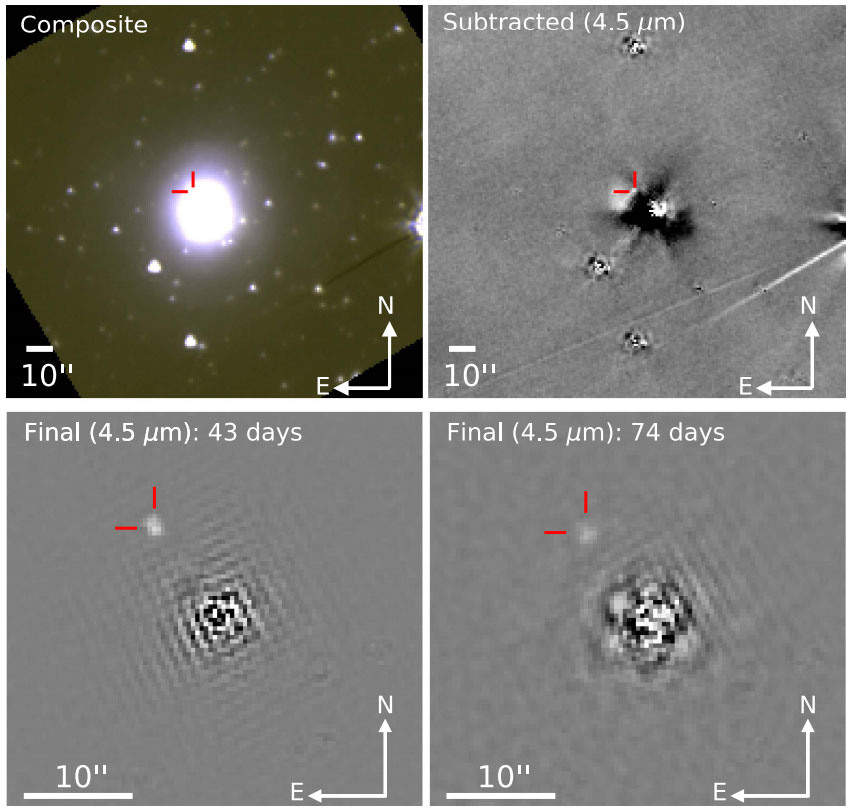
    Upper left: Spitzer 3.6 and 4.5 μm color composite image from the observations on 2017 September 29 (43 days post-merger). The location of GW170817 is marked by the red cross hairs. Upper right: residual from HOTPANTS image subtraction of the 4.5 μm images at 43 and 264 days. While a point source is visible at the position of GW170817, its location is contaminated by subtraction residuals from the host galaxy. Bottom: residual images (left: 43 days; right: 74 days) after subtracting a masked and smoothed version of the image from itself. An isolated point source is clearly visible at the location of GW170817.

    GW170817 is the name given to a gravitational wave signal seen by the LIGO and Virgo detectors on August 17, 2017. Lasting for about 100 seconds, the signal was produced by the merger of two neutron stars. The observation was then confirmed — the first time this has happened for gravitational waves — by observations with light waves: the preceding five detections of merging black holes did not have (and were not expected to have) any detectable electromagnetic signals. The light from the neutron star merger is produced by the radioactive decay of atomic nuclei created in the event. (Neutron star mergers do more than just produce optical light, by the way: they are also responsible for making most of the gold in the universe.) Numerous ground-based optical observations of the merger concluded that the decaying atomic nuclei fall into at least two groups, a rapidly evolving and fast-moving one composed of elements less massive than Lanthanide Series elements, and one that is more slowly evolving and dominated by heavier elements.

    Ten days after the merger, the continuum emission peaked at infrared wavelengths with a temperature of approximately 1300 Kelvin (1,o00 Celsius or 1,900 Fahrenheit), and continued to cool and dim. The Infrared Array Camera (IRAC) on the Spitzer Space Telescope observed the region around GW170817 for 3.9 hours in three epochs 43, 74, and 264 days after the event (SAO is the home of IRAC PI Fazio and his team). The shape and evolution of the emission reflect the physical processes at work, for example, the fraction of heavy elements in the ejecta or the possible role of carbon dust. Tracking the flux over time enables the astronomers to refine their models and understanding of what happens when neutron stars merge.

    A team of CfA astronomers, Victoria Villar, Philip Cowperthwaite, Edo Berger, Peter Blanchard, Sebastian Gomez, Kate Alexander, Tarraneh Eftekhari, Giovanni Fazio, James Guillochon, Joe Hora, Matthew Nicholl, and Peter Williams and two colleagues participated in an effort to measure and interpret the infrared observations. The source was extremely faint and moreover lies close to a very bright point source. Using a novel algorithm to prepare and subtract the IRAC images to eliminate the constant-brightness objects, the team was able to spot the merger source clearly in the first two epochs, although it was fainter than was predicted by the models by more than about a factor of two. It had dimmed beyond detection by the third epoch. However, the rate of dimming and the infrared colors are consistent with models; at these epochs the material had cooled down to about 1200 Kelvin (900 Celsius or 1,700 Fahrenheit). The team suggests several possible reasons for the surprising faintness, including the possible transformation of the ejecta into a nebulous phase, and notes that the new dataset will help refine the models.

    The scientists conclude by emphasizing that future binary star merger detections (an improved LISA will begin observing again in 2019) will similarly benefit from infrared observations, and that characterization of the infrared will enable more accurate determination of the nuclear decay processes underway. Their current paper, moreover, shows that Spitzer should be able to spot binary mergers as far away as four hundred million light-years, about the distance that the improved LISA should be able to probe.

    Reference: “Spitzer Space Telescope Infrared Observations of the Binary Neutron Star Merger GW170817” by V. A. Villar, P. S. Cowperthwaite, E. Berger, P. K. Blanchard, S. Gomez, K. D. Alexander, R. Margutti, R. Chornock, T. Eftekhari, G. G. Fazio, J. Guillochon, J. L. Hora, M. Nicholl and P. K. G. Williams, 24 July 2018, The Astrophysical Journal.
    DOI: 10.3847/2041-8213/aad281

    Never miss a breakthrough: Join the SciTechDaily newsletter.
    Follow us on Google and Google News.

    Astronomy Astrophysics Cosmology Harvard-Smithsonian Center for Astrophysics Neutron Star Spitzer Space Telescope
    Share. Facebook Twitter Pinterest LinkedIn Email Reddit

    Related Articles

    Astronomers Reveal Superluminous Supernova Gaia16apd is Powered by a Magnetar

    Astronomers Study the Star Formation Rates of Galaxies

    Colliding Neutron Stars Produce Gold

    Magnetic Winds From a Young Star in the Orion Nebula

    NGC 6334 Experiencing a “Mini-Starburst”

    NASA Data Suggests Black Holes Abundant Among the Earliest Stars

    New Study Challenges Planck Results

    Calculations Show the Ideal Time to Study the Cosmos

    Using Infrared Images from Hubble & Spitzer, Scientists Discover 25 Distant Galaxies

    Leave A Reply Cancel Reply

    • Facebook
    • Twitter
    • Pinterest
    • YouTube

    Don't Miss a Discovery

    Subscribe for the Latest in Science & Tech!

    Trending News

    Stanford Scientists Discover a Remarkable Way To Rescue Dying Corals in Just Seven Weeks

    0 to 15 MPH in a Single Swipe: New Research Reveals How Ancient Giant Sea Monsters Ambushed Their Prey

    Late-Night Snacking Could Be Putting Your Liver at Risk

    40 Years of Superconductor Science Just Got Turned Upside Down by a Stunning Discovery

    A 50-Year-Old Mystery: Scientists Discover What May Have Killed Brazil’s Frogs

    Scientists Discover Exercise Changes the Body in Ways We Never Fully Understood

    Scientists Restore Memory in Mice With Alzheimer’s by Boosting a Single Brain Protein

    Scientists Create “Super Ice” That’s 10 Times Stronger and Rivals Concrete in Strength

    Follow SciTechDaily
    • Facebook
    • Twitter
    • YouTube
    • Pinterest
    • Newsletter
    • RSS
    SciTech News
    • Biology News
    • Chemistry News
    • Earth News
    • Health News
    • Physics News
    • Science News
    • Space News
    • Technology News
    Recent Posts
    • Common Chemicals Trigger Alarming Changes in Human Breast Tissue Models
    • A Deadly Virus Has Been Hiding in Brazil for 142 Years – and Scientists Just Uncovered a Hidden Danger
    • MIT Scientists Reprogram Immune Cells Inside the Body To Destroy Cancer
    • Scientists Discover Ancient Human DNA Hidden in Cave Walls for Thousands of Years
    • Scientists Discover a Hidden Oxygen Source Deep Inside Earth That Could Rewrite Our Planet’s History
    Copyright © 1998 - 2026 SciTechDaily. All Rights Reserved.
    • Science News
    • About
    • Contact
    • Editorial Board
    • Privacy Policy
    • Terms of Use

    Type above and press Enter to search. Press Esc to cancel.