
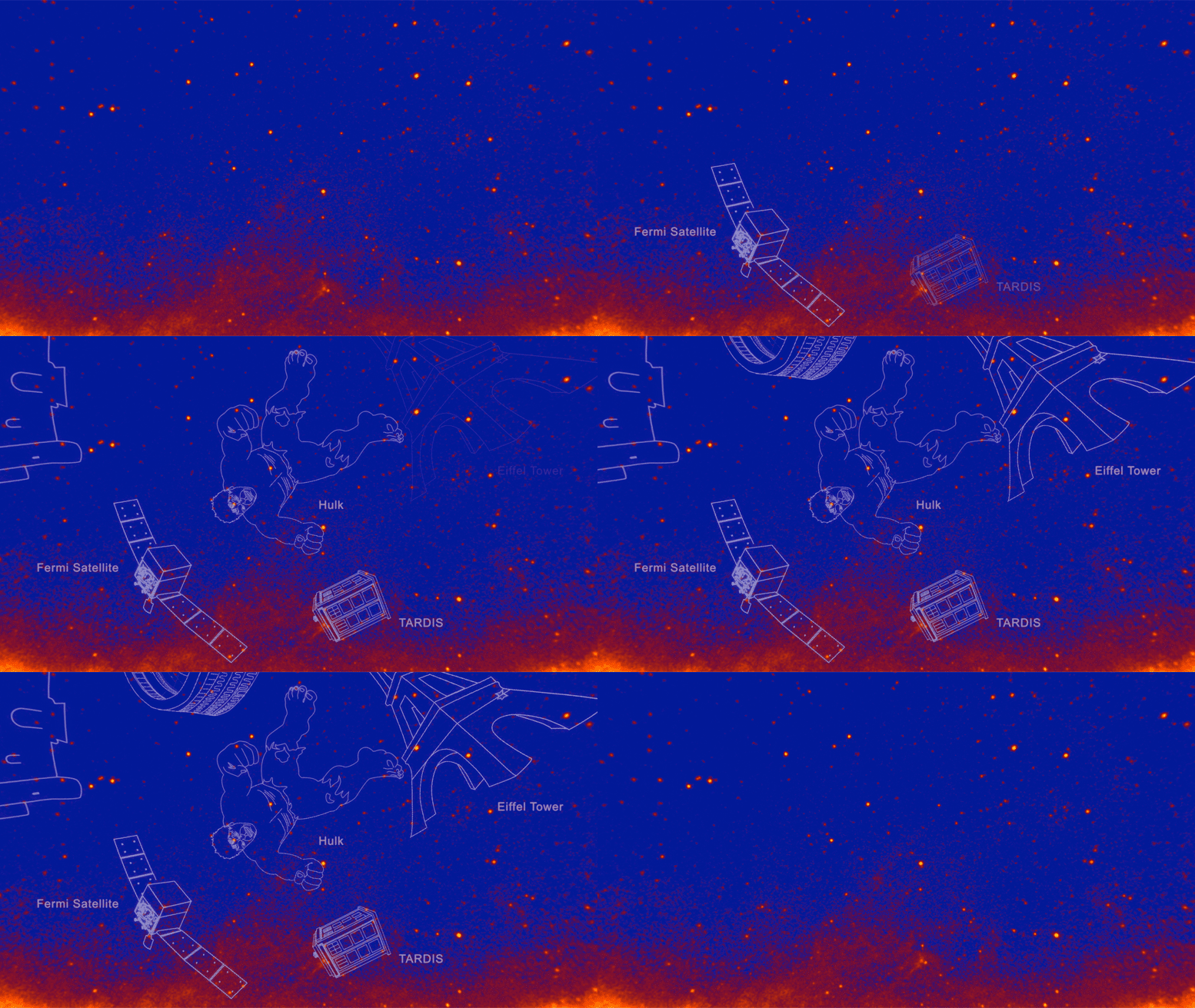
Long ago, sky watchers linked the brightest stars into patterns reflecting animals, heroes, monsters and even scientific instruments into what is now an official collection of 88 constellations. Now scientists with NASA’s Fermi Gamma-ray Space Telescope have devised a set of modern constellations constructed from sources in the gamma-ray sky to celebrate the mission’s 10th year of operations.
To explore Fermi’s Gamma-ray Constellations, visit:https://fermi.gsfc.nasa.gov/science/constellations/
The new constellations include a few characters from modern myths. Among them are the Little Prince, the time-warping TARDIS from “Doctor Who,” Godzilla and his heat ray, the antimatter-powered U.S.S. Enterprise from “Star Trek: The Original Series” and the Hulk, the product of a gamma-ray experiment gone awry.
“Developing these unofficial constellations was a fun way to highlight a decade of Fermi’s accomplishments,” said Julie McEnery, the Fermi project scientist at NASA’s Goddard Space Flight Center in Greenbelt, Maryland. “One way or another, all of the gamma-ray constellations have a tie-in to Fermi science.”
Since July 2008, Fermi’s Large Area Telescope (LAT) has been scanning the entire sky each day, mapping and measuring sources of gamma rays, the highest-energy light in the universe. The emission may come from pulsars, nova outbursts, the debris of supernova explosions and giant gamma-ray bubbleslocated in our own galaxy, or supermassive black holes and gamma-ray bursts — the most powerful explosions in the cosmos — in others.
“By 2015, the number of different sources mapped by Fermi’s LAT had expanded to about 3,000 — 10 times the number known before the mission,” said Goddard’s Elizabeth Ferrara, who led the constellation project. “For the first time ever, the number of known gamma-ray sources was comparable to the number of bright stars, so we thought a new set of constellations was a great way to illustrate the point.”
The 21 gamma-ray constellations include famous landmarks — such as Sweden’s recovered warship, Vasa, the Washington Monument and Mount Fuji in Japan — in countries contributing to Fermi science. Others represent scientific ideas or tools, from Schrödinger’s Cat — both alive and dead, thanks to quantum physics — to Albert Einstein, Radio Telescope and Black Widow Spider, the namesake of a class of pulsars that evaporate their unfortunate companion stars.
Ferrara and Daniel Kocevski, an astrophysicist now at NASA’s Marshall Space Flight Center in Huntsville, Alabama, developed a web-based interactive to showcase the constellations, with artwork from Aurore Simonnet, an illustrator at Sonoma State University in Rohnert Park, California, and a map of the whole gamma-ray sky from Fermi. Clicking on a constellation turns on its artwork and name, which includes a link to a page with more information. Other controls switch on the visible sky and selected traditional constellations.
“Fermi is still going strong, and we are now preparing a new all-sky LAT catalog,” said Jean Ballet, a Fermi team member at the French Atomic Energy Commission in Saclay. “This will add about 2,000 sources, many varying greatly in brightness, further enriching these constellations and enlivening the high-energy sky!”
NASA’s Fermi Gamma-ray Space Telescope is an astrophysics and particle physics partnership, developed in collaboration with the U.S. Department of Energy and with important contributions from academic institutions and partners in France, Germany, Italy, Japan, Sweden and the United States.
Never miss a breakthrough: Join the SciTechDaily newsletter.
Follow us on Google and Google News.