
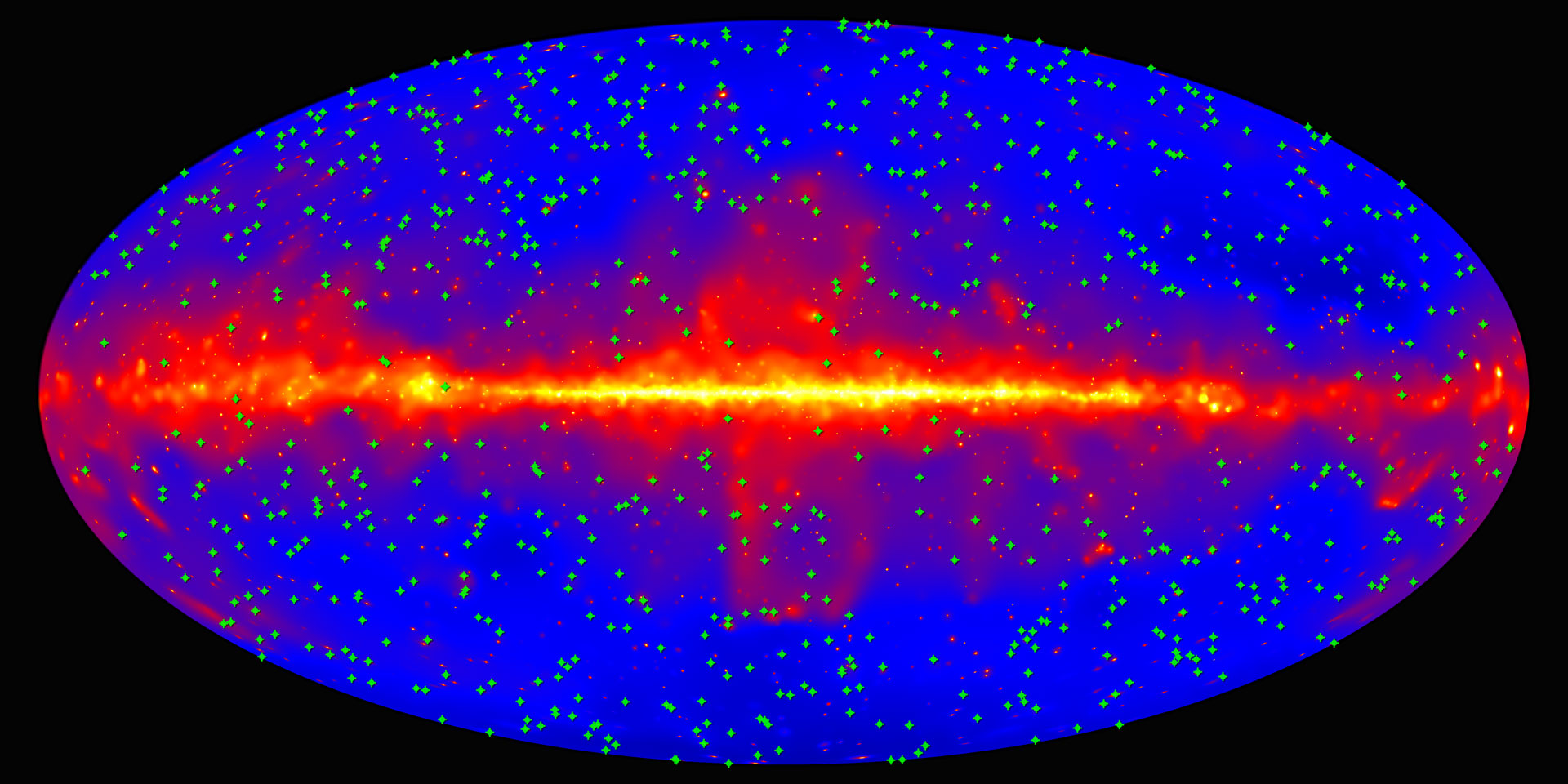
Scientists using data from NASA’s Fermi Gamma-ray Space Telescope have measured all the starlight produced over 90 percent of the universe’s history. The analysis, which examines the gamma-ray output of distant galaxies, estimates the formation rate of stars and provides a reference for future missions that will explore the still-murky early days of stellar evolution.
“Stars create most of the light we see and synthesize most of the universe’s heavy elements, like silicon and iron,” said lead scientist Marco Ajello, an astrophysicist at Clemson University in South Carolina. “Understanding how the cosmos we live in came to be depends in large part on understanding how stars evolved.”
Gamma rays from distant galaxies called blazars interact with starlight as they travel across the universe. As shown in this video, those reaching the Fermi Gamma-ray Space Telescope can help scientists learn about the history of star formation throughout the cosmos. Credit: NASA’s Goddard Space Flight Center
One of the main goals of the Fermi mission, which celebrated its 10th anniversary in orbit this year, was to assess the extragalactic background light (EBL), a cosmic fog composed of all the ultraviolet, visible, and infrared light stars have created over the universe’s history. Because starlight continues to travel across the cosmos long after its sources have burned out, measuring the EBL allows astronomers to study stellar formation and evolution separately from the stars themselves.
“This is an independent confirmation of previous measurements of star-formation rates,” said David Thompson, Fermi’s deputy project scientist at NASA’s Goddard Space Flight Center in Greenbelt, Maryland. “In astronomy, when two completely independent methods give the same answer, that usually means we’re doing something right. In this case we’re measuring star formation without looking at stars at all but by observing gamma rays that have traveled across the cosmos.”
Gamma rays are the highest-energy form of light. They are so energetic, in fact, that their interactions with starlight have unusual consequences. “When the right frequencies of light collide, they can convert into matter through Albert Einstein’s famous equation E=mc2,” said co-author Alberto Dominguez, an astrophysicist at the Complutense University of Madrid.
The collision between a high-energy gamma ray and infrared light, for example, transforms the energy into a pair of particles, an electron, and its antimatter counterpart, a positron. The same process occurs when medium-energy gamma rays interact with visible light, and low-energy gamma rays interact with ultraviolet light. Fermi’s ability to detect gamma rays across a wide range of energies makes it uniquely suited for mapping the EBL spectrum. Enough of these interactions occur over cosmic distances that the farther back scientists look, the more evident their effects become on gamma-ray sources, enabling a deep probe of the universe’s stellar content.
The scientists, led by Vaidehi Paliya, a postdoctoral researcher in Ajello’s group at Clemson, examined gamma-ray signals from 739 blazars — galaxies with monster black holes at their centers — collected over nine years by Fermi’s Large Area Telescope (LAT). The measurement quintuples the number of blazars used in an earlier Fermi EBL analysis published in 2012 and includes new calculations of how the EBL builds over time, revealing the peak of star formation around 10 billion years ago.
The new EBL measurement also provides important confirmation of previous estimates of star formation from missions that analyze many individual sources in deep galaxy surveys, like the Hubble Space Telescope. These types of surveys, however, often miss fainter stars and galaxies and cannot account for star formation that takes place in intergalactic space. These missing contributions must be estimated during each survey’s analysis.
The EBL, though, includes starlight from all sources and avoids these problems. The Fermi result, therefore, provides independent confirmation that measurements using deep galaxy surveys properly account for their biases. It can also help guide future surveys from missions like the James Webb Space Telescope (JWST).
“One of Webb’s primary objectives is to unravel what happened in the first billion years after the big bang,” said co-author Kári Helgason, an astrophysicist at the University of Iceland. “Our workplaces important new limits on the amount of starlight we can expect to see in those first billion years — a largely unexplored epoch in the universe — and provides a benchmark for future studies.”
The Fermi Gamma-ray Space Telescope is an astrophysics and particle physics partnership managed by NASA’s Goddard Space Flight Center in Greenbelt, Maryland. Fermi was developed in collaboration with the U.S. Department of Energy, with important contributions from academic institutions and partners in France, Germany, Italy, Japan, Sweden, and the United States.
Reference: “A gamma-ray determination of the Universe’s star formation history” by The Fermi-LAT Collaboration, 30 Nov 2018, Science.
DOI: 10.1126/science.aat8123
Never miss a breakthrough: Join the SciTechDaily newsletter.
Follow us on Google and Google News.