

Close Menu
    Facebook X (Twitter) Instagram
    SciTechDaily
    • Biology
    • Chemistry
    • Earth
    • Health
    • Physics
    • Science
    • Space
    • Technology
    Facebook X (Twitter) Pinterest YouTube RSS
    SciTechDaily
    Home»Physics»Defrosting Surfaces in Seconds at 100x Efficiency
    Physics

    Defrosting Surfaces in Seconds at 100x Efficiency

    By American Institute of PhysicsAugust 30, 2019No Comments4 Mins Read
    Facebook Twitter Pinterest Telegram LinkedIn WhatsApp Email Reddit
    Share
    Facebook Twitter LinkedIn Pinterest Telegram Email Reddit

    Artists Illustration Melting Ice Fast

    A group of researchers has devised a method of sliding ice and frost off surfaces by melting the interfacial layer directly.

    In the future, a delayed flight due to ice will be no cause for a meltdown.

    A group of researchers at the University of Illinois at Urbana-Champaign and Kyushu University has developed a way to remove ice and frost from surfaces extremely efficiently, using less than 1% of the energy and less than 0.01% of the time needed for traditional defrosting methods.

    The group describes the method in Applied Physics Letters, from AIP Publishing. Instead of conventional defrosting, which melts all the ice or frost from the top layer down, the researchers established a technique that melts the ice where the surface and the ice meet, so the ice can simply slide off.

    “The work was motivated by the large energy efficiency losses of building energy systems and refrigeration systems due to the need to do intermittent defrosting. The systems must be shut down, the working fluid is heated up, then it needs to be cooled down again,” said author Nenad Miljkovic, at UIUC. “This eats up a lot of energy when you think of the yearly operational costs of running intermittent defrosting cycles.”

    According to the authors, the biggest source of inefficiency in conventional systems is that much of the energy used for de-icing goes into heating other components of the system rather than directly heating the frost or ice. This increases energy consumption and system downtime.
    De-Icing at Where the Ice and Surface Meet
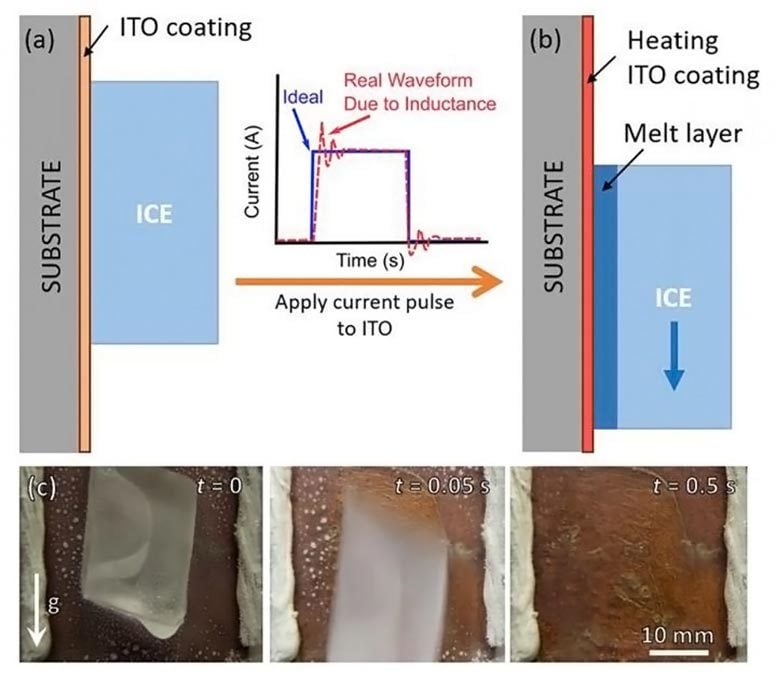
    Researchers have developed a way to remove ice and frost from surfaces extremely efficiently, using less than 1% of the energy and less than 0.01% of the time needed for traditional defrosting methods. Instead of conventional defrosting, which melts all the ice or frost from the top layer down, the researchers established a technique that melts the ice where the surface and the ice meet, so the ice can simply slide off. They describe their work in Applied Physics Letters. This image shows (a) thin layer of ITO coating applied to substrate to be de-iced; (b) ITO heats up as current applied, water melts at interface allowing ice to slide down under gravity; (c) time-lapse images during de-icing. Credit: Nenad Miljkovic

    Instead, the researchers proposed delivering a pulse of very high current where the ice and the surface meet to create a layer of water. To ensure the pulse reaches the intended space rather than melting the exposed ice, the researchers apply a thin coating of indium tin oxide (ITO) — a conductive film often used for defrosting — to the surface of the material. Then, they leave the rest to gravity.

    To test this, the scientists defrosted a small glass surface cooled to minus 15.1 degrees Celsius (59.2 degrees Fahrenheit) — about as cold as the warmest parts of Antarctica — and to minus 71 degrees Celsius — colder than the coldest parts of Antarctica. These temperatures were chosen to model heating, ventilation, air conditioning and refrigeration applications and aerospace applications, respectively. In all tests, the ice was removed with a pulse lasting less than one second.

    In a real, 3D system, gravity would be assisted by airflow. “At scale, it all depends on the geometry,” Miljkovic said. “However, the efficiency of this approach should definitely still be much better than conventional approaches.”

    The group hasn’t studied more complicated surfaces like airplanes yet, but they think it’s an obvious future step.

    “They are a natural extension as they travel fast, so the shear forces on the ice are large, meaning only a very thin layer at the interface needs to be melted in order to remove the ice,” Miljkovic said. “Work would be needed to figure out how we can coat curved components conformally with the ITO and to figure out how much energy we would need.”

    The researchers hope to work with external companies on scaling up their approach to commercialization.

    For more on this research, see Technique to Efficiently De-Ice Surfaces in Seconds.

    Reference: “Pulse interfacial defrosting” by S. Chavan, T. Foulkes, Y. Gurumukhi, K. Boyina, K.F. Rabbi and N. Miljkovic, 12 August 2019, Applied Physics Letters.
    DOI: 10.1063/1.5113845

    Never miss a breakthrough: Join the SciTechDaily newsletter.
    Follow us on Google and Google News.

    American Institute of Physics Ice Kyushu University Popular University of Illinois at Urbana-Champaign
    Share. Facebook Twitter Pinterest LinkedIn Email Reddit

    Related Articles

    Yikes! Flushing Toilets Create Long-Lasting Clouds of Virus-Containing Particles

    Next-Gen Laser Beams With Up to 10 Petawatts of Power Will Usher In New Era of Relativistic Plasmas Research

    Glug, Glug: Physics of Bubble Dynamics Reveals How to Empty Bottles Faster

    Galileo’s Jupiter Entry Probe Vaporized – New Gaps Revealed in Heat Shield Modeling

    World’s Most Efficient Single-Photon Source Created Using Time Multiplexing

    Researchers Develop Technique to Efficiently De-Ice Surfaces in Seconds

    Physicists Use Lasers to Study Explosions

    Unraveling One of the Greatest Mysteries in Condensed Matter Physics

    Physicists Make First Ever Measurement of Antiproton Interactions

    Leave A Reply Cancel Reply

    • Facebook
    • Twitter
    • Pinterest
    • YouTube

    Don't Miss a Discovery

    Subscribe for the Latest in Science & Tech!

    Trending News

    Scientists Recreate a Nuclear Fireball and Uncover Fallout’s Hidden Chemistry

    These Tiny Gut Particles Could Be Accelerating Aging Throughout the Body

    Doctors Changed One Thing and Weight Gain Stopped

    Magnetic Fields May Solve a Longstanding Binary Star Mystery

    The Probiotic Breakthrough for Natural Anxiety Relief and Better Mental Health

    Animal vs. Plant Protein: Scientists Found a Surprising Nutritional Difference

    According to Scientists, This Simple Dietary Change Is Linked to Lower Depression Scores

    Researchers Discover a Hidden Vitamin D Problem That Persists Year-Round

    Follow SciTechDaily
    • Facebook
    • Twitter
    • YouTube
    • Pinterest
    • Newsletter
    • RSS
    SciTech News
    • Biology News
    • Chemistry News
    • Earth News
    • Health News
    • Physics News
    • Science News
    • Space News
    • Technology News
    Recent Posts
    • Scientists Tracked 4,500 Animals During COVID – What They Discovered Was Surprising
    • Hidden Phase of Matter Finally Captured After Decades of Predictions
    • The Strange “Spacetime Crystal” That Can Suddenly Turn Into a Black Hole
    • A Hidden Gut Signal May Be Driving Sleep Apnea’s Deadly Heart Risks
    • This AI-Designed “Universal Vaccine” Could Stop Future Pandemics Before They Start
    Copyright © 1998 - 2026 SciTechDaily. All Rights Reserved.
    • Science News
    • About
    • Contact
    • Editorial Board
    • Privacy Policy
    • Terms of Use

    Type above and press Enter to search. Press Esc to cancel.