

Airplane wings, wind turbines, and indoor heating systems all struggle under the weight and chill of ice. Defrosting and de-icing techniques are energy-intensive, however, and often require large masses of ice to melt completely in order to work. Researchers from the University of Illinois and Kyushu University in Japan have developed a new technique that requires only a thin layer of ice at the interface of a surface to melt, allowing it to slide off under the force of gravity.
The method, which uses less than 1% of the energy and less than 0.01% of the time needed for traditional de-icing techniques, is published in the journal Applied Physics Letters.
The inefficiency problem in conventional systems results from most of the energy used in heating and de-icing needing to go into warming other components of the system rather than directly heating the frost or ice, the researchers said. This increases energy consumption and system downtime.
“In order to defrost, the system cooling function is shut down, the working fluid is heated up to melt ice or frost, then it needs to be cooled down again once the surface is clean,” said lead author and U. of I. mechanical science and engineering professor Nenad Miljkovic. “This consumes a lot of energy, when you think of the yearly operational costs of running intermittent defrosting cycles.”
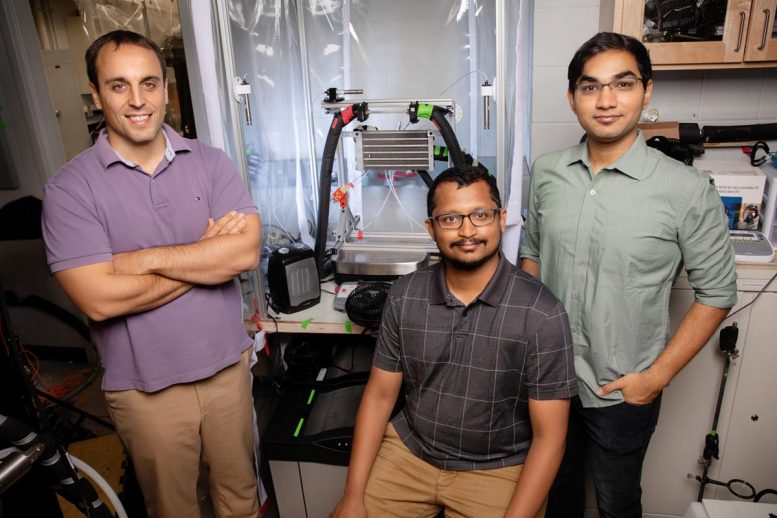
The researchers propose delivering a pulse of very high current to the interface between the ice and the surface to create a layer of water. To ensure the pulse is able to generate the required heat at the interface, the researchers apply a thin coating of a material called indium tin oxide – a conductive film often used for defrosting – to the surface of the material. Then, they leave the rest to gravity.
To test this, the team defrosted a vertical glass plate cooled to -15 degrees Celsius (5 degree Fahrenheit) and to -70 degrees Celsius (-94 degree Fahrenheit). These temperatures were chosen to model heating, ventilation, and air conditioning applications and refrigeration and aerospace applications, respectively. In all tests, the ice was removed with a pulse lasting less than one second.
In a real-world setting, gravity would be assisted by airflow, Miljkovic said. “This new approach is more efficient than conventional methods.”
The group has not yet studied more complicated 3D surfaces like airplane components, which they said is an obvious future step. “Aircraft are a natural extension as they travel fast, so shear forces on the ice are large, meaning only a very thin layer at the interface needs to be melted in order to remove ice,” Miljkovic said. “More work is needed to figure out how we can coat curved components with indium tin oxide conformably and in a cost-effective manner while maintaining safety compliance.”
Large systems such as aircraft wings would require very high amounts of instantaneous current, the researchers said. “Although the total power during the pulse is very low, the instantaneous power is high,” said Illinois graduate student Yashraj Gurumukhi. “Further work is needed in terms of electronics required to power the circuits that heat up the interface.”
The Air Conditioning and Refrigeration Center, National Science Foundation, and Japanese Ministry of Education, Culture, Sports, Science and Technology supported this research.
Reference: “Pulse interfacial defrosting” by S. Chavan, T. Foulkes, Y. Gurumukhi, K. Boyina, K.F. Rabbi and N. Miljkovic, 12 August 2019, Applied Physics Letters.
DOI: 10.1063/1.5113845
Never miss a breakthrough: Join the SciTechDaily newsletter.
Follow us on Google and Google News.