
Close Menu
    Facebook X (Twitter) Instagram
    SciTechDaily
    • Biology
    • Chemistry
    • Earth
    • Health
    • Physics
    • Science
    • Space
    • Technology
    Facebook X (Twitter) Pinterest YouTube RSS
    SciTechDaily
    Home»Physics»Physicists Use Lasers to Study Explosions
    Physics

    Physicists Use Lasers to Study Explosions

    By Larry Frum, American Institute of PhysicsSeptember 3, 2019No Comments3 Mins Read
    Facebook Twitter Pinterest Telegram LinkedIn WhatsApp Email Reddit
    Share
    Facebook Twitter LinkedIn Pinterest Telegram Email Reddit

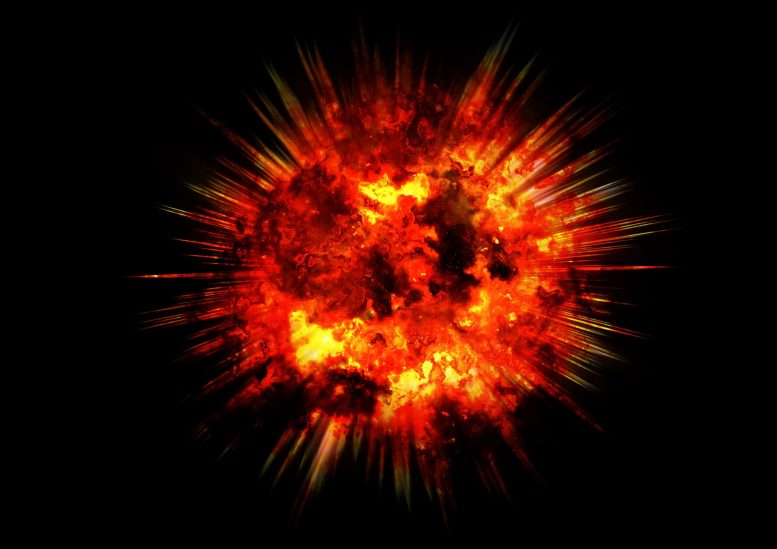
    Explosion

    An explosion is a complex event involving quickly changing temperatures, pressures, and chemical concentrations. In a paper in the Journal of Applied Physics, from AIP Publishing, a special type of infrared laser, known as a swept-wavelength external cavity quantum cascade laser (swept-ECQCL), is used to study explosions. This versatile instrument has a broad wavelength tuning range that allows the measurement of multiple chemical substances, even large molecules, in an explosive fireball.

    The ability to measure and monitor the dramatic changes during explosions could help scientists understand and even control them. Measurements using rugged temperature or pressure probes placed inside an exploding fireball can provide physical data but cannot measure chemical changes that may be generated during the explosion. Sampling the end products of a detonation is possible but provides information only once the explosion is over.

    In this work, molecules in the fireball are detected by monitoring the way they interact with light, especially in the infrared region. These measurements are fast and can be taken a safe distance away. Since fireballs are turbulent and full of strongly absorbing substances, lasers are needed.
    Swept Wavelength External Cavity Quantum Cascade Laser
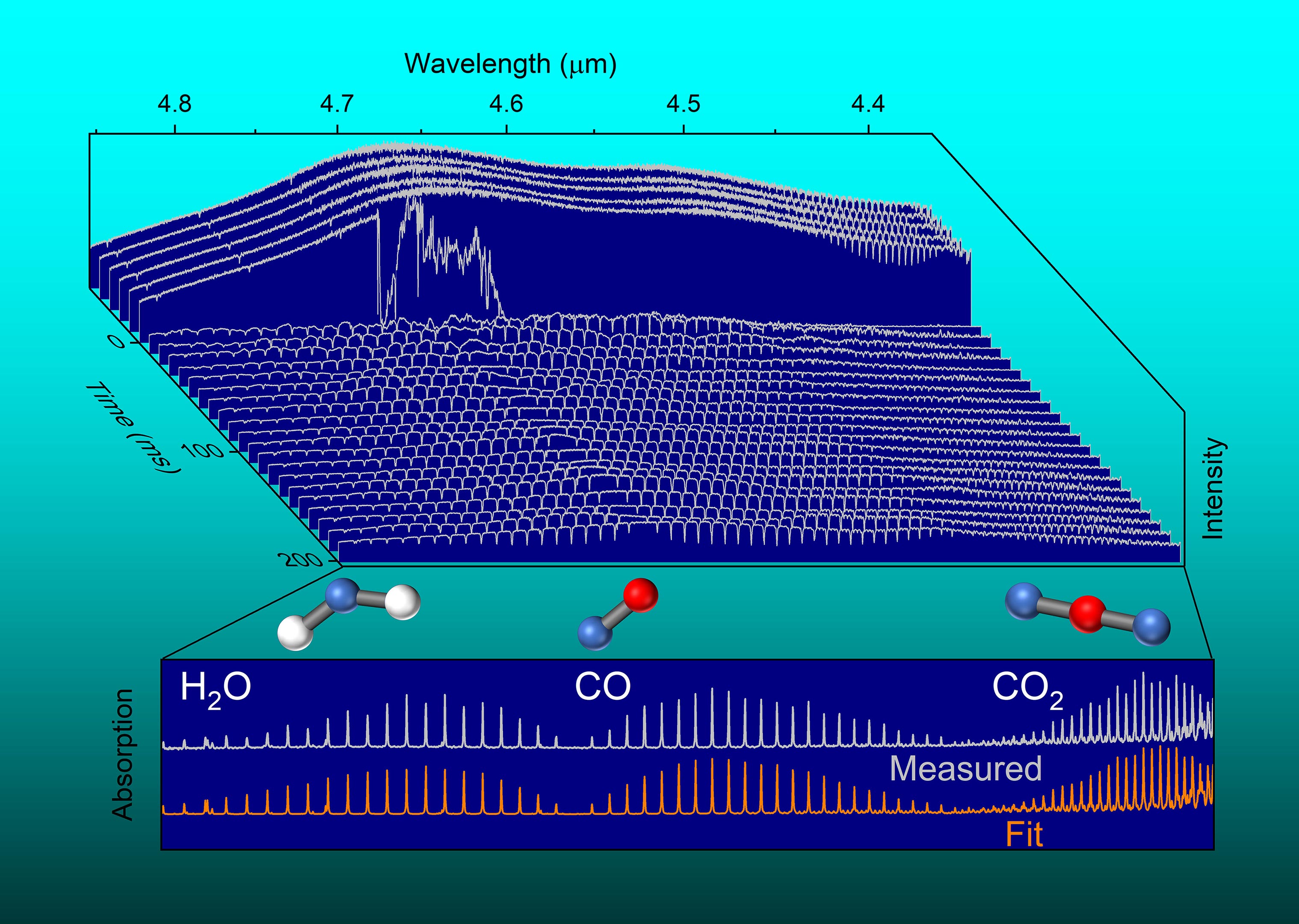
    An explosion is a complex event involving quickly changing temperatures, pressures and chemical concentrations. A special type of infrared laser, known as a swept-wavelength external cavity quantum cascade laser, can be used to study explosions. This versatile instrument has a broad wavelength tuning range that allows the measurement of multiple chemical substances in an explosive fireball. The ability to measure and monitor the dramatic changes during explosions could help scientists understand and even control them. This image shows how a swept-wavelength external cavity quantum cascade laser measures rapid changes in infrared light absorbed by molecules inside an explosive detonation. Credit: Mark C. Phillips

    Using a new instrument built in their lab, the investigators measured explosive events at faster speeds, at higher resolutions and for longer time periods than previously possible using infrared laser light.

    “The swept-ECQCL approach enables new measurements by combining the best features of high-resolution tunable laser spectroscopy with broadband methods such as FTIR,” co-author Mark Phillips explained.

    The study looked at four types of high-energy explosives, all placed in a specially designed chamber to contain the fireball. A laser beam from the swept-ECQCL was directed through this chamber while rapidly varying the laser light’s wavelength. The laser light transmitted through the fireball was recorded throughout each explosion to measure changes in the way infrared light was absorbed by molecules in the fireball.

    The explosion produces substances such as carbon dioxide, carbon monoxide, water vapor, and nitrous oxide. These can all be detected by the characteristic way each absorbs infrared light. Detailed analysis of the results provided the investigators with information about the temperature and concentrations of these substances throughout the explosive event. They were also able to measure the absorption and emission of infrared light from tiny solid particles (soot) created by the explosion.

    The swept-ECQCL measurements provide a new way to study explosive detonations that could have other uses. In future studies, the investigators hope to extend the measurements to more wavelengths, faster scan rates, and higher resolutions.

    ###

    Reference: “Characterization of high-explosive detonations using broadband infrared external cavity quantum cascade laser absorption spectroscopy” by Mark C. Phillips, Bruce E. Bernacki, Sivanandan S. Harilal, Brian E. Brumfield, Joel M. Schwallier and Nick G. Glumac, September 3, 2019, Journal of Applied Physics.
    DOI: 10.1063/1.5107508

    Never miss a breakthrough: Join the SciTechDaily newsletter.
    Follow us on Google and Google News.

    American Institute of Physics Explosion Lasers Popular
    Share. Facebook Twitter Pinterest LinkedIn Email Reddit

    Related Articles

    Next-Gen Laser Beams With Up to 10 Petawatts of Power Will Usher In New Era of Relativistic Plasmas Research

    Previously Unseen Phase of Matter Produced by Ultrafast Laser Pulses

    A Star Is Born: Using World’s Biggest Laser to Study Nucleosynthesis

    Galileo’s Jupiter Entry Probe Vaporized – New Gaps Revealed in Heat Shield Modeling

    Defrosting Surfaces in Seconds at 100x Efficiency

    Physicists Make First Ever Measurement of Antiproton Interactions

    Fastest Laser Blast – 67 Quintillionths of a Second

    Berkeley Lab Laser Accelerator Achieves World Record Performance

    First Real-Time Image of Two Atoms Vibrating in a Molecule

    Leave A Reply Cancel Reply

    • Facebook
    • Twitter
    • Pinterest
    • YouTube

    Don't Miss a Discovery

    Subscribe for the Latest in Science & Tech!

    Trending News

    Largest-Ever Study Finds Medicinal Cannabis Ineffective for Anxiety, Depression, PTSD

    250-Million-Year-Old Egg Solves One of Evolution’s Biggest Mysteries

    Living With Roommates Might Be Changing Your Gut Microbiome Without You Knowing

    Century-Old Cleaning Chemical Linked to 500% Increased Risk of Parkinson’s Disease

    What if Your Memories Never Happened? Physicists Take a New Look at the Boltzmann Brain Paradox

    One of the Universe’s Largest Stars May Be Getting Ready To Explode

    Scientists Discover Enzyme That Could Supercharge Ozempic-Like Weight Loss Drugs

    Popular Sweetener Linked to DNA Damage – “It’s Something You Should Not Be Eating”

    Follow SciTechDaily
    • Facebook
    • Twitter
    • YouTube
    • Pinterest
    • Newsletter
    • RSS
    SciTech News
    • Biology News
    • Chemistry News
    • Earth News
    • Health News
    • Physics News
    • Science News
    • Space News
    • Technology News
    Recent Posts
    • The Most Elusive Number in Physics Just Got Even More Mysterious
    • Scientists Uncover Hidden Trigger Behind Stem Cell Aging
    • Scientists Discover Coral Reefs Are Teeming With Previously Unknown Life
    • Scientists Find Way to Reverse Fatty Liver Disease Without Changing Diet
    • Could Humans Regrow Limbs? New Study Reveals Promising Genetic Pathway
    Copyright © 1998 - 2026 SciTechDaily. All Rights Reserved.
    • Science News
    • About
    • Contact
    • Editorial Board
    • Privacy Policy
    • Terms of Use

    Type above and press Enter to search. Press Esc to cancel.