
Close Menu
    Facebook X (Twitter) Instagram
    SciTechDaily
    • Biology
    • Chemistry
    • Earth
    • Health
    • Physics
    • Science
    • Space
    • Technology
    Facebook X (Twitter) Pinterest YouTube RSS
    SciTechDaily
    Home»Physics»A Star Is Born: Using World’s Biggest Laser to Study Nucleosynthesis
    Physics

    A Star Is Born: Using World’s Biggest Laser to Study Nucleosynthesis

    By American Physical SocietyOctober 21, 2019No Comments4 Mins Read
    Facebook Twitter Pinterest Telegram LinkedIn WhatsApp Email Reddit
    Share
    Facebook Twitter LinkedIn Pinterest Telegram Email Reddit
    Shot Time Image Stellar Nucleosynthesis
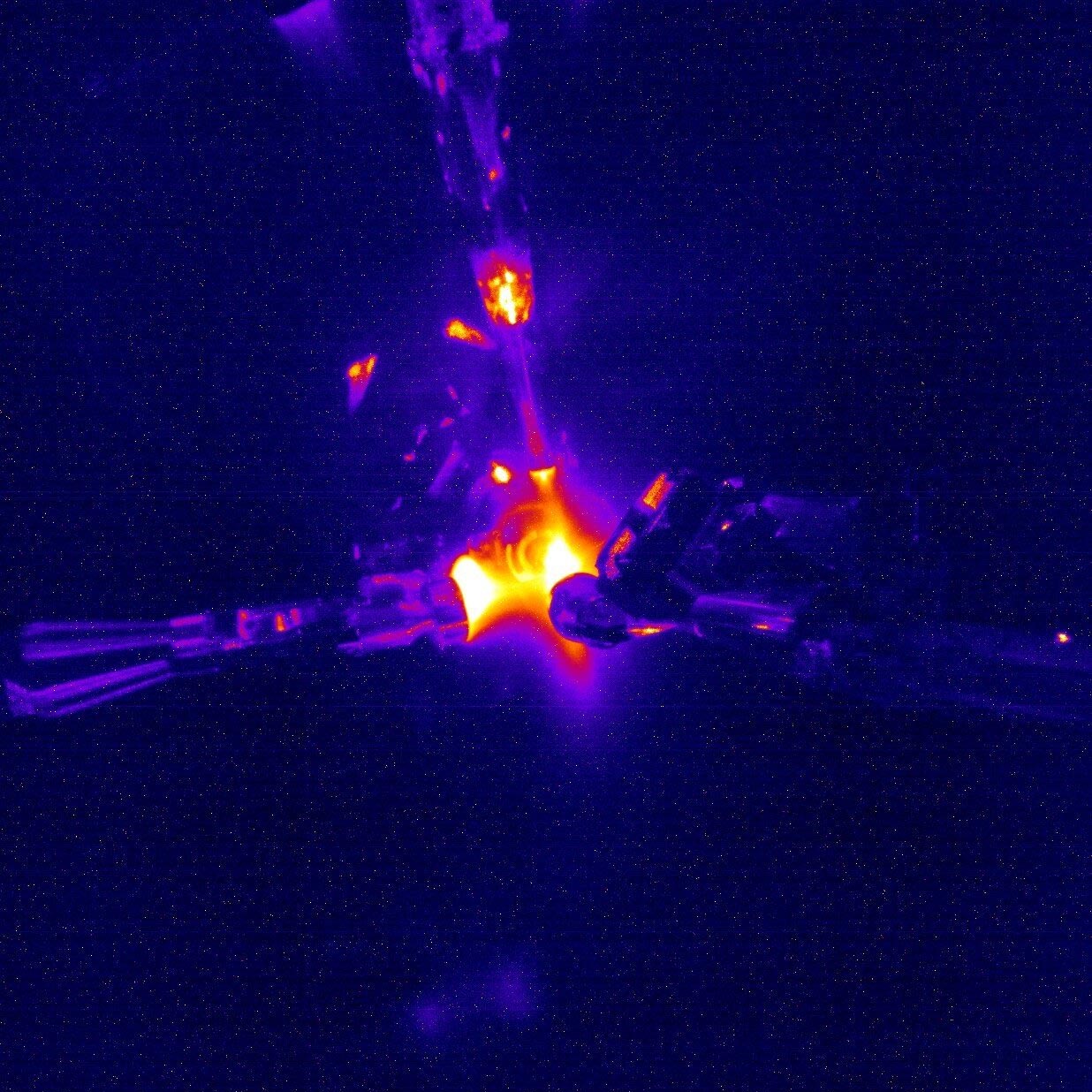
    Shot-time image from a NIF experiment to study stellar nucleosynthesis. Solar 3He-3He reactions are happening in the bright center of the image, where the very hot and very dense star-like conditions are created by blasting a small plastic capsule filled with gas at 10 times the atmospheric pressure with 192 high-powered laser beams. Some of the focused laser beams can be seen coming in from the top and left sides of the image. Credit: Don Jedlovec, LLNL

    Probing nucleosynthesis in star-like conditions using the world’s biggest laser at NIF.

    On a typical day at the world’s biggest laser, the National Ignition Facility (NIF) in Livermore, California, you can find scientists casually making star-like conditions using 192 high-powered lasers. Stars in the universe are formed through a process called nucleosynthesis, which fuses lighter atoms to create new heavier atomic nuclei. Natural elements found here on Earth, such as helium and aluminum, were formed through this process inside of a star not unlike our own sun.

    The NIF laser beams’ energy is amplified in a building equivalent to the length of three football fields and then focused onto tiny gas- or ice-filled capsules with 18 micrometer thick walls (about the thickness of a human hair) and 3mm outer diameters. The capsule is accurately placed in the center of a target chamber that has a diameter of 10 meters. It’s like trying to precisely place an ant in the exact center of a school bus. When the capsules are blasted with all 192 laser beams, they implode, creating very hot and very dense star-like conditions.

    Ongoing experiments at the NIF are studying one of the primary nucleosynthesis processes in the sun, the 3He-3He reaction between two helium ions, in stellar-like conditions. This reaction, shown in the image at the top of the page, is responsible for nearly half the energy generation in our sun as it burns hydrogen into helium.

    “What is so cool about these experiments is that unlike in earlier studies on Earth, we are actually probing this reaction at temperature and density conditions comparable to those found in stars,” says project lead scientist Dr. Maria Gatu Johnson of MIT.

    At the American Physical Society Division of Plasma Physics meeting in Ft. Lauderdale, Florida this week, Dr. Gatu Johnson will report on how protons from the solar 3He-3He reaction have been observed in these experiments under a range of conditions.

    “Surprisingly,” Dr. Gatu Johnson says, “the preliminary results show that at lower temperatures, relatively more protons are seen with higher energy than with lower energy.”

    These results will help scientists add important constraints on theoretical calculations of this complicated reaction and estimate the probability of the 3He-3He reaction happening, as well as other important processes in the sun. There will be one more round of experiments, currently planned for February 2020, where Dr. Gatu Johnson plans to better characterize the temperatures reached in the star-like conditions.

    These experiments are part of a new effort to study nucleosynthesis reactions and relevant phenomena in stellar-like conditions using lasers.

    “High-energy-density plasmas are the only laboratory on earth that recreate the extreme conditions in which the elements were produced in the universe,” says co-Principal Investigator Dr. Alex Zylstra of Lawrence Livermore National Laboratory. The work will continue using this platform to probe other nucleosynthesis reactions and relevant phenomena in the future–this is a new, creative way of studying how star stuff is made!

    This work was supported in part by the U.S. Department of Energy and the National Nuclear Security Administration (DE-NA0001857, DE-NA0002949, DE-NA0002905, DE-FG02-88ER40387, DE-NA-0001808, Center-of-Excellence grant DE-NA0003868).

    Abstract:

    Katherine E. Weimer Award Talk: Studying 3D asymmetries and resulting flows in ICF implosions, and using ICF implosions to study nuclear reactions relevant to stellar nucleosynthesis
    2:00 PM – 5:00 PM, Wednesday, October 23, 2019
    Room: Floridian Ballroom AB

    Never miss a breakthrough: Join the SciTechDaily newsletter.
    Follow us on Google and Google News.

    American Physical Society DOE Fusion Lasers National Ignition Facility Popular
    Share. Facebook Twitter Pinterest LinkedIn Email Reddit

    Related Articles

    World’s Most Powerful Laser Reveals Secrets of Pressure-Driven Ionization in Stars and Nuclear Fusion

    Experiments Probe Carbon’s Crystal Structure at Record Pressures – Five Times the Pressure in Earth’s Core

    Igniting Shock Waves Using Some of the World’s Most Powerful Lasers to Mimic Stars Exploding As Supernovas

    Fusion Energy Solution May Come From Permanent Magnets Like Those on Refrigerator Doors – But Far Stronger

    Fusion Researchers Find Safer, More Effective Way to Create a Star on Earth

    Scientists Invent Way to See Fastest Motions of Electrons That Drive Chemistry for the First Time

    Blowing Bubbles: New Way to Launch and Drive Current in Fusion Plasmas Confirmed

    Previously Unseen Phase of Matter Produced by Ultrafast Laser Pulses

    Magneto-Inertial Fusion Experiment With 36 Plasma Guns – Advancing Toward Clean, Safe Power

    Leave A Reply Cancel Reply

    • Facebook
    • Twitter
    • Pinterest
    • YouTube

    Don't Miss a Discovery

    Subscribe for the Latest in Science & Tech!

    Trending News

    New “Nanozyme Hypothesis” Could Rewrite the Story of Life’s Origins

    Anatomy Isn’t Finished: The Human Body Still Holds Secrets

    “Pretty Close to Home”: The Hidden Earthquake Threat Beneath Seattle

    The Surprising Reason You Might Want To Sleep Without a Pillow

    Scientists Say This Natural Hormone Reverses Obesity by Targeting the Brain

    35-Million-Year-Old Mystery: Strange Arachnid Discovered Preserved in Amber

    Is AI Really Just a Tool? It Could Be Altering How You See Reality

    JWST Reveals a “Forbidden” Planet With a Baffling Composition

    Follow SciTechDaily
    • Facebook
    • Twitter
    • YouTube
    • Pinterest
    • Newsletter
    • RSS
    SciTech News
    • Biology News
    • Chemistry News
    • Earth News
    • Health News
    • Physics News
    • Science News
    • Space News
    • Technology News
    Recent Posts
    • Scientists Freeze a Spinning Nanoparticle to Its Quantum Limit
    • A 100x Faster Breakthrough Could Fix Quantum Computers’ Biggest Problem
    • New Memory Chip Survives 1300°F, Hotter Than Lava
    • Scientists Unveil Microscopy Breakthrough That Reveals “Invisible” Molecular States
    • Scientists Finally Crack the Mystery of Water’s Strangest Behavior After Decades of Research
    Copyright © 1998 - 2026 SciTechDaily. All Rights Reserved.
    • Science News
    • About
    • Contact
    • Editorial Board
    • Privacy Policy
    • Terms of Use

    Type above and press Enter to search. Press Esc to cancel.