
Close Menu
    Facebook X (Twitter) Instagram
    SciTechDaily
    • Biology
    • Chemistry
    • Earth
    • Health
    • Physics
    • Science
    • Space
    • Technology
    Facebook X (Twitter) Pinterest YouTube RSS
    SciTechDaily
    Home»Space»Saturn’s Largest Moon Titan Seen in Unprecedented Detail
    Space

    Saturn’s Largest Moon Titan Seen in Unprecedented Detail

    By SciTechDailyMarch 6, 20124 Comments3 Mins Read
    Facebook Twitter Pinterest Telegram LinkedIn WhatsApp Email Reddit
    Share
    Facebook Twitter LinkedIn Pinterest Telegram Email Reddit
    titan-saturn-moon-north-pole
    Saturn’s largest moon Titan north pole.

    As one of the coldest places in the solar system, Titan, Saturn’s largest moon, is also one of the most dynamic. A new collection of 13 studies about Titan reveal previously undetected craters, rivers, and have provided maps of its surface and interior.

    The studies have also revealed new details about the moon’s eerie 29.5-Earth-year-long seasonal cycle.

    titan-saturn-moon-craters

    The findings come from 8 years of observations by NASA’s Cassini spacecraft in the Saturn system. Ralph Lorenz, from John Hopkins University’s Applied Physics Laboratory, co-authored the new studies published in the journal Planetary and Space Science.

    Cassini’s tour of Saturn began in July 2004 and showcased the hazy clouds made up of ethane and methane that shrouded Titan’s lake-covered north pole. In 2009, the haze layer dropped, which allowed astronomers to use Cassini’s optical and infrared instruments to probe the moon.

    titan-saturn-moon-paxsi

    The dynamic atmospheric veil has allowed Cassini to partially map Titan, which is marked by craters left by asteroids, comets, and meteorites. Planetary scientists have identified a strange, ring-shaped feature called Paxsi on August 25th, 2009. It wasn’t until 2012 that it was confirmed that this was a 75-mile-wide impact crater.

    titan-saturn-moon-ligeia-mare-lake

    Other craters on Titan are between 1 billion and 200 hundred million years old. This indicates that the surface of Titan is relatively young. The surface is studded with lakes and rivers in which liquid hydrocarbons flow. Ethane and methane are found in gaseous form on Earth but on Titan, where surface temperatures hover at around -291˚F (93.7˚K), the compounds coalesce into liquids.

    Lorenz hopes to launch a nuclear-powered robotic boat in 2016 called the Titan Mare Explorer (TiME) into the Sea of Ligeia.
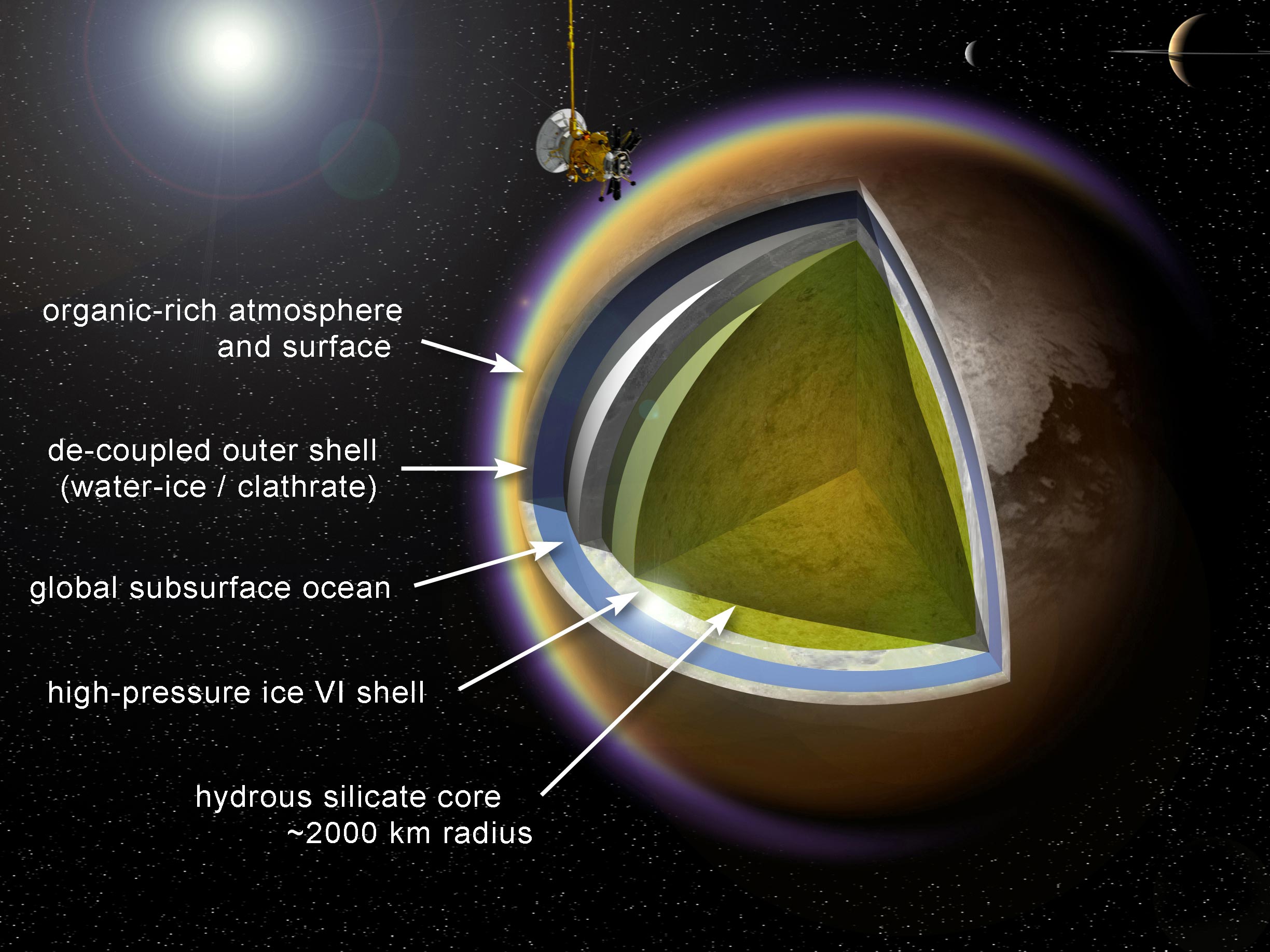
     

    Cassini Titan’s Internal Structure Labeled
    This artist’s concept shows a possible model of Titan’s internal structure that incorporates data from NASA’s Cassini spacecraft. In this model, Titan is fully differentiated, which means the denser core of the moon has separated from its outer parts. This model proposes a core consisting entirely of water-bearing rocks and a subsurface ocean of liquid water. The mantle, in this image, is made of icy layers, one that is a layer of high-pressure ice closer to the core and an outer ice shell on top of the sub-surface ocean. Credit: A. D. Fortes/UCL/STFC

    Titan’s atmosphere is twice as thick as the Earth’s, making it difficult for astronomical instruments to image its surface in the visible light spectrum. Researchers had to combine several image data sets to get the most accurate map of Titan yet.

    Doppler tracking has allowed them to measure Titan’s gravitational field, which has given the researchers an idea of the internal composition of Titan. The layers include a water-ice crust, subsurface ocean, a shell of high pressure, and a rocky interior.

    References:

    “Titan through time: Formation, evolution and fate” by Conor A. Nixon and Ralph D. Lorenz, 19 December 2011, Planetary and Space Science.
    DOI: 10.1016/j.pss.2011.12.012

    Titan Through Time: A Workshop on Titan’s Formation, Evolution and Fate

    Never miss a breakthrough: Join the SciTechDaily newsletter.
    Follow us on Google and Google News.

    Cassini-Huygens Mission Ethane Hydrocarbon Lakes Methane NASA Popular Saturn Solar System Titan
    Share. Facebook Twitter Pinterest LinkedIn Email Reddit

    Related Articles

    NASA’s Surprising Discovery: Saturn’s Planet-Sized Moon Titan Drifting Away 100X Faster Than Thought

    First Global Geologic Map of Titan (Saturn’s Largest Moon) Completed

    Cassini Images Show Signs That the Seasons Are Turning On Saturn’s Moon Titan

    Cassini Data Reveals Likely Subsurface Ocean on Titan

    Heat from Within the Planet Powers Saturn’s Jet Streams

    Cassini Detects Methane Lakes on Titan

    The Mysterious Dusty Plasma Plumes of Saturn’s Moon Enceladus

    Saturn’s Moon Phoebe Has Planet-Like Qualities

    Cassini Explores Titan’s Lake, Similarities to Etosha Salt Pan

    4 Comments

    1. TeamDoJoe on March 6, 2012 4:21 pm

      Wow, I wonder if we will ever be able to go visit this place. Also wonder if google is planning on “mapping” all the planets next? You KNOW they are thinking it.

      Reply
      • Hank on March 9, 2012 12:29 pm

        that would be awesome

        Reply
    2. MARTY ZOGAS on March 23, 2013 9:11 pm

      MY GOD…………………WE’RE SO TINY ! AND THERE’S SO MUCH TO LEARN !

      Reply
    3. spiros ioannou on June 1, 2013 7:19 pm

      thank you for ALL the information regarding SPACE /SATURN AND HIS MOONS AND EVERY THING AROUND IN OUR TINY SOLAR SYSTEM? AWSOME

      Reply
    Leave A Reply Cancel Reply

    • Facebook
    • Twitter
    • Pinterest
    • YouTube

    Don't Miss a Discovery

    Subscribe for the Latest in Science & Tech!

    Trending News

    NASA’s Voyager 1 Is About to Become the First Spacecraft One Light-Day From Earth

    A Woman Who Lived 30,000 Years Ago Is Changing What We Know About Ice Age Europe

    A Rare Radioactive Element Reveals a Hidden Secret About the Heaviest Atoms

    Breakthrough Cancer Treatment Wipes Out Deadly Brain Tumors in Every Mouse Tested

    Something Remarkable Is Happening to Dogs Living Near Chernobyl’s Nuclear Plant

    Hubble Uncovers a Mysterious 93-Billion-Mile Structure Hiding in a Nearby Star System

    Earth’s Oceans Were Slowly Suffocating Millions of Years Before a Devastating Mass Extinction

    Why Are Men Twice As Likely To Develop Parkinson’s? Scientists Discover a Hidden Clue in the Brain

    Follow SciTechDaily
    • Facebook
    • Twitter
    • YouTube
    • Pinterest
    • Newsletter
    • RSS
    SciTech News
    • Biology News
    • Chemistry News
    • Earth News
    • Health News
    • Physics News
    • Science News
    • Space News
    • Technology News
    Recent Posts
    • Could Type 2 Diabetes Be Reversed? 14-Year Study Reveals Remarkable Results
    • The Secret to Saving Shellfish From Acidifying Oceans Could Be Hiding in Crushed Shells
    • Earthquake Faults Can Suddenly Become Almost As Fluid as Water, Study Finds
    • Scientists Reveal How a Mysterious Brain Structure Keeps Memories From Fading
    • The Hidden Brain Mechanism That Makes You Love Coffee, Chocolate, Fat, and Sugar
    Copyright © 1998 - 2026 SciTechDaily. All Rights Reserved.
    • Science News
    • About
    • Contact
    • Editorial Board
    • Privacy Policy
    • Terms of Use

    Type above and press Enter to search. Press Esc to cancel.