
Close Menu
    Facebook X (Twitter) Instagram
    SciTechDaily
    • Biology
    • Chemistry
    • Earth
    • Health
    • Physics
    • Science
    • Space
    • Technology
    Facebook X (Twitter) Pinterest YouTube RSS
    SciTechDaily
    Home»Space»New Results on Black Hole and Neutron Star X-Ray Binaries From Insight-HXMT
    Space

    New Results on Black Hole and Neutron Star X-Ray Binaries From Insight-HXMT

    By Chinese Academy of Sciences HeadquartersOctober 25, 20195 Comments4 Mins Read
    Facebook Twitter Pinterest Telegram LinkedIn WhatsApp Email Reddit
    Share
    Facebook Twitter LinkedIn Pinterest Telegram Email Reddit
    Hard X-ray Modulation Telescope (Insight-HXMT)
    Scientists with the Hard X-ray Modulation Telescope (Insight-HXMT) team presented their new results on black hole and neutron star X-ray binaries during a press conference held on October 25 at the first China Space Science Assembly in Xiamen. Credit: IHEP

    Scientists with the Hard X-ray Modulation Telescope (Insight-HXMT) team presented their new results on black hole and neutron star X-ray binaries during a press conference held on October 25 at the first China Space Science Assembly in Xiamen.

    X-ray binaries are binary stars that emit X-rays and are composed of a normal star and either a neutron star or a black hole. The gravity of the very dense neutron star or black hole causes material from the normal star to fall toward it, creating a rapidly rotating accretion disk that emits intense X-ray radiation. X-ray binaries are an important research target for those trying to understand strong gravitational and magnetic fields and the matter affected by them.

    The Insight-XHMT scientists were able to study quasi-periodic oscillations (QPOs) in black hole X-ray binaries up to 100 keV, an increase from the previous upper limit of 30 keV. They revealed the energy dependence of QPO amplitude and centroid frequency ranges from 1-100 keV. These achievements exceed what was possible with previous satellites and open a new window for black hole studies.

    A detailed timing study of the brightest persistent X-ray source Sco X-1 was also conducted using Insight-HXMT data. The results yielded three key insights: 1) All types of QPOs originate from non-thermal emissions; 2) The innermost region of the accretion disk is non-thermal in nature; and 3) The corona is nonhomogeneous geometrically.

    For the first time, scientists observed the sudden change of accretion disk state when the X-ray intensity of a neutron star X-ray binary is at a certain value. This verified the theory, put forward nearly 50 years ago, that the radiation pressure of light causes structural mutation of the accretion disk.

    In the past, corona cooling was detected from stacking a series of short Type I bursts that occurred during the low/hard state of a neutron star X-ray binary. The current study represents the first time to observe the rapid cooling of a very hot corona – usually at a high temperature of several hundred million degrees – via a “shower” of low-energy X-ray photons from a single thermonuclear burst on the surface of a neutron star. This method provides a nearly unique means for studying the physical properties and heating mechanism of the high-temperature corona. Also, the interaction between a thermonuclear burst and the accretion disk detected in a single burst probably provides a new method for constraining the innermost radius of the accretion disk.

    In addition, scientists confirmed that the energy of the X-ray cyclotron absorption line of the famous neutron star X-ray binary Her X-1 is no longer decreasing. The data prove that the magnetic field strength near the X-ray radiation area has become stable after nearly 20 years of slow decline.

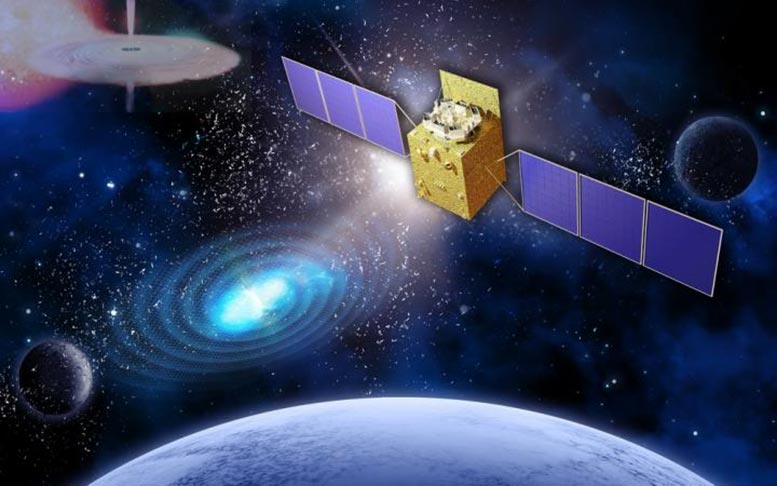
    Insight-HXMT, China’s first X-ray astronomy satellite, has observed many black holes, neutron stars, and gamma-ray bursts with high precision and cadence since it was launched on June 15, 2017. The satellite comprises three X-ray slat-collimated telescopes – the High-energy X-ray Telescope, the Medium-energy X-ray Telescope, and the Low-energy X-ray Telescope – as well as a space environment monitor.

    So far, the satellite has carried out more than a thousand observations and generated 29 TB of scientific data. Altogether, more than 10 scientific papers have been accepted or published in main international astrophysical journals, with additional important research results still in the publication pipeline.

    Never miss a breakthrough: Join the SciTechDaily newsletter.
    Follow us on Google and Google News.

    Astrophysics Black Hole Chinese Academy of Sciences Neutron Star Popular
    Share. Facebook Twitter Pinterest LinkedIn Email Reddit

    Related Articles

    Mystery in Space: Chinese Astronomers Discover Black Hole That’s Breaking the Rules

    Astrophysics in Crisis? Mystery Object Discovered That Could Change Everything

    Einstein’s Enigma: How a Mysterious Cosmic Object in Milky Way Could Test Relativity Like Never Before

    Astronomers Unprecedented Discovery – Stellar Corpse Shows Signs of Life

    Scientists Propose New Explanation for “Impossible” Gamma-Ray Burst

    Supernova Scavenger Hunt: Cracking the Case of Cosmic Ghost Stars

    New Astrophysics Model Unveils the Secrets of Long Gamma-Ray Bursts

    Supermassive Black Hole’s Spin Verified – Einstein’s General Theory of Relativity Shines

    Revealing the Start of Time Itself: Ripples in the Fabric of the Universe May Peer Back to the Beginning of Everything We Know

    5 Comments

    1. Kodi on December 22, 2019 10:34 am

      The official Kodi TV App with step by step guide.

      Reply
    2. Tutuapp on December 22, 2019 10:34 am

      Player is used and trusted by over 30 million users globally.

      Reply
    3. ShowBox on December 22, 2019 10:35 am

      It is one of the best packages of entertainment one can have.

      Reply
    4. friv on February 12, 2020 2:14 am

      Neutron star pairs form when two super-massive stars in a binary system reach the end of their life. They can also form separately and merge in orbit

      Reply
    5. word counter on July 14, 2020 12:27 am

      Your article is great and rewarding

      Reply
    Leave A Reply Cancel Reply

    • Facebook
    • Twitter
    • Pinterest
    • YouTube

    Don't Miss a Discovery

    Subscribe for the Latest in Science & Tech!

    Trending News

    The Universe Is Expanding Too Fast and Scientists Can’t Explain Why

    “Like Liquid Metal”: Scientists Create Strange Shape-Shifting Material

    Early Warning Signals of Esophageal Cancer May Be Hiding in Plain Sight

    Common Blood Pressure Drug Shows Surprising Power Against Deadly Antibiotic-Resistant Superbug

    Scientists Uncover Dangerous Connection Between Serotonin and Heart Valve Disease

    Scientists Discover a “Protector” Protein That Could Help Reverse Hair Loss

    Bone-Strengthening Discovery Could Reverse Osteoporosis

    Scientists Uncover Hidden Trigger Behind Stem Cell Aging

    Follow SciTechDaily
    • Facebook
    • Twitter
    • YouTube
    • Pinterest
    • Newsletter
    • RSS
    SciTech News
    • Biology News
    • Chemistry News
    • Earth News
    • Health News
    • Physics News
    • Science News
    • Space News
    • Technology News
    Recent Posts
    • Scientists Overcome Major Quantum Bottleneck, Potentially Transforming Teleportation and Computing
    • Quantum Physics’ Strangest Problem May Hold the Key to Time Itself
    • Scientists Create “Liquid Gears” That Spin Without Touching
    • The Simple Habit That Could Help Prevent Cancer
    • Forgotten Medicinal Plant Shows Promise in Fighting Dangerous Superbugs
    Copyright © 1998 - 2026 SciTechDaily. All Rights Reserved.
    • Science News
    • About
    • Contact
    • Editorial Board
    • Privacy Policy
    • Terms of Use

    Type above and press Enter to search. Press Esc to cancel.