
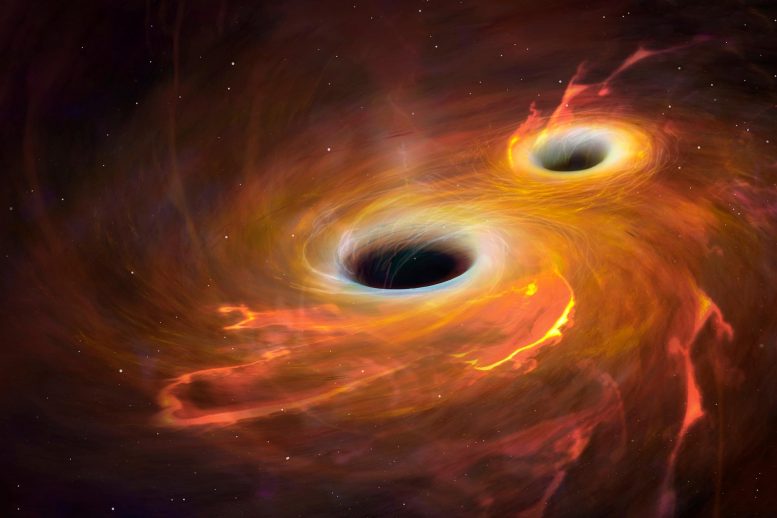
New study proposes light signature for detecting black hole mergers.
Gravitational wave detectors are finding black hole mergers in the universe at the rate of one per week. If these mergers occur in empty space, researchers cannot see the associated light that is needed to determine where they happened. However, a new study in The Astrophysical Journal Letters, led by scientists at the American Museum of Natural History and the City University of New York (CUNY), suggests that researchers might finally be able to see light from black hole mergers if the collisions happen in the presence of gas.
“With a light signature, astronomers could easily pinpoint the cosmic location of these mergers and study them in much more detail than is presently possible,” said paper author Barry McKernan, a research associate in the Museum’s Department of Astrophysics as well as a professor at the Borough of Manhattan Community College, CUNY, and a faculty member at CUNY’s Graduate Center.
Black holes form when massive stars die. Much like dense objects sinking into a river on Earth, black holes tend to sink into regions of galaxies where gravity is strongest. It is believed that large numbers of black holes build up in the centers of galaxies, where a much larger, single, supermassive black hole lurks.
If individual small black holes pass close enough to each other as they orbit, their mutual gravity allows them to pair off and orbit each other, while also orbiting the central supermassive black hole. But a second random close encounter with another small black hole can easily break apart such a pairing.
“So the black holes dance, forming and breaking partnerships, but rarely getting close enough to each other to merge,” said paper coauthor K.E. Saavik Ford, who is also a research associate in the Museum’s Department of Astrophysics as well as a professor at the Borough of Manhattan Community College, CUNY, and a faculty member at CUNY’s Graduate Center. “If a merger does happen, it will occur in the dark, with no associated light.”
This picture changes if a large mass of gas falls onto the central supermassive black hole. This will result in a bright gas disk that envelops many of the black holes swarming around the central supermassive black hole and changes their orbits. Once inside the disk, the gas tugs on the black holes, causing them to spiral closer to the central supermassive black hole. If the smaller black holes pass close enough to each other, gas very quickly drives them together causing a merger and a burst of gravitational waves that can be detected by the Laser Interferometer Gravitational-Wave Observatory (LIGO) in the United States and the European-based Virgo detector.
The new work by McKernan, Ford, and collaborators at the California Institute of Technology, Jet Propulsion Laboratory, University of Edinburgh, Columbia University, and the University of Florida, suggests that it may be possible to see the effect of black hole mergers on the gas disk. The idea: once the black holes merge, they typically experience a kick at high speed (about 50 kilometers per second/112,000 miles per hour). Nearby gas attempts to follow the merger product, but smacks into neighboring disk gas causing a shock collision. If the gas disk is thin enough to let the light escape, the shock glow may be detectable with telescope sky surveys. The likelihood of detecting the shock glow against an already bright disk is best for large-mass black hole mergers, around smaller-mass central black holes. The timescale during which the glow is released may help astronomers distinguish the black hole merger from random variations in the disk gas.
“LIGO has opened up this whole new way of letting us ‘hear’ how two black holes merge into one; and if we are correct, there may well now be a way we can see these otherwise invisible events happen,” said co-author Nicholas Ross of the University of Edinburgh. “This would have deep implications for how we study black holes and for observational cosmology.”
Co-author Matthew Graham of Caltech adds: “We’ve got lots of telescopes, such as ZTF [Zwicky Transient Facility], now covering large regions of the sky every night. If there is an optical counterpart, we should see it; if we don’t find any then that also tells us something interesting.”
###
Reference: “Ram-pressure Stripping of a Kicked Hill Sphere: Prompt Electromagnetic Emission from the Merger of Stellar Mass Black Holes in an AGN Accretion Disk” by B. McKernan, K. E. S. Ford, I. Bartos, M. J. Graham, W. Lyra, S. Marka, Z. Marka, N. P. Ross, D. Stern and Y. Yang, 17 October 2019, The Astrophysical Journal Letters.
DOI: 10.3847/2041-8213/ab4886
This work was supported in part by the U.S. National Science Foundation grant # 1831412.
Never miss a breakthrough: Join the SciTechDaily newsletter.
Follow us on Google and Google News.
1 Comment
How many things can you ad hoc make black holes explain? Only your astrophysicist knows for sure! The question is, is there anything black holes can’t explain? So, first we’ve got black holes at the centers of galaxies, but wait, that doesn’t really work too well, so we better make them supermassive black holes, but wait, that doesn’t really explain things too well either, so now it’s “”believed” that large numbers of black holes build up in the centers of galaxies, where a much larger, single, supermassive black hole lurks.” And these “black holes dance, forming and breaking partnerships, but rarely getting close enough to each other to merge.” Seems to be a very fickle Dancing With The Stars universe in much need of eHarmony.