
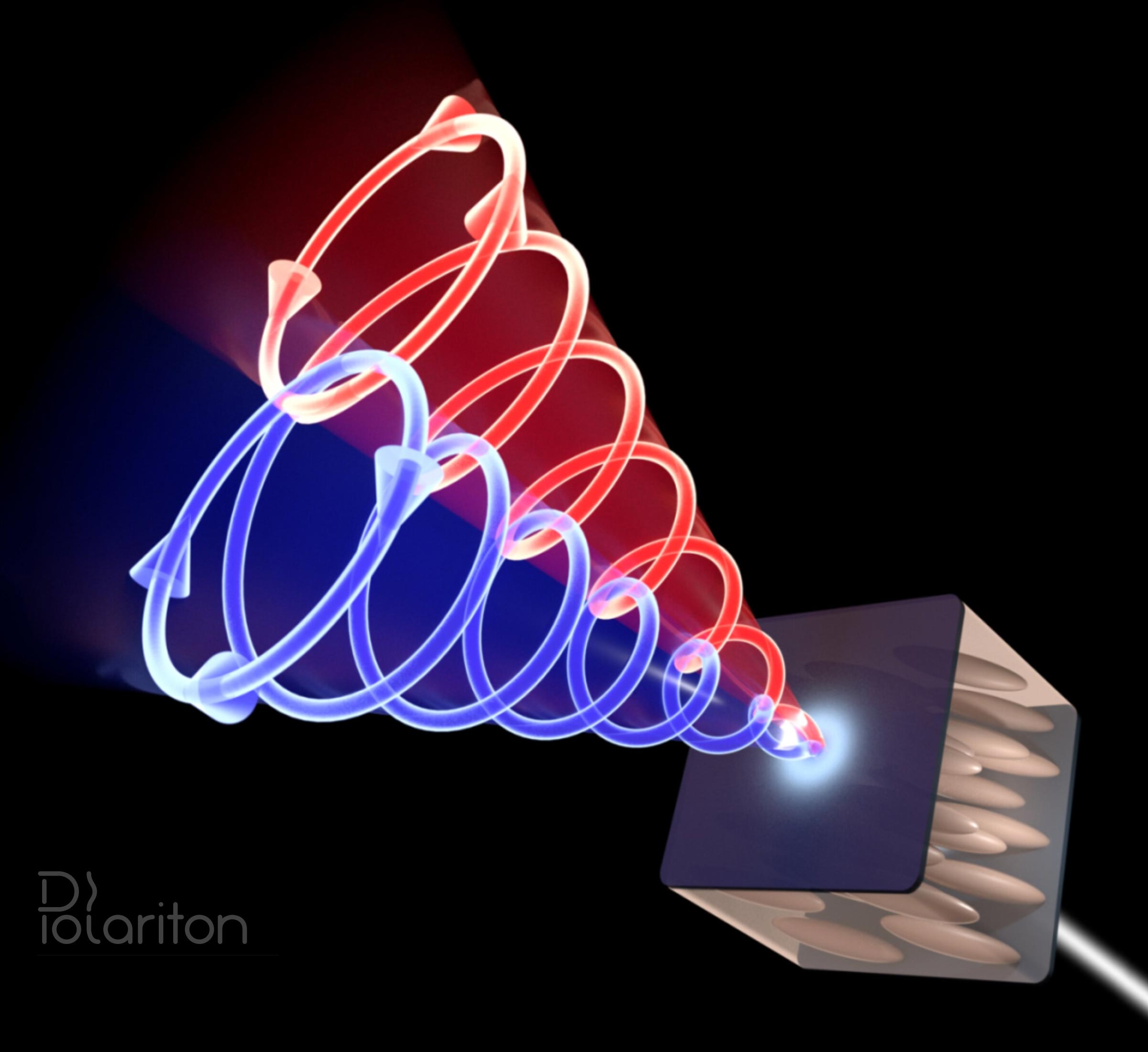
An international research collaboration from Poland, the UK, and Russia has created a two-dimensional system — a thin optical cavity filled with liquid crystal — in which they trapped photons. As the properties of the cavity were modified by an external voltage, the photons behaved like massive quasiparticles endowed with a magnetic moment, called “spin”, under the influence of an artificial magnetic field. The research has been published in Science on November 8, 2019.
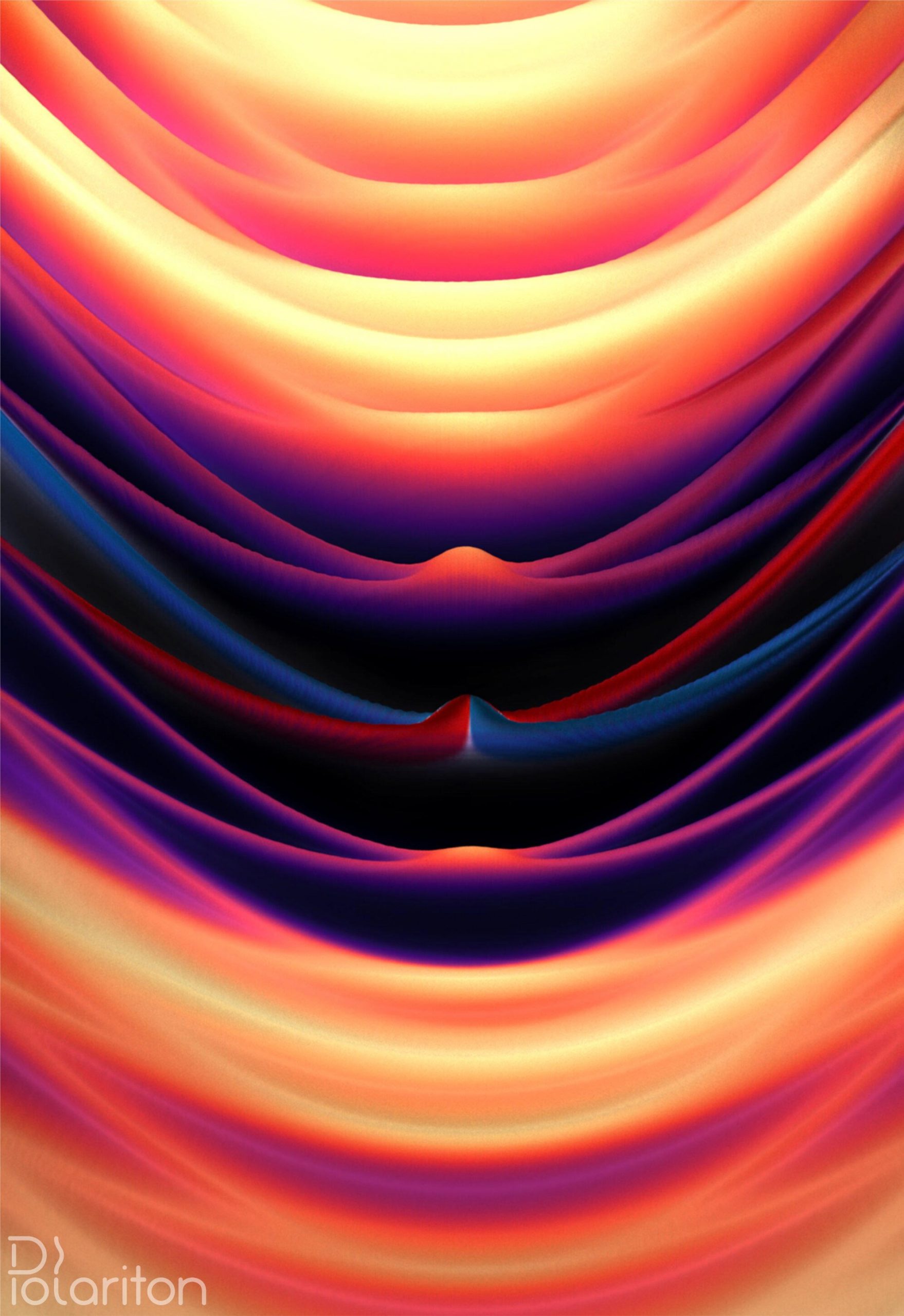
The world around us has one temporal and three spatial dimensions. Physicists studying condensed matter have long been dealing with systems of lower dimensionality — two-dimensional (2D) quantum wells, one-dimensional (1D) quantum wires and zero-dimensional (0D) quantum dots. 2D systems have found the widest technical applications — it is thanks to the reduced dimensions that efficient LEDs and laser diodes, fast transistors in integrated circuits, and WiFi radio amplifiers operate. Trapped electrons in two dimensions can behave completely differently than free electrons. For example, in graphene, a two-dimensional carbon structure with honeycomb symmetry, electrons behave like massless objects, i.e. light particles called photons.
Electrons in a crystal interact with each other and with the crystal lattice, creating a complex system whose description is possible thanks to the introduction of the concept of so-called quasiparticles. Properties of these quasiparticles, including electric charge, magnetic moment, and mass, depend on the symmetry of the crystal and its spatial dimension. Physicists can create materials with reduced dimensions, discovering “quasi-universes” full of exotic quasiparticles. The massless electron in two-dimensional graphene is such an example.
These discoveries inspired researchers from the University of Warsaw, the Polish Military University of Technology, the Institute of Physics of the Polish Academy of Sciences, the University of Southampton, and the Skolkovo Institute near Moscow, to study light trapped in two-dimensional structures — optical cavities. The authors of the Science paper created an optical cavity in which they trapped photons between two mirrors. The original idea was to fill the cavity with a liquid crystal material that acts as an optical medium. Under the influence of an external voltage, molecules of this medium can rotate and change the optical path length. Because of this, it was possible to create standing waves of light in the cavity, whose energy (frequency of vibrations) was different when the electric field of the wave (polarization) was directed across the molecules and different for polarization along their axis (this phenomenon is called optical anisotropy).

During the research, conducted at the University of Warsaw, the unique behavior of photons trapped in the cavity was found as they behaved like mass-bearing quasiparticles. Such quasiparticles have been observed before, but they were difficult to manipulate because the light does not react to electric or magnetic fields. This time, it was noted that as the optical anisotropy of the liquid crystal material in the cavity was changed, the trapped photons behaved like quasiparticles endowed with a magnetic moment, or a “spin” in “artificial magnetic field”. Polarization of the electromagnetic wave played the role of “spin” for light in the cavity. The behavior of light in this system is easiest to explain using the analogy of the behavior of electrons in condensed matter.
The equations describing the motion of photons trapped in the cavity resemble the equations of motion of electrons with spin. Therefore, it was possible to build a photonic system that perfectly imitates electronic properties and leads to many surprising physical effects such as topological states of light.
The discovery of new phenomena related to the entrapment of light in optically anisotropic cavities may enable the implementation of new optoelectronic devices, e.g. optical neural networks and perform neuromorphic calculations. There is a particular promise to the prospect of creating a unique quantum state of matter — the Bose Einstein condensate. Such a condensate can be used for quantum calculations and simulations, solving problems that are too difficult for modern computers. The studied phenomena will open up new possibilities for technical solutions and further scientific discoveries.
Reference: “Engineering spin-orbit synthetic Hamiltonians in liquid-crystal optical cavities” by Katarzyna Rechcińska, Mateusz Król, Rafał Mazur, Przemysław Morawiak, Rafał Mirek, Karolina Łempicka, Witold Bardyszewski, Michał Matuszewski, Przemysław Kula, Wiktor Piecek, Pavlos G. Lagoudakis, Barbara Piętka and Jacek Szczytko, 8 November 2019, Science.
DOI: 10.1126/science.aay4182
The research was supported by the Polish National Science Center, the Ministry of Science and Higher Education, the Ministry of National Defense, and UK Engineering and Physical Sciences Research Council.
Physics and Astronomy first appeared at the University of Warsaw in 1816, under the then Faculty of Philosophy. In 1825 the Astronomical Observatory was established. Currently, the Faculty of Physics’ Institutes include Experimental Physics, Theoretical Physics, Geophysics, Department of Mathematical Methods and an Astronomical Observatory. Research covers almost all areas of modern physics, on scales from the quantum to the cosmological. The Faculty’s research and teaching staff includes ca. 200 university teachers, of which 77 are employees with the title of professor. The Faculty of Physics, University of Warsaw, is attended by ca. 1000 students and more than 170 doctoral students.
Never miss a breakthrough: Join the SciTechDaily newsletter.
Follow us on Google and Google News.
2 Comments
Is the electron a photon with toroidal topology? http://www.cybsoc.org/electron.pdf
This question was posed in the J.G. Williamson(a) and M.B. van der Mark(b) paper of 1997. John Duffield (The Physics Detective) supports this idea and further suggests that the proton is a photon trapped in a much tighter and smaller trefoil knot. This article may connect with these recent reports…
https://physicsworld.com/a/physicists-tie-light-into-knots/ 16 Oct 2013
https://phys.org/news/2019-06-property.html New property of light discovered
https://physicsworld.com/a/twisted-light-gains-angular-momentum-through-self-torque/ 29 Jun 2019
https://phys.org/news/2019-06-multicolored-ways.html Multicolored light twists in new knotted ways
… this corroboration that light (photons) can be actually tied or trapped in knots is crucial evidence in support of the theory that the stable sub atomic particles are high energy photons trapped in a confined orbital configuration.
Yes, James. That’s exactly right. Search for the paper: “Matter in the form of toroidal electromagnetic vortices”. Everything in reality is flux of the field that is the eternal fabric. There is nothing that it does not account for. There’s simply a lot of configurations (patterns) of flux, and the ability for it to be “trapped” in and by vortices, that leads to the complexity we see in nature. This will be the next revolution of physics, and it’s not far off, if people start opening their eyes. It accounts for everything, and is the grand unifier we’ve all been waiting for.