
Close Menu
    Facebook X (Twitter) Instagram
    SciTechDaily
    • Biology
    • Chemistry
    • Earth
    • Health
    • Physics
    • Science
    • Space
    • Technology
    Facebook X (Twitter) Pinterest YouTube RSS
    SciTechDaily
    Home»Physics»Astonishing Nanomaterial Is Both Twisted and Untwisted at the Same Time
    Physics

    Astonishing Nanomaterial Is Both Twisted and Untwisted at the Same Time

    By University of BathSeptember 14, 2019No Comments3 Mins Read
    Facebook Twitter Pinterest Telegram LinkedIn WhatsApp Email Reddit
    Share
    Facebook Twitter LinkedIn Pinterest Telegram Email Reddit
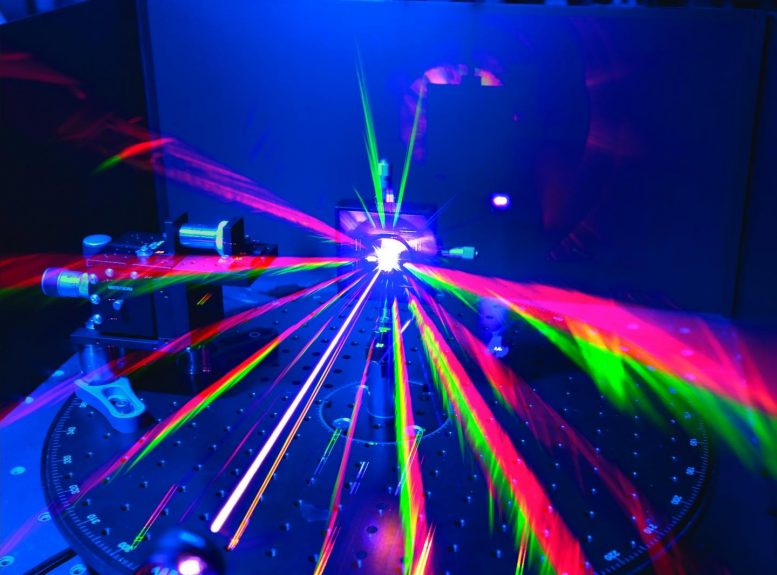
    Nanomaterial That Is Twisted and Untwisted
    A nanomaterial developed at University of Bath allows for incredibly sensitive detection of the direction molecules twist using laser light. Credit: Ventsislav Valev and Alex Murphy

    Scientists illuminate secrets of a nanomaterial that is both twisted and untwisted at the same time. The material developed at University of Bath allows for incredibly sensitive detection of the direction molecules twist.

    A new nanomaterial developed by scientists at the University of Bath could solve a conundrum faced by scientists probing some of the most promising types of future pharmaceuticals.

    Scientists who study the nanoscale – with molecules and materials 10,000 smaller than a pinhead – need to be able to test the way that some molecules twist, known as their chirality, because mirror-image molecules with the same structure can have very different properties. For instance, one kind of molecule smells of lemons when it twists in one direction, and oranges when twisted the other way.

    Detecting these twists is especially important in some high-value industries such as pharmaceuticals, perfumes, food additives, and pesticides.

    Recently, a new class of nanoscale materials has been developed to help distinguish the chirality of molecules. These so-called ‘nanomaterials’ usually consist of tiny twisted metal wires, that are chiral themselves.

    However, it has become very hard to distinguish the twist of the nanomaterials from the twist of the molecules they are supposed to help study.

    To solve this problem the team from the University of Bath’s Department of Physics created a nanomaterial that is both twisted and it is not. This nanomaterial has the equal number of opposite twists – meaning they cancel each other out. Usually, upon interacting with light, such material appears without any twist; how then could it be optimized to interact with molecules? Using a mathematical analysis of the material’s symmetry properties, the team discovered a few special cases, which can bring the ‘hidden’ twist to light and allow very sensitive detection of chirality in molecules.

    Lead author Professor Ventsislav Valev, from the University of Bath Department of Physics, said: “This work removes an important roadblock for the entire research field and paves the way to ultra-sensitive detection of chirality in molecules, using nanomaterials.”

    Ph.D. student Alex Murphy, who worked on the study, said: “Molecular chirality is an amazing property to study. You can smell chirality, since the same but oppositely twisted molecules smell of lemons and oranges. You can taste chirality, since one twist of Aspartame is sweet and the other is tasteless. You can feel chirality, since one twist of menthol gives a cool sensation to the skin while the other does not. You touch chirality expressed in the twist of seashells. And it is great to see chirality expressed in its interactions with the colors of laser light.”

    The study is published in the journal Nanoscale Horizons. The research was funded by the Royal Society, the Engineering and Physical Sciences Research Council, and the Science and Technology Facilities Council.

    Reference: “Measuring optical activity in the far-field from a racemic nanomaterial: diffraction spectroscopy from plasmonic nanogratings” by Christian Kuppe, Xuezhi Zheng, Calum Williams, Alexander W. A. Murphy, Joel T. Collins, Sergey N. Gordeev, Guy A. E. Vandenbosch and Ventsislav K. Valev, 10 May 2019,  Nanoscale Horiz.
    DOI: 10.1039/C9NH00067D

    Never miss a breakthrough: Join the SciTechDaily newsletter.
    Follow us on Google and Google News.

    Nanotechnology Optics University of Bath
    Share. Facebook Twitter Pinterest LinkedIn Email Reddit

    Related Articles

    Physicists Create Quasiparticles That Bind Together Two Differently Colored Particles of Light

    Massive Photons Trapped in an Artificial Magnetic Field

    New Technique for Studying Ultrafast Events in Individual Quantum Dots

    Efficient Quantum-Mechanical Interface Leads to a Strong Interaction Between Light and Matter

    New Method for Detecting the Invisible Properties of Nano-Structured Light Fields

    Scientists Closing In on “Holy Grail” of Room Temperature Quantum Computing Chips

    Physicists Spawn Rings of Exceptional Points Out of Dirac Cones

    Engineers Move Toward Using Light Instead of Wires Inside Computers

    Cathodoluminescence Used to Probe Metamaterials

    Leave A Reply Cancel Reply

    • Facebook
    • Twitter
    • Pinterest
    • YouTube

    Don't Miss a Discovery

    Subscribe for the Latest in Science & Tech!

    Trending News

    Popular Sugar-Free Sweetener Linked to Liver Disease, Study Warns

    What Is Hantavirus? The Deadly Disease Raising Alarm Worldwide

    Scientists Just Discovered How the Universe Builds Monster Black Holes

    Scientists Unveil New Treatment Strategy That Could Outsmart Cancer

    A Simple Vitamin May Hold the Key to Treating Rare Genetic Diseases

    Scientists Think the Real Fountain of Youth May Be Hiding in Your Gut

    Ravens Don’t Follow Wolves, They Predict Them

    This Common Knee Surgery May Be Doing More Harm Than Good

    Follow SciTechDaily
    • Facebook
    • Twitter
    • YouTube
    • Pinterest
    • Newsletter
    • RSS
    SciTech News
    • Biology News
    • Chemistry News
    • Earth News
    • Health News
    • Physics News
    • Science News
    • Space News
    • Technology News
    Recent Posts
    • Why Are So Many New Fathers Dying? Scientists Say the U.S. Has a Dangerous Blind Spot
    • Scientists Identify Simple Supplement That Greatly Reduces Alzheimer’s Damage
    • You May Have a Dangerous Type of Cholesterol Even if Your Tests Look Normal
    • Study Reveals Dangerous Flaw in AI Symptom Checkers
    • New MRI Breakthrough Captures Stunningly Clear Images of the Eye and Brain
    Copyright © 1998 - 2026 SciTechDaily. All Rights Reserved.
    • Science News
    • About
    • Contact
    • Editorial Board
    • Privacy Policy
    • Terms of Use

    Type above and press Enter to search. Press Esc to cancel.