
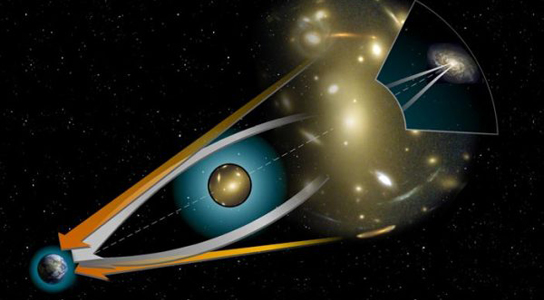
A rare cosmic zoom lens, which uses the gravity of a large mass to magnify light from distant objects, has allowed a team of US and European astronomers to spot a galaxy so remote that its light was emitted 490 million years after the Big Bang, which is 3.6% of the Universe’s current age.
The infant galaxy, MACS1149-JD1, is too faint to be seen by Hubble alone, which needed the gravity lens to discriminate the object. The newly discovered object is noteworthy because of the measurement of its redshift that works as a surrogate for distance. Thanks to several images taken by Hubble and the Spitzer Space Telescopes, the measurement is actually quite precise. The astronomers published their findings public arXiv.
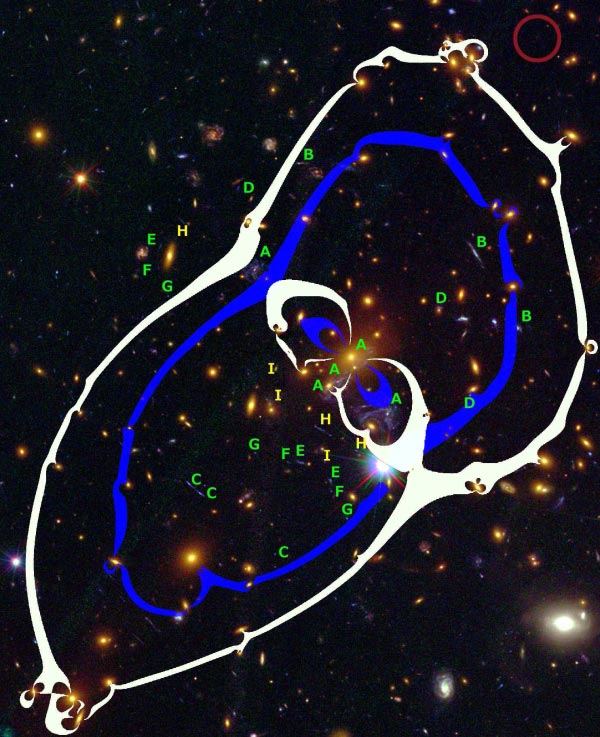
The faint galaxy appears 15 times brighter than it normally would, which is possible thanks to the gravity lens offered by a massive galaxy cluster lying between it and Earth, and astronomers say that it could be examined in detail by Hubble’s successor, the James Webb Space Telescope that is scheduled to launch in 2018.
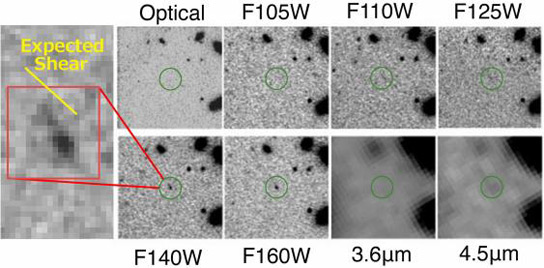
The team calculated that the body is less than 200 million years old, and the mass of its constituent stars weigh only 1% of that of the Milky Way. The paper is currently under peer review for several academic journals.
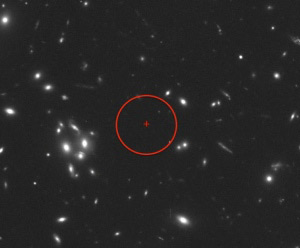 MACS1149-JD1 has a redshift of 9.6, putting it a candidate of an extremely remote galaxy. The paper suggests that the early Universe may have held a larger number of baby galaxies than researchers had previously estimated. This could mean that the ionization radiation from such galaxies played a more important part in breaking apart hydrogen atoms, allowing light to escape into space for the first time.
Reference: “A magnified young galaxy from about 500 million years after the Big Bang” by Wei Zheng, Marc Postman, Adi Zitrin, John Moustakas, Xinwen Shu, Stephanie Jouvel, Ole Høst, Alberto Molino, Larry Bradley, Dan Coe, Leonidas A. Moustakas, Mauricio Carrasco, Holland Ford, Narciso Benítez, Tod R. Lauer, Stella Seitz, Rychard Bouwens, Anton Koekemoer, Elinor Medezinski, Matthias Bartelmann, Tom Broadhurst, Megan Donahue, Claudio Grillo, Leopoldo Infante, Saurabh W. Jha, Daniel D. Kelson, Ofer Lahav, Doron Lemze, Peter Melchior, Massimo Meneghetti, Julian Merten, Mario Nonino, Sara Ogaz, Piero Rosati, Keiichi Umetsu and Arjen van der Wel, 19 September 2012, Nature.
DOI: 10.1038/nature11446
Never miss a breakthrough: Join the SciTechDaily newsletter.
Follow us on Google and Google News.