
Close Menu
    Facebook X (Twitter) Instagram
    SciTechDaily
    • Biology
    • Chemistry
    • Earth
    • Health
    • Physics
    • Science
    • Space
    • Technology
    Facebook X (Twitter) Pinterest YouTube RSS
    SciTechDaily
    Home»Chemistry»Exciting Molecular Tweaks Could Improve the Efficiency of Organic Solar Cells
    Chemistry

    Exciting Molecular Tweaks Could Improve the Efficiency of Organic Solar Cells

    By Kyoto UniversityMarch 5, 2020No Comments3 Mins Read
    Facebook Twitter Pinterest Telegram LinkedIn WhatsApp Email Reddit
    Share
    Facebook Twitter LinkedIn Pinterest Telegram Email Reddit
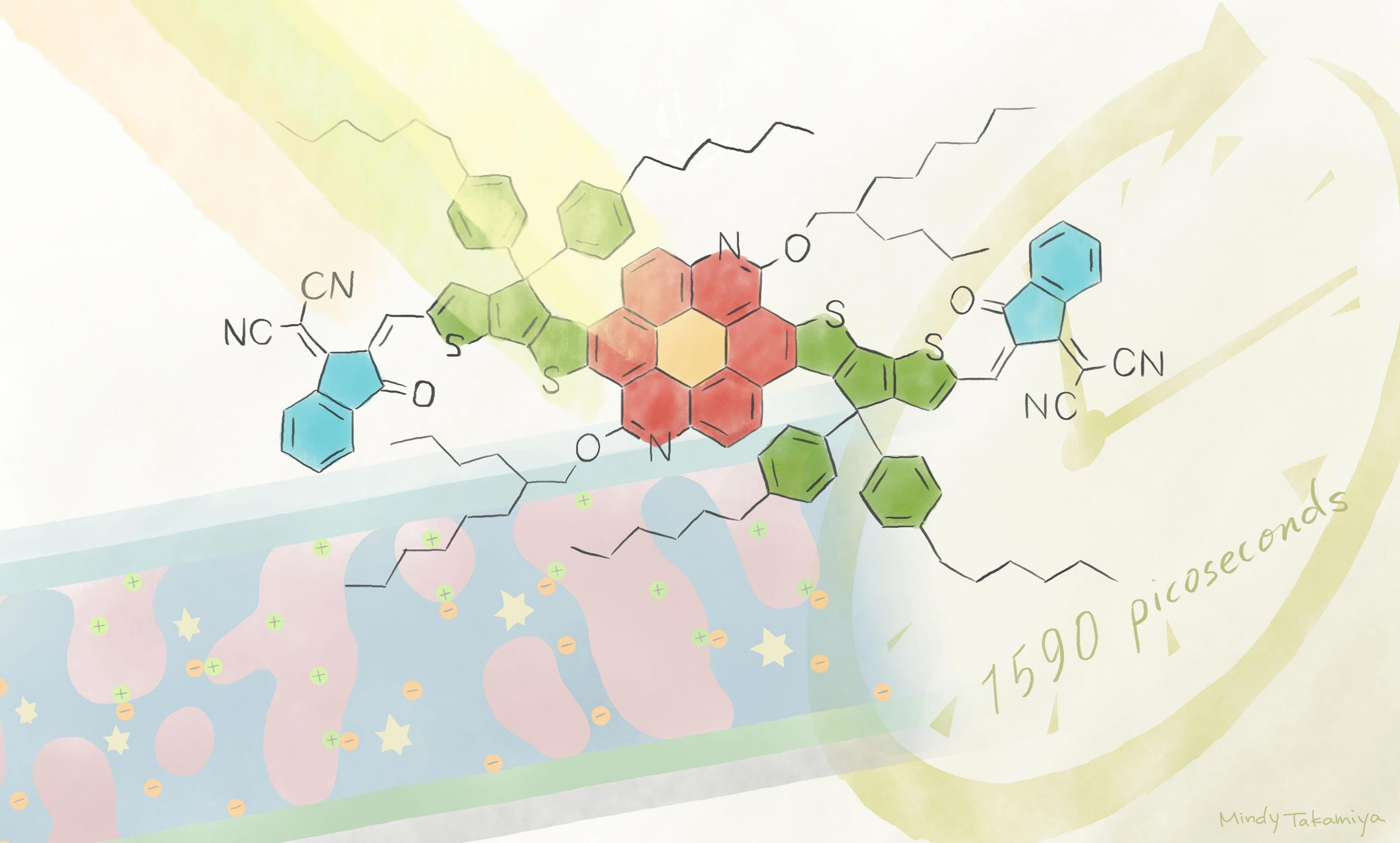
    Electron-Accepting Molecule TACIC
    The new electron-accepting molecule TACIC can maintain its excited state 50 times longer than a conventional one. Credit: Illustration by Mindy Takamiya

    Molecular changes could improve the efficiency of next-generation photovoltaics.

    A molecular tweak has improved organic solar cell performance, bringing us closer to cheaper, efficient, and more easily manufactured photovoltaics. The new design approach, targeting the molecular backbone of the cell’s power-generating layer, was developed by scientists at Kyoto University’s Institute for Integrated Cell-Material Sciences (iCeMS) and published today (March 5, 2020) in the journal Chemical Science.

    Organic photovoltaics are expected to become the next generation of solar cells as they use cheaper components, and are more lightweight, flexible and easily manufactured compared to currently used inorganic solar cells.

    “There is growing concern over the use of fossil fuels and their environmental impacts,” says Hiroshi Imahori, a molecular engineer at iCeMS who led the work with colleague Tomokazu Umeyama. “We need to work hard to improve sustainable energy systems.”

    The power-generating layer in organic photovoltaics contains molecules that either donate or accept electrons. Light is absorbed by this thin layer, exciting the molecules, which generate charges that go on to form an electric current. But for light to be efficiently converted to electricity, the electron-accepting component needs to stay excited.

    One type of organic cell is very good at absorbing a broad spectrum of light, but doesn’t stay excited for long. To try to address this, Imahori, Umeyama and their colleagues in Japan targeted the molecular backbone of the cell’s electron-accepting component. Specifically, they replaced a central ring with a molecule called thienoazacoronene, creating a new molecule called TACIC.

    Similar to its predecessor, TACIC absorbed a broad spectrum of visible and near-infrared light. Significantly, it maintained its excited state 50 times longer, converting more than 70% of light particles into current. The design achieved this by stabilizing the vibration and rotation that normally occur when light is absorbed, saving kinetic energy and facilitating intermolecular interaction.

    The cell continues to have a power conversion efficiency of just under 10%, which is comparable to other organic solar cells being researched. The team believes modifications to the side chains and core structure of the thienoazacoronene molecule could further improve the efficiency of organic photovoltaics.

    Reference: ” Targeted and modular architectural polymers employing bioorthogonal chemistry for quantitative therapeutic delivery” by Gayathri R. Ediriweera, Joshua D. Simpson, Adrian V. Fuchs, Taracad K. Venkatachalam, Matthias Van De Walle, Christopher B. Howard, Stephen M. Mahler, James P. Blinco, Nicholas L. Fletcher, Zachary H. Houston, Craig A. Bell and Kristofer J. Thurecht, 5 March 2020, Chemical Science.
    DOI: 10.1039/C9SC06456G

    Never miss a breakthrough: Join the SciTechDaily newsletter.
    Follow us on Google and Google News.

    Energy Kyoto University Popular Solar Cells
    Share. Facebook Twitter Pinterest LinkedIn Email Reddit

    Related Articles

    Sandwich Structure Improves Efficiency of Next-Generation Solar Panels

    Researchers Identify the Defect That Limits Solar-Cell Performance: Hydrogen in Hybrid Perovskites

    Harvesting Hot Electrons Without Tricks Could Increase Solar Panel Efficiency

    New Organic Solar Cells Set Efficiency World Record

    Solving a Riddle That Would Provide the World With Entirely Clean, Renewable Energy

    Turning Plastic Trash Into Treasure: Upcycling Plastic Into High-Quality Liquid Products

    Powered by Sunlight, ‘Artificial Leaf’ Successfully Produces Clean Gas From CO2 and Water

    New Material Captures Carbon Dioxide and Efficiently Converts It to Useful Organic Materials

    Catalytic Reactor Turns Greenhouse Gas Into Pure Liquid Fuel

    Leave A Reply Cancel Reply

    • Facebook
    • Twitter
    • Pinterest
    • YouTube

    Don't Miss a Discovery

    Subscribe for the Latest in Science & Tech!

    Trending News

    Scientists Just Found a Smiling “Happy-Face” Spider in the Himalayas

    A Colossal Moon Impact May Have Left Ancient Secrets Near Future Artemis Landing Sites

    Earthquake Researchers Discover Dangerous Stress Levels Building Beneath Southern California

    NASA Satellites Spot Rare Underwater Volcano Eruption That Could Create Earth’s Newest Island

    520-Million-Year-Old Fossils Solve One of Evolution’s Biggest Mysteries

    This Popular Workout Supplement May Give Cancer Immunotherapy a Big Boost

    Scientists Discover Quantum Entanglement in a Crystal You Can Hold

    New Nonsurgical Knee Treatment Delivers Lasting Pain Relief

    Follow SciTechDaily
    • Facebook
    • Twitter
    • YouTube
    • Pinterest
    • Newsletter
    • RSS
    SciTech News
    • Biology News
    • Chemistry News
    • Earth News
    • Health News
    • Physics News
    • Science News
    • Space News
    • Technology News
    Recent Posts
    • Scientists Unravel a Century-Old Mystery About Hybrid Male Sterility
    • These 567-Million-Year-Old Fossils Are Rewriting the Story of Life on Earth
    • Scientists Discover 250+ Genes That Could Lead to New Ways To Prevent Melanoma
    • This Gut Microbe Could Be the Secret to Staying Strong as You Age
    • The Spider-Like Creatures Helping Scientists Decode the Origins of Fatherhood
    Copyright © 1998 - 2026 SciTechDaily. All Rights Reserved.
    • Science News
    • About
    • Contact
    • Editorial Board
    • Privacy Policy
    • Terms of Use

    Type above and press Enter to search. Press Esc to cancel.