
Close Menu
    Facebook X (Twitter) Instagram
    SciTechDaily
    • Biology
    • Chemistry
    • Earth
    • Health
    • Physics
    • Science
    • Space
    • Technology
    Facebook X (Twitter) Pinterest YouTube RSS
    SciTechDaily
    Home»Earth»One of the World’s Greatest Natural Wonders: Victoria Falls From Space
    Earth

    One of the World’s Greatest Natural Wonders: Victoria Falls From Space

    By European Space Agency (ESA)April 12, 2020No Comments3 Mins Read
    Facebook Twitter Pinterest Telegram LinkedIn WhatsApp Email Reddit
    Share
    Facebook Twitter LinkedIn Pinterest Telegram Email Reddit
    Victoria Falls From Space
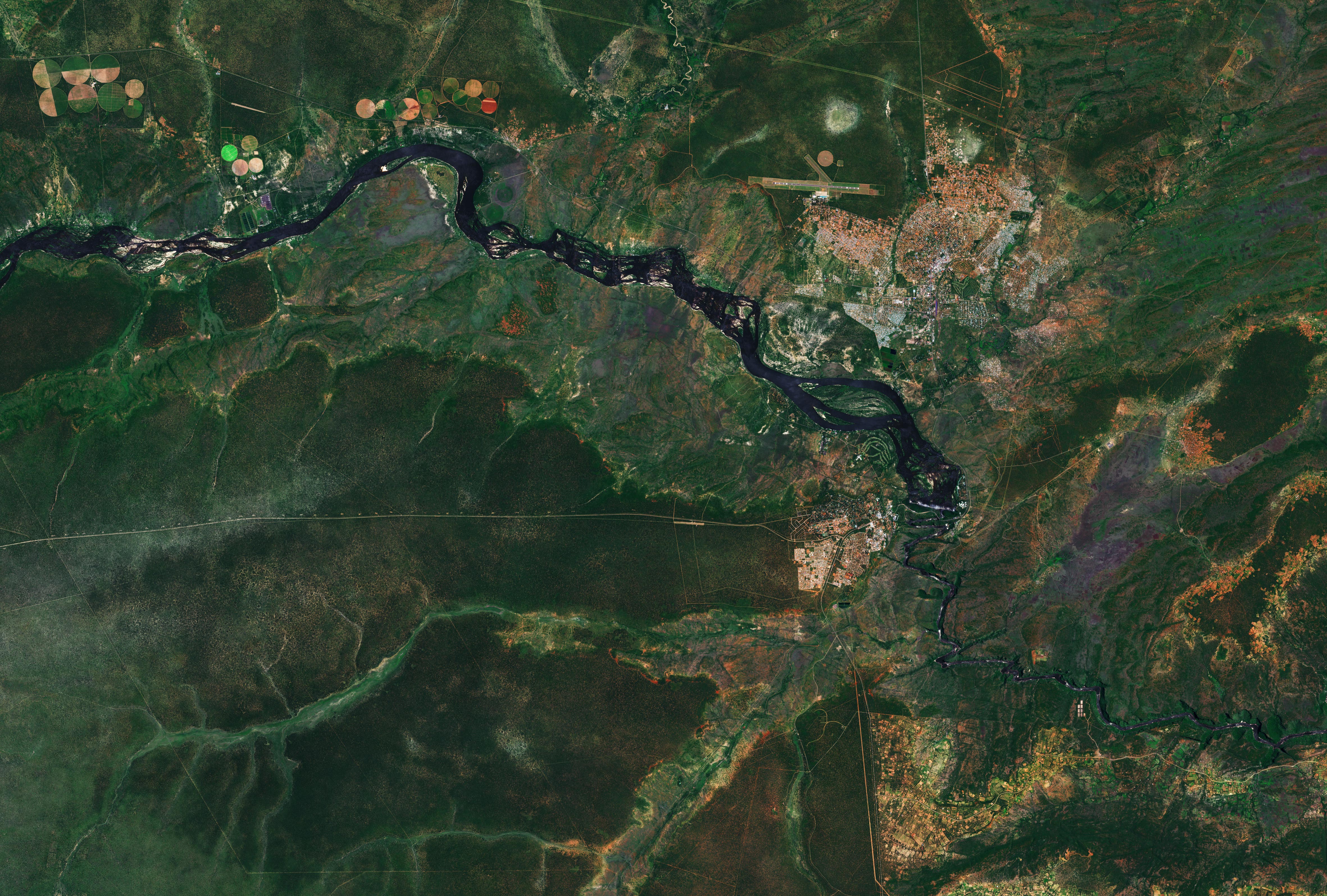
    In this image, captured on February 22, 2019, the river cuts from left to right in the image before plunging over Victoria Falls – visible as a white line in the image. While it is neither the highest nor the widest waterfall in the world, Victoria Falls has a width of around 1700 m and a height of over 100 m which classifies it as the world’s largest sheet of falling water. Credit:
    Contains modified Copernicus Sentinel data (2019), processed by ESA

    The Copernicus Sentinel-2 mission takes us over Victoria Falls – one of the world’s greatest natural wonders.

    Victoria Falls, known locally as Mosi-oa Tunya or ‘the smoke that thunders,’ lies along the course of the Zambezi River, on the border between Zambia to the north and Zimbabwe to the south. The Zambezi River flows for around 3500 km (2,200 mi)  from its source on the Central African Plateau and empties into the Indian Ocean.

    In this image, captured on February 22, 2019, the river cuts from left to right in the image before plunging over Victoria Falls – visible as a white line in the image. While it is neither the highest nor the widest waterfall in the world, Victoria Falls has a width of around 1,700 m (5,600 ft) and a height of over 100 m (330 ft) which classifies it as the world’s largest sheet of falling water.

    The spray from the falls normally rises to a height of over 400 m (1,300 ft) and is sometimes visible from up to 40 km (25 mi) away. The water from the Zambezi River then continues and enters a narrow, zigzagging series of gorges, visible in the bottom right of the image.

    Despite recent reports of Victoria Falls drying up, the Zambezi River is subject to large seasonal fluctuations – with water levels rising and dropping dramatically throughout the year. According to the Zambezi River Authority, the lowest recorded water flows recorded were during the 1995—96 season, which had an annual mean flow of around 390 cubic meters (103,000 gallons) per second, compared to the long-term mean annual flow of around 1100 cubic meters(291,000 gallons) per second.

    The town of Victoria Falls, in Zimbabwe, can be seen west of the falls, while the town of Livingstone – named after the famous Scottish explorer – is visible just north of the falls, in Zambia. The Harry Mwanga Nkumbula airport can be seen west of the town.

    The circular shapes in the image are an example of an irrigation method called pivot irrigation or center-pivot irrigation, where equipment rotates around a central pivot and crops are watered with sprinklers.

    Sentinel-2 is a two-satellite mission to supply the coverage and data delivery needed for Europe’s Copernicus program. The mission’s frequent revisits over the same area and high spatial resolution allow changes in inland water bodies to be closely monitored.

    Never miss a breakthrough: Join the SciTechDaily newsletter.
    Follow us on Google and Google News.

    European Space Agency Geology
    Share. Facebook Twitter Pinterest LinkedIn Email Reddit

    Related Articles

    Salt and Spectacle: Satellite Reveals East Africa’s Pink Lakes

    Exploring Earth From Space: Maharloo Lake, Iran [Video]

    Vast Mineral Deposits in the Atacama Desert Seen From Space

    Mysterious Red Circles in Satellite Image of Southern Ukraine Explained

    Dutch Tulip Fields Come Into Bloom in Stunning Satellite Images

    Incredible View From Space: Kuwait and the Second Largest Oil Field in the World

    Earth From Space: Magnificent Canadian Arctic Archipelago

    Earth From Space: Bolivian Highland Heart [Video]

    Search for Extra-Terrestrial Life Takes Mars Scientists on Expedition to Australia

    Leave A Reply Cancel Reply

    • Facebook
    • Twitter
    • Pinterest
    • YouTube

    Don't Miss a Discovery

    Subscribe for the Latest in Science & Tech!

    Trending News

    Scientists May Have Solved a Long-Standing Melanoma Treatment Mystery

    This Flesh-Eating Fly Is Back in the U.S. – Scientists Are Tracking Where It Could Strike Next

    Scientists Have Uncovered a Troubling New Pattern Hidden in America’s Rivers

    “Entirely Surprising” – Scientists Have Found a Martian Meteorite Unlike Any Known Before

    “Find of the Year” – Archaeologists Discover the Smallest Ice Age Figurines Ever Found

    New Research Challenges Common Exercise Advice for Bone Health

    Avoiding These 3 Health Risks in Midlife Linked to 13 More Years Without Dementia

    Where Were All the Tiny Dinosaurs? Scientists May Finally Have an Answer

    Follow SciTechDaily
    • Facebook
    • Twitter
    • YouTube
    • Pinterest
    • Newsletter
    • RSS
    SciTech News
    • Biology News
    • Chemistry News
    • Earth News
    • Health News
    • Physics News
    • Science News
    • Space News
    • Technology News
    Recent Posts
    • The Ancient Mediterranean Diet Wasn’t What You Think
    • 11,000-Year-Old Grains Reveal a Surprise About the Origins of Agriculture
    • Lost Vatican Letter Recasts 1066 as a Holy War Against “Followers of Satan”
    • This Common Gut-Bacteria Compound May Be Linked to Alzheimer’s Disease
    • Scientists Are Discovering Unexpected Benefits of GLP-1 Drugs
    Copyright © 1998 - 2026 SciTechDaily. All Rights Reserved.
    • Science News
    • About
    • Contact
    • Editorial Board
    • Privacy Policy
    • Terms of Use

    Type above and press Enter to search. Press Esc to cancel.