
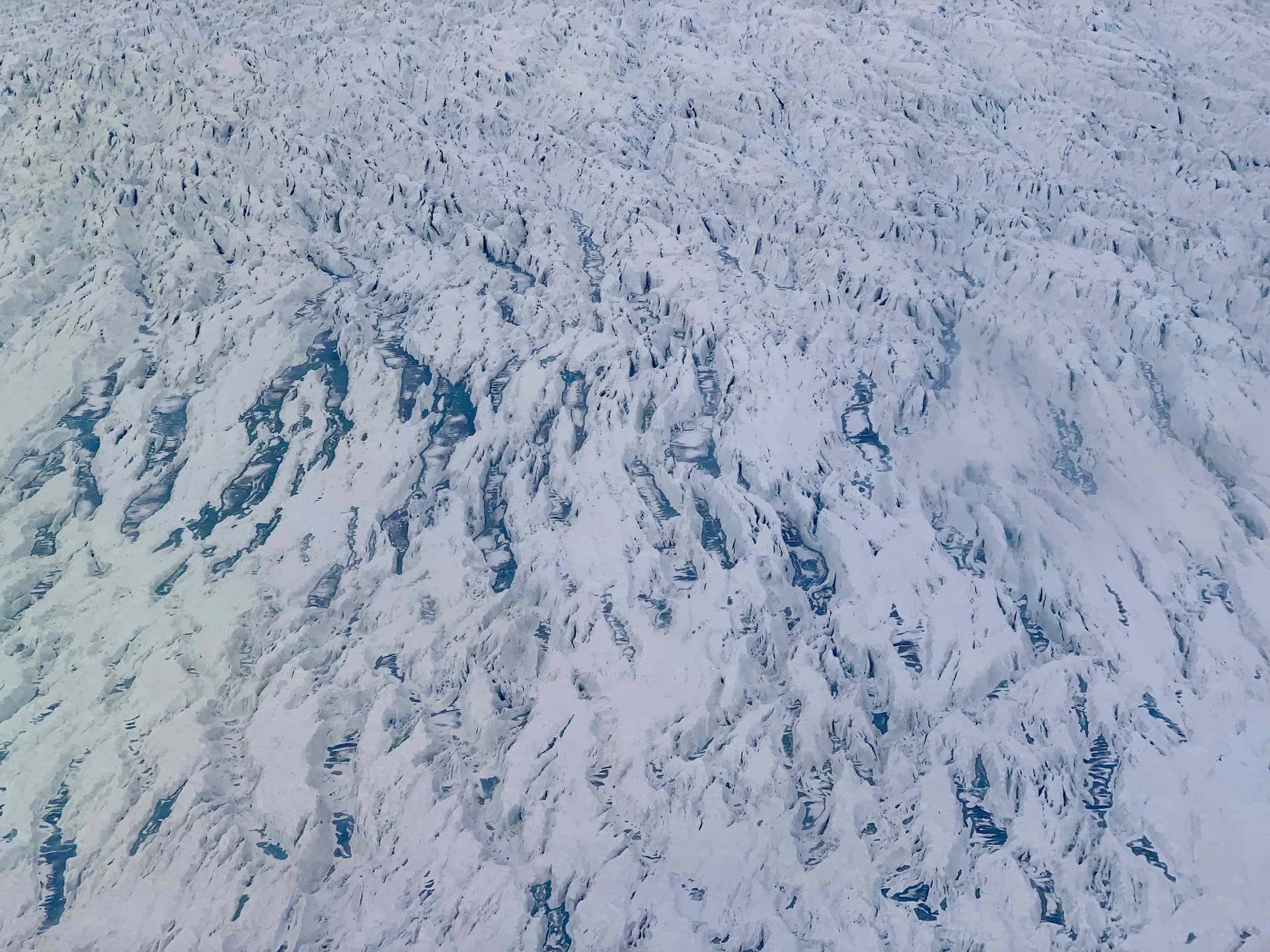
UCI, NASA JPL project tracking Earth-sensing satellite turnover yields striking results.
During the exceptionally warm Arctic summer of 2019, Greenland lost 600 billion tons of ice, enough to raise global sea levels by 2.2 millimeters in two months. On the opposite pole, Antarctica continued to lose mass in the Amundsen Sea Embayment and Antarctic Peninsula but saw some relief in the form of increased snowfall in Queen Maud Land, in the eastern part of the continent.
These new findings and others by glaciologists at the University of California, Irvine and NASA’s Jet Propulsion Laboratory are the subject of a paper published recently in the American Geophysical Union journal Geophysical Research Letters.
“We knew this past summer had been particularly warm in Greenland, melting every corner of the ice sheet, but the numbers are enormous,” said lead author Isabella Velicogna, UCI professor of Earth system science and JPL senior scientist.
Between 2002 and 2019, Greenland lost 4,550 billion tons of ice, an average of 268 billion tons annually – less than half what was shed last summer. To put that in perspective, Los Angeles County residents consume 1 billion tons of water per year.
“In Antarctica, the mass loss in the west proceeds unabated, which is very bad news for sea level rise,” Velicogna said. “But we also observe a mass gain in the Atlantic sector of East Antarctica caused by an increase in snowfall, which helps mitigate the enormous increase in mass loss that we’ve seen over the last two decades in other parts of the continent.”
She and her colleagues came to these conclusions in the process of establishing data continuity between the recently decommissioned Gravity Recovery and Climate Experiment satellite mission and its new and improved successor, GRACE Follow-On.
A project of NASA and the German Aerospace Center, the twin GRACE satellites were designed to make extremely precise measurements of changes in Earth’s gravity. The spacecraft has proven to be particularly effective at monitoring the planet’s water reserves, including polar ice, global sea levels, and groundwater.
The first GRACE mission was deployed in 2002 and collected data for more than 15 years, a decade longer than its intended life span. Toward the end of this period, the GRACE satellites began to lose battery power, leading to the end of the mission in October 2017.
GRACE Follow-On – based on a similar technology but also including an experimental instrument using laser interferometry instead of microwaves to gauge minute changes in distance between the twin spacecraft – was launched in May 2018. The gap between the missions made it necessary for Velicogna and her cohort to test how well data amassed by the GRACE and GRACE-FO missions matched.
“It’s great to see how well the data line up in Greenland and Antarctica, even at the regional level,” she said. “It’s a tribute to the months of effort by the project, engineering and science teams to make the endeavor successful.”
For more on this research read NASA Satellites Track How Quickly the Poles Are Melting.
Reference: “Continuity of ice sheet mass loss in Greenland and Antarctica from the GRACE and GRACE Follow‐Onmissions” by Isabella Velicogna, Yara Mohajerani, A Geruo, Felix Landerer, Jeremie Mouginot, Brice Noel, Eric Rignot, Tyler Sutterley, Michiel van den Broeke, J.M. van Wessem and David Wiese, 18 March 2020, Geophysical Research Letters.
DOI: 10.1029/2020GL087291
In addition to scientists from UCI and NASA JPL, the GRACE and GRACE-FO data continuity project involved researchers from France’s University of Grenoble, the Netherlands’ Utrecht University and the University of Washington’s Polar Science Center.
Never miss a breakthrough: Join the SciTechDaily newsletter.
Follow us on Google and Google News.
1 Comment
While previously reported, it wasn’t mentioned here that the “exceptionally warm” Summer was a result of exceptionally clear skies, not a general increase in the global average air temperatures:
https://scitechdaily.com/record-greenland-ice-loss-in-2019-driven-by-unusually-clear-skies/
The driver appears to be weather, not climate change.