
Close Menu
    Facebook X (Twitter) Instagram
    SciTechDaily
    • Biology
    • Chemistry
    • Earth
    • Health
    • Physics
    • Science
    • Space
    • Technology
    Facebook X (Twitter) Pinterest YouTube RSS
    SciTechDaily
    Home»Technology»Mouse Trap for Magnetic Waves: Researchers Build Sensor Consisting of Only 11 Atoms
    Technology

    Mouse Trap for Magnetic Waves: Researchers Build Sensor Consisting of Only 11 Atoms

    By Delft University of TechnologyJune 24, 2020No Comments3 Mins Read
    Facebook Twitter Pinterest Telegram LinkedIn WhatsApp Email Reddit
    Share
    Facebook Twitter LinkedIn Pinterest Telegram Email Reddit
    11 Atom Sensor
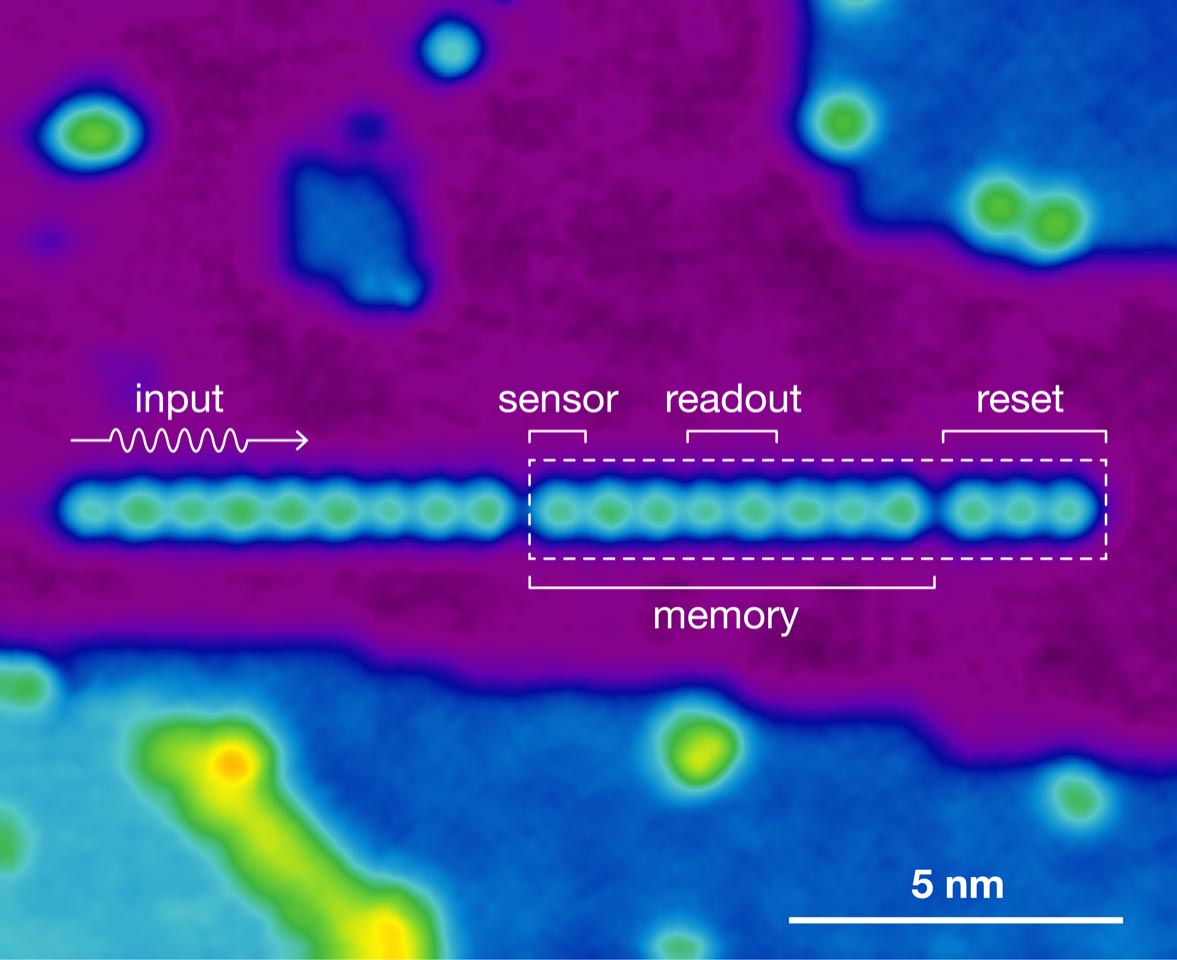
    Microscope image, recorded using a scanning tunneling microscope, of the detector device (inside the dashed rectangle), connected to a wire consisting of nine magnetic atoms. Credit: TU Delft

    Researchers at Delft University of Technology have developed a sensor that is only 11 atoms in size. The sensor is capable of capturing magnetic waves and consists of an antenna, a readout capability, a reset button, and a memory unit. The researchers hope to use their atomic sensor to learn more about the behavior of magnetic waves, so that hopefully such waves can be used in green ICT applications one day.   

    Sander Otte
    Professir Dr. Sander Otte. Credit: TU Delft

    In theory, we can make electronic data processing much more efficient by switching to spintronics. Instead of using electrical signals, this technology makes use of magnetic signals to transmit data. Unfortunately, magnetism tends to get incredibly complicated, especially at the tiny scale of our computer chips. You could view a magnetic wave as millions of compass needles performing a complex collective dance. Not only do the waves propagate extremely fast, causing them to vanish in mere nanoseconds, the tricky laws of quantum mechanics also allow them to travel in multiple directions at the same time. This makes them even more elusive.

    Mouse trap for magnetic waves

    In order to still be able to study these rapid oscillations, researchers from Delft University of Technology have developed a minuscule device. Consisting of only eleven atoms, the device is equipped with an antenna, a readout capability, a reset button, and a memory unit to store the measurement outcomes. The central idea of the invention is that the device instantly detects a passing magnetic wave and remembers this information. “Compare it to a mouse trap,” research leader Sander Otte explains. “A mouse is typically too fast and too small to capture by hand. But a mouse trap reacts very quickly and then hold the mouse in place.”

    The researchers connected the device to magnetic atomic wires through which magnetic waves were sent. Although the test wires were still very short, the results are promising: the waves moved very peculiarly, as one would expect from quantum mechanics. The next step is to also apply this technique to more complicated circuits in order to gain more insight into the behavior of spintronics.

    Reference: “Remote detection and recording of atomic-scale spin dynamics” by R. J. G. Elbertse, D. Coffey, J. Gobeil and A. F. Otte, 25 May 2020, Communications Physics.
    DOI: 10.1038/s42005-020-0361-z

    Never miss a breakthrough: Join the SciTechDaily newsletter.
    Follow us on Google and Google News.

    Delft University of Technology Nanotechnology Spintronics
    Share. Facebook Twitter Pinterest LinkedIn Email Reddit

    Related Articles

    Nanoscale Structures Could Yield Higher-Performance Computer Memory

    Brookhaven National Laboratory Scientists Explore Ways to Synchronize Magnetic Spins for Nanoscale Electronic Devices

    Scientists Create New Electronic Material with Potential for Flexible Light-Based Electronics

    Researchers Develop Transistors without Semiconductors

    Improving Magnetic Memory by Controlling Spin Orientation

    3D Microchip Allows Information to Travel in Three Dimensions

    HARPES Technique Reveals Ferromagnetic Secrets of Dilute Magnetic Semiconductors

    Electronic Read-Out of the Quantum State of an Atom

    Converting Heat to Electricity in a Non-Magnetic Semiconductor

    Leave A Reply Cancel Reply

    • Facebook
    • Twitter
    • Pinterest
    • YouTube

    Don't Miss a Discovery

    Subscribe for the Latest in Science & Tech!

    Trending News

    Black Hole Collisions May Follow a Surprisingly Simple Rule

    The Eye Has a Hidden Cleanup System and Scientists Just Discovered It

    The Truth About Vikings Is More Complicated Than Museums Admit

    New Catalyst Turns Stubborn Plant Waste Into Valuable Chemicals

    Quantum Gravity May Be Far Less Quantum Than Physicists Expected

    New Tool Supercharges Immunotherapy Against Prostate Cancer

    The Hidden Cancer Risk of Ketogenic Diets

    One Asteroid Collision May Have Rocked Earth, Mars, and the Moon

    Follow SciTechDaily
    • Facebook
    • Twitter
    • YouTube
    • Pinterest
    • Newsletter
    • RSS
    SciTech News
    • Biology News
    • Chemistry News
    • Earth News
    • Health News
    • Physics News
    • Science News
    • Space News
    • Technology News
    Recent Posts
    • Scientists Built a Programmable Chip That Can Slow Light on Command
    • Astronomers Detect an Atmosphere on a Potentially Earth-Like World
    • The Backyard “Silly Sprinkler” That Cracked One of Physics’ Biggest Puzzles
    • Magnetic Nanoparticles Restore Movement in Mice With Parkinson’s-Like Symptoms
    • Scientists Found What May Be Keeping the Alzheimer’s Brain Awake
    Copyright © 1998 - 2026 SciTechDaily. All Rights Reserved.
    • Science News
    • About
    • Contact
    • Editorial Board
    • Privacy Policy
    • Terms of Use

    Type above and press Enter to search. Press Esc to cancel.